
Objective: To evaluate the feasibility of artificial intelligence (AI) for identifying true hemifacial spasm (HFS) from mimicking facial movements.
Background: Diagnosis of HFS typically relies on clinical assessment and may be challenging, particularly when distinguishing true HFS from voluntary or functional facial movements. Although AI shows promise in facial video analysis for several neurological disorders, evidence for differentiating HFS from other facial movements remains limited. In this pilot study, mimicking facial movements generated by healthy participants were used as a controlled dataset for assessing the capability of AI to distinguish true HFS from mimic facial activity.
Method: Facial videos were collected from HFS patients and healthy participants. Healthy participants recorded mimicking HFS movements (HFS Mimic) and normal resting facial activity (Normal Rest). A total of 186 videos were analyzed (70 HFS, 77 HFS Mimic, 39 Normal Rest), yielding 98,799 frames after preprocessing (40,403 HFS, 28,467 Mimic, 29,929 Normal Rest). Eighteen facial features representing eye geometry, facial landmarks, and facial motion were extracted using MediaPipe. A Support Vector Machine (SVM) classifier was trained to categorize facial activity into three classes (HFS, HFS Mimic, Normal Resting) using an 80/20 training–test split. Model performance was evaluated at both frame and video levels, with video-level classification determined by majority voting across frames.
Results: The studies included 57 HFS and 39 healthy participants. The optimized SVM model (RBF kernel; C = 100, γ = 0.1) achieved a mean cross-validation score of 0.960 ± 0.001. Frame-level accuracy was 96.54% with a macro F1 score of 0.963. For HFS detection, frame-level sensitivity, specificity, and positive predictive value were 97.6%, 98.1%, and 98.3%, respectively. Aggregating frame predictions yielded 100% video-level accuracy with 100% sensitivity and specificity for HFS detection.
Conclusion: This pilot study demonstrates the potential of AI-based facial movement analysis for distinguishing true HFS from mimicking facial movements. Results should be interpreted cautiously given the small sample size and age difference between groups. Validation of a larger and age-matched dataset should be performed. Nevertheless, this approach may support clinical assessment, particularly in telemedicine or remote settings.
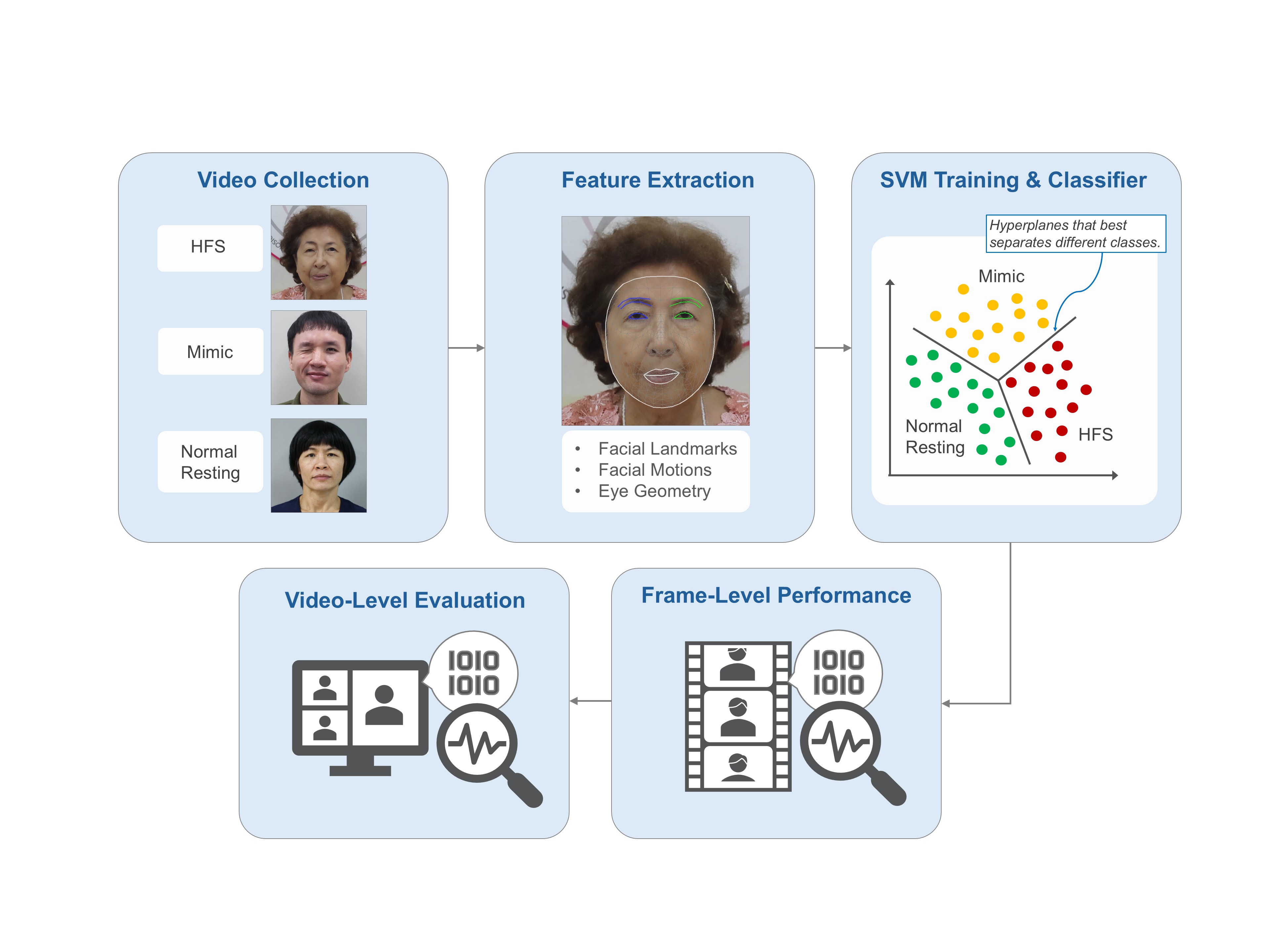
Figure1
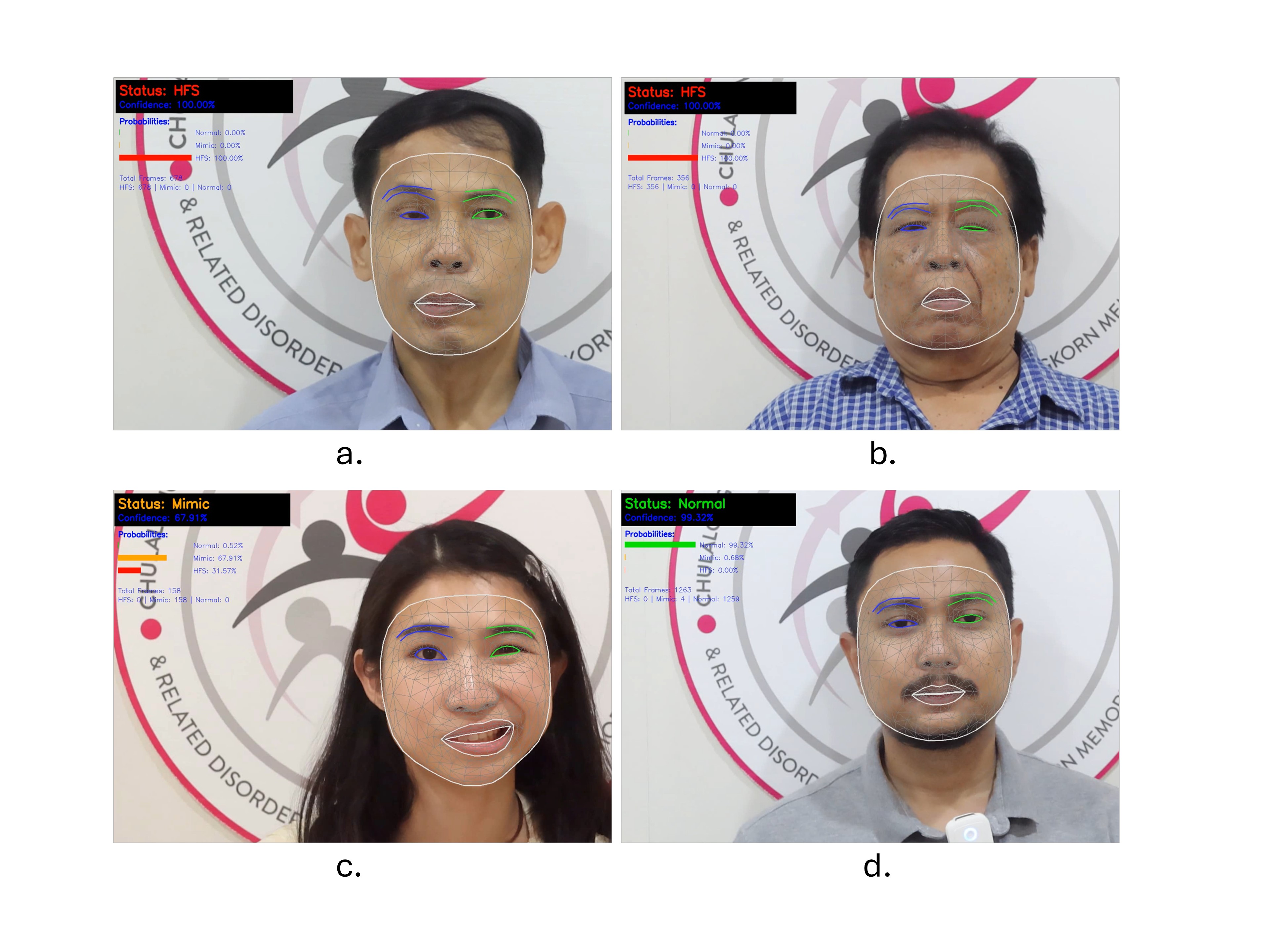
Figure2
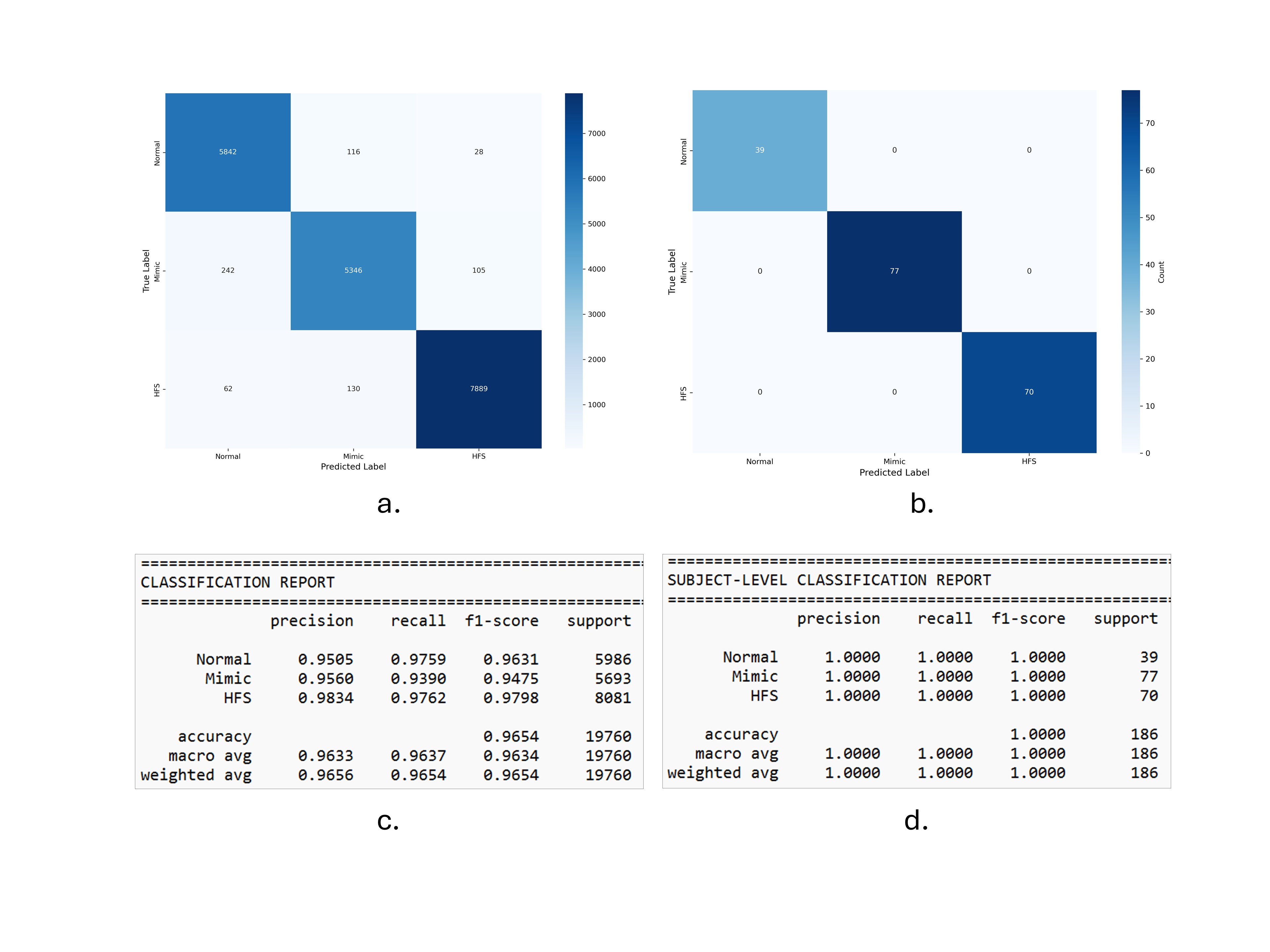
Figure3
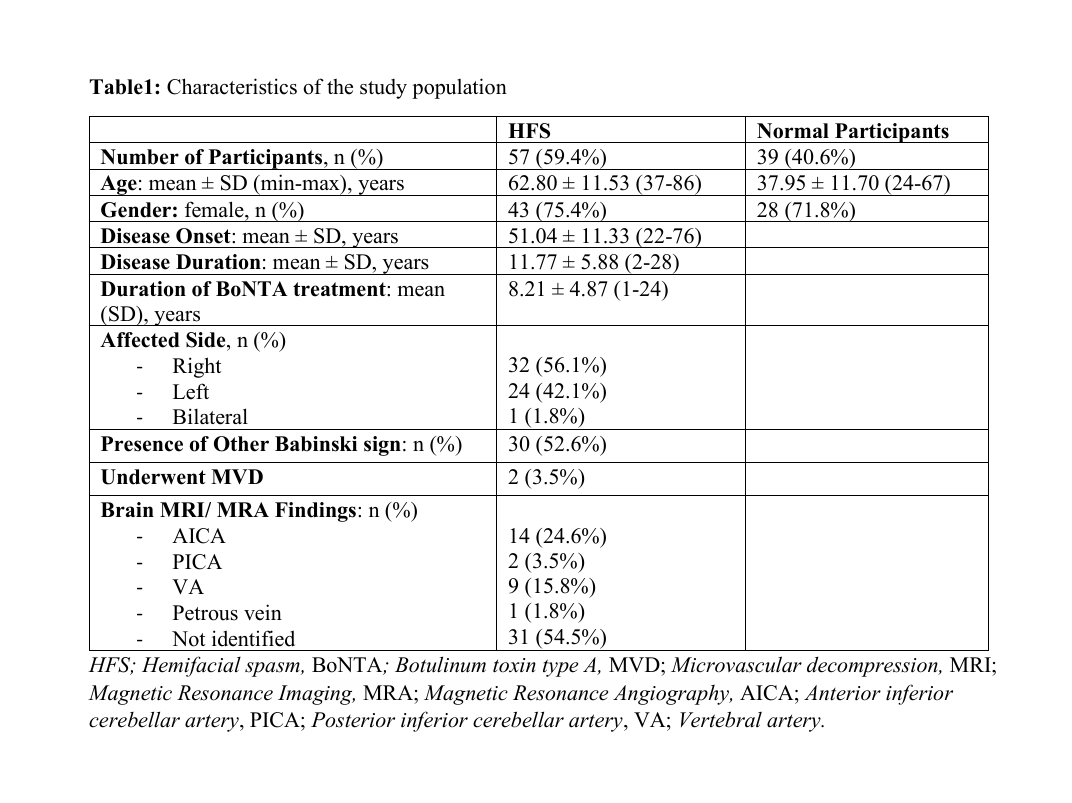
Table1
References: 1. Menabbawy AA, Ruhser L, Refaee EE, Weidemeier ME, Matthes M, Schroeder HWS. From spasms to smiles: how facial recognition and tracking can quantify hemifacial spasm severity and predict treatment outcomes. Acta Neurochir (Wien). 2025 Jan 7;167(1):4.
2. Adnan, T., Islam, M. S., Rahman, W., Lee, S., Tithi, S. D., Noshin, K., … & Hoque, E. (2023). Unmasking Parkinson’s Disease with Smile: An AI-enabled Screening Framework. arXiv preprint arXiv:2308.02588.
3. Müller, Seraina L. C. MD1; Pfister, Pablo MD1; Menzi, Nadia MD1; Muller, Laurent MD2; Klein, Holger J. MD3; Schweizer, Riccardo MD4; Lee, Z-Hye MD5; Kollar, Branislav MD6; Eisenhardt, Steffen U. MD6; Schaefer, Dirk J. MD1; Ismail, Tarek MD1. Artificial Intelligence in Facial Palsy Treatment: A Systematic Review and Recommendations. Plastic and Reconstructive Surgery 156(3):p 477-490, September 2025.
To cite this abstract in AMA style:
S. Maytharakcheep, A. Saeng-Xuto, P. Songthung, D. Surangsrirat, P. Vateekul, R. Bhidayasiri, O. Phokaewvarangkul. Automated Facial Movement Analysis for Differentiating True Hemifacial Spasm from Mimicking Facial Movements: A Pilot Study [abstract]. Mov Disord. 2026; 41 (suppl 1). https://www.mdsabstracts.org/abstract/automated-facial-movement-analysis-for-differentiating-true-hemifacial-spasm-from-mimicking-facial-movements-a-pilot-study/. Accessed October 1, 2026.« Back to 2026 International Congress
MDS Abstracts - https://www.mdsabstracts.org/abstract/automated-facial-movement-analysis-for-differentiating-true-hemifacial-spasm-from-mimicking-facial-movements-a-pilot-study/