
Objective: To evaluate a novel motor assessment using a handheld accelerometer and machine learning to objectively support Parkinson’s disease (PD) diagnosis.
Background: PD diagnosis is primarily based on established clinical criteria (e.g., UK Brain Bank, MDS criteria) rather than biomarkers. A core component is the motor examination, which relies heavily on clinical observation and is fundamentally non-objective. While standardised rating scales like the MDS-UPDRS are invaluable for quantifying symptom severity, the evaluation itself remains subjective. Developing an objective tool utilising sensor data and machine learning would greatly enhance diagnostic confidence and help mitigate the clinical challenges of inappropriate treatments.
Method: The study analysed 122 signal recordings of controlled-end ballistic hand movements [table1] captured by a low-cost, three-axis handheld accelerometer [table2]. Examples of gathered lateral movements of control vs. PD patients can be seen in Table 3 and Table 4, respectively. Data was refined to create a balanced dataset comparing PD patients in “off” medication states against healthy controls. Following preprocessing, 188 features were extracted to produce nine datasets: one utilising the full raw signal and eight using various time-windowing techniques. Twenty-eight machine learning models, including Artificial Neural Networks (ANNs) and Random Forests, were trained and evaluated using 5-fold cross-validation.
Results: The full-signal dataset demonstrated superior performance compared to the windowed approaches. The most effective model was an ANN with a 4-4 hidden-layer architecture, achieving an average accuracy of 86.67% and a specificity of 83%. In contrast, models trained on the windowed datasets yielded sub-optimal results, with the best-performing windowed model reaching an average accuracy of only 65.64%.
Conclusion: Utilising full-signal accelerometer data coupled with non-linear classifiers presents a feasible and objective method to support clinicians in identifying PD motor patterns. While windowing techniques require further investigation and optimisation, this novel motor assessment shows clear potential as an objective supplementary tool within the clinical diagnostic framework.
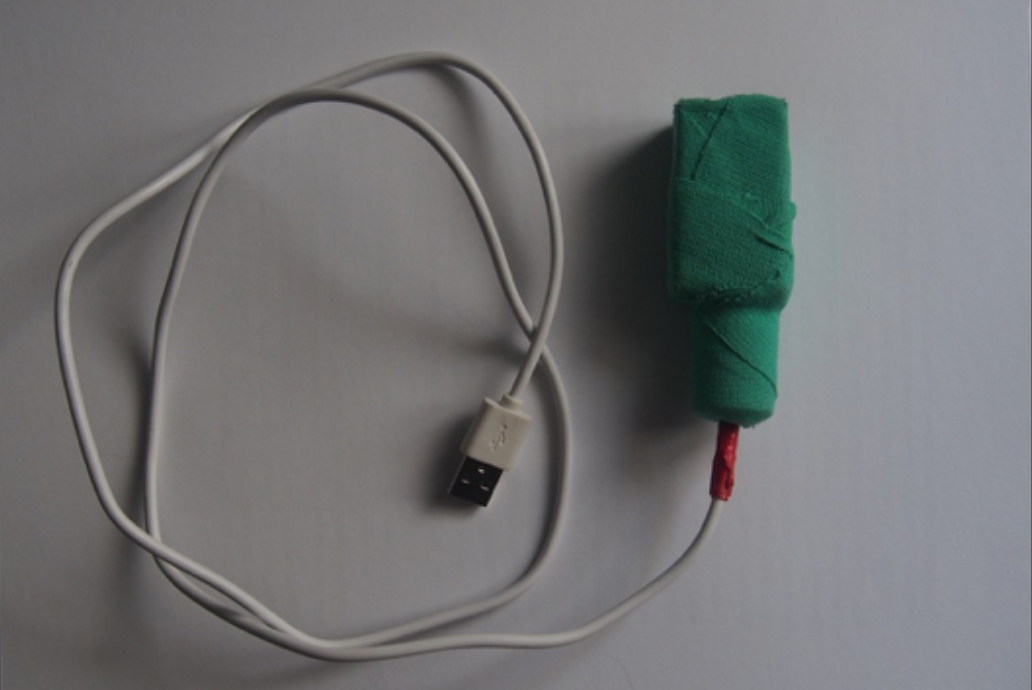
Handheld accelerometer used for motor assessment.
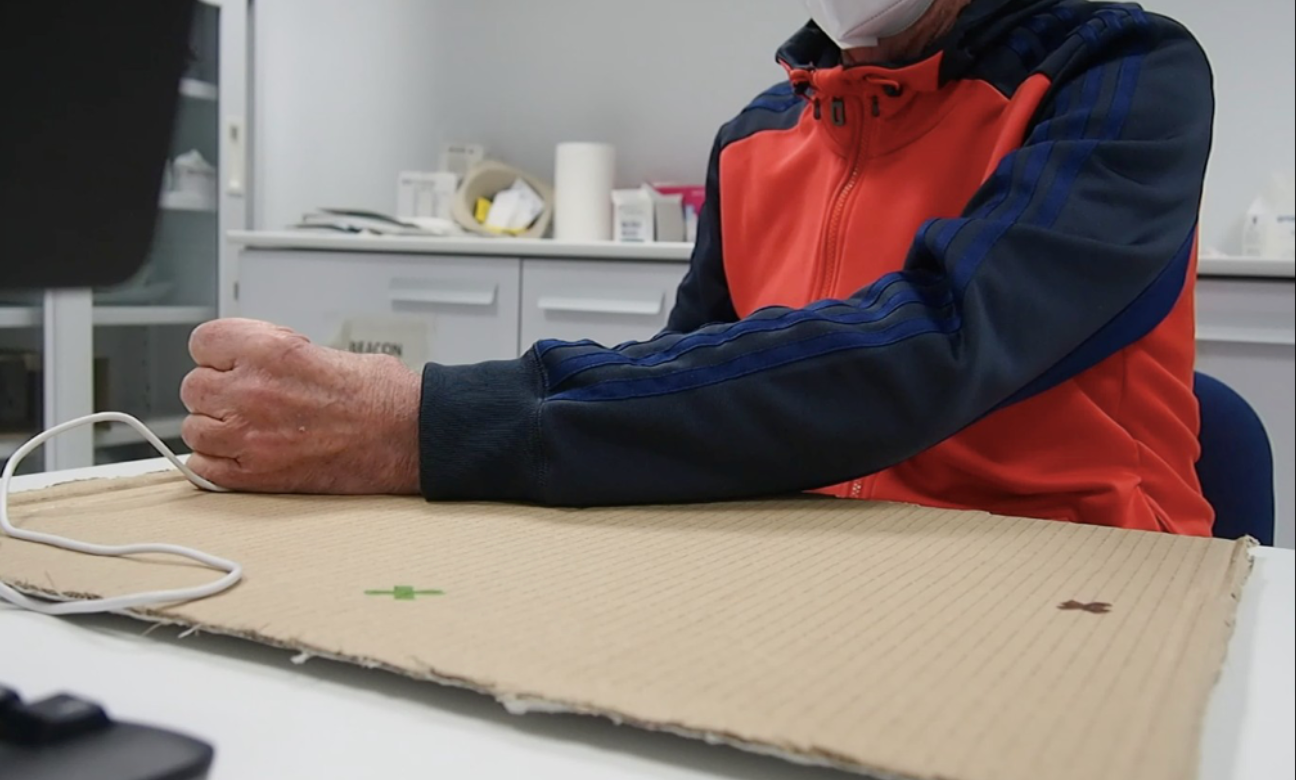
Board setup for cued ballistic hand movements.
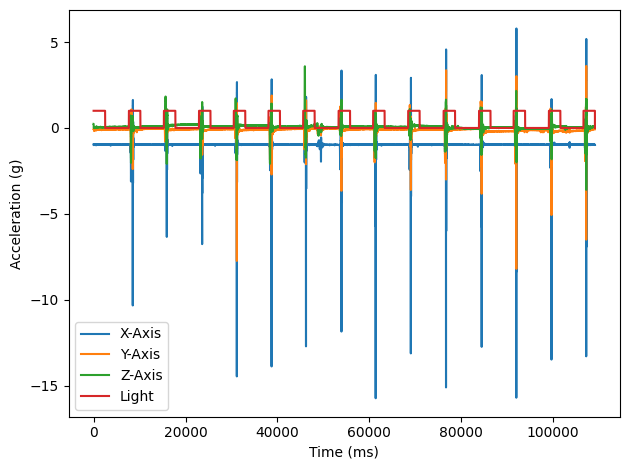
Stable hand acceleration in a healthy control.
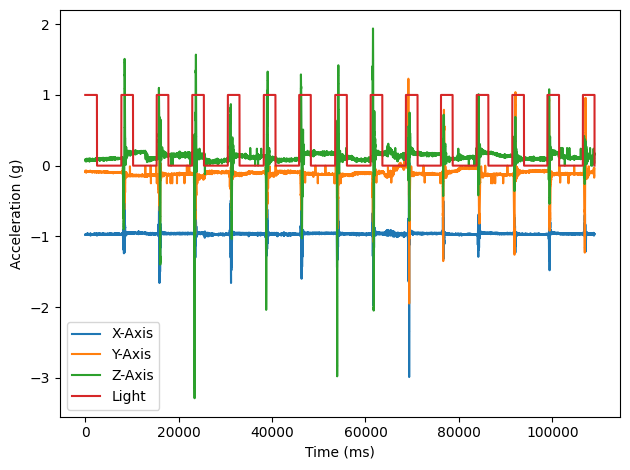
Accelerometer data showing tremors in PD.
References: Goetz CG, Fahn S, Martinez-Martin P, Poewe W, Sampaio C, Stebbins GT, Stern MB, Tilley BC, Dodel R, Dubois B, Holloway R, Jankovic J, Kulisevsky J, Lang AE, Lees A, Leurgans S, LeWitt PA, Nyenhuis D, Olanow CW, Rascol O, Schrag A, Teresi JA, Van Hilten JJ, LaPelle N. Movement Disorder Society-sponsored revision of the Unified Parkinson’s Disease Rating Scale (MDS-UPDRS): Process, format, and clinimetric testing plan. Mov Disord. 2007 Jan;22(1):41-7. doi: 10.1002/mds.21198. PMID: 17115387.
Maetzler W, Domingos J, Srulijes K, Ferreira JJ, Bloem BR. Quantitative wearable sensors for objective assessment of Parkinson’s disease. Mov Disord. 2013 Oct;28(12):1628-37. doi: 10.1002/mds.25628. Epub 2013 Sep 12. PMID: 24030855.
To cite this abstract in AMA style:
L. Jurcaga, E. Amigo, J. Oyaga-Orus, S. Aldea-Campillo, J. Marín-Lahoz, M. Vallejo. Objective Parkinson’s Diagnosis Using a Novel Accelerometer Assessment and Machine Learning [abstract]. Mov Disord. 2026; 41 (suppl 1). https://www.mdsabstracts.org/abstract/objective-parkinsons-diagnosis-using-a-novel-accelerometer-assessment-and-machine-learning/. Accessed October 1, 2026.« Back to 2026 International Congress
MDS Abstracts - https://www.mdsabstracts.org/abstract/objective-parkinsons-diagnosis-using-a-novel-accelerometer-assessment-and-machine-learning/