
Objective: To identify objective digital mobility outcomes (DMOs) that can explain self-perceived gait security in people with Parkinsonian disorders (PwPD).
Background: Gait impairments are among the most disabling symptoms in PwPD [1]. DMOs can help identify which mobility aspects affect perceived gait security, thereby supporting individualized therapeutic targeting [2].
Method: This study used home-monitoring data from the Luxembourgish cohort of the Mobility_App study [3]. PwPD reported daily perceived gait security on a 3-point Likert scale (not secure, rather secure, completely secure). Objective DMOs were computed according to MobiliseD guidelines [4] from foot-worn sensor data.
Feature selection was performed using nested patient-grouped elastic net cross-validation (12-fold outer, 3-fold inner). All possible combinations of six selected features were then used to train Bayesian ordinal regression models were trained to generate individualized probability profiles characterizing patient-specific gait security and population-level predictors. Convergence, Pareto-k diagnostics > 0.7, and posterior predictive checks were evaluated to ensure the robustness of the models [5].
Results: 83 days from 12 PwPD were analyzed (5 females, 7 males; age 68 ± 10 years, Hoen & Yahr: 2.5 ± 0.5). Feature selection identified 8 predictors representing different mobility aspects, including stride characteristics, mobility patterns, and adherence. From these, 28 six-feature models were trained and evaluated. All models met convergence and Pareto criteria, with seven of them showing the highest and comparable predictive performance. Fixed-effect analyses of these models identified five population-level predictors of self-reported gait security Figure 1, which were used to derive individualized probability profiles, Figure 2. Estimated effects were negative for freezing of gait (mean 1.44, CI width 2.29), positive for wearing time (mean 0.81, CI width 1.51) and stride length during medium–long walking bouts (WB) (mean 0.79, CI width 1.65), and negative for the number of very short WB (mean 0.71, CI width 1.79) and information entropy (mean 0.57, CI width 1.46).
Conclusion: DMOs reflect perceived gait security by capturing multiple mobility aspects at both population and individual levels.
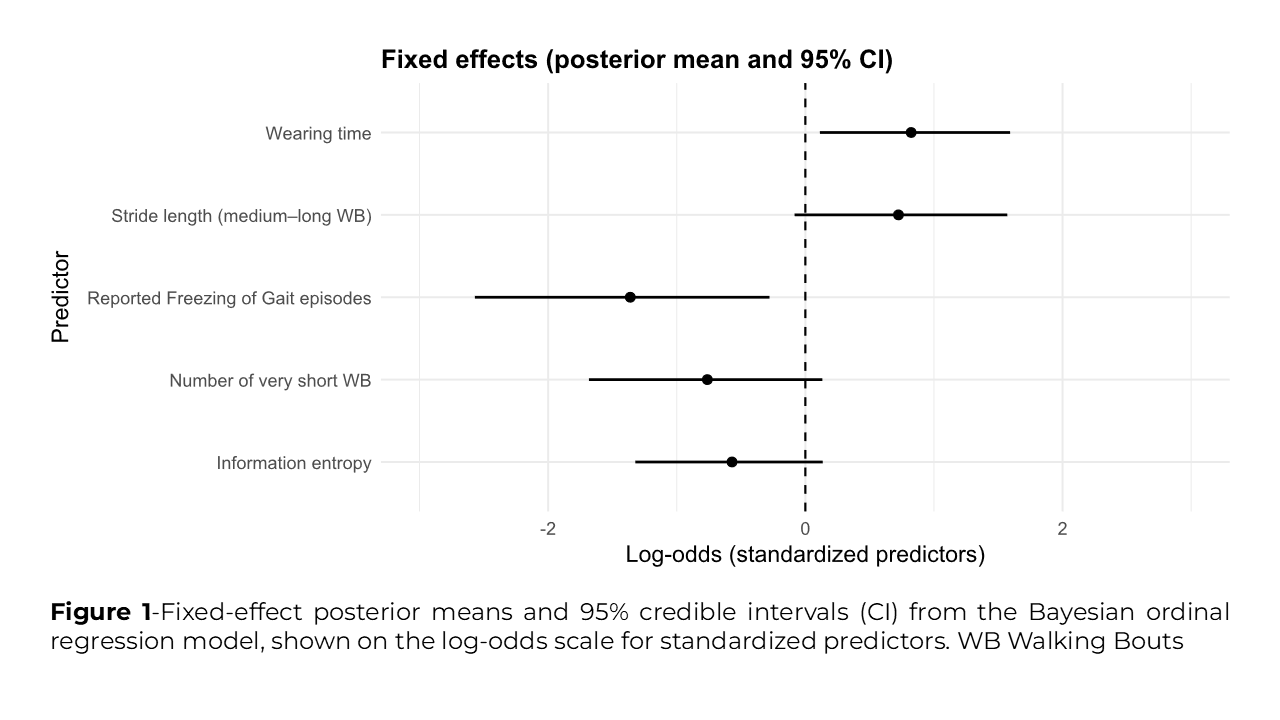
Figure 1
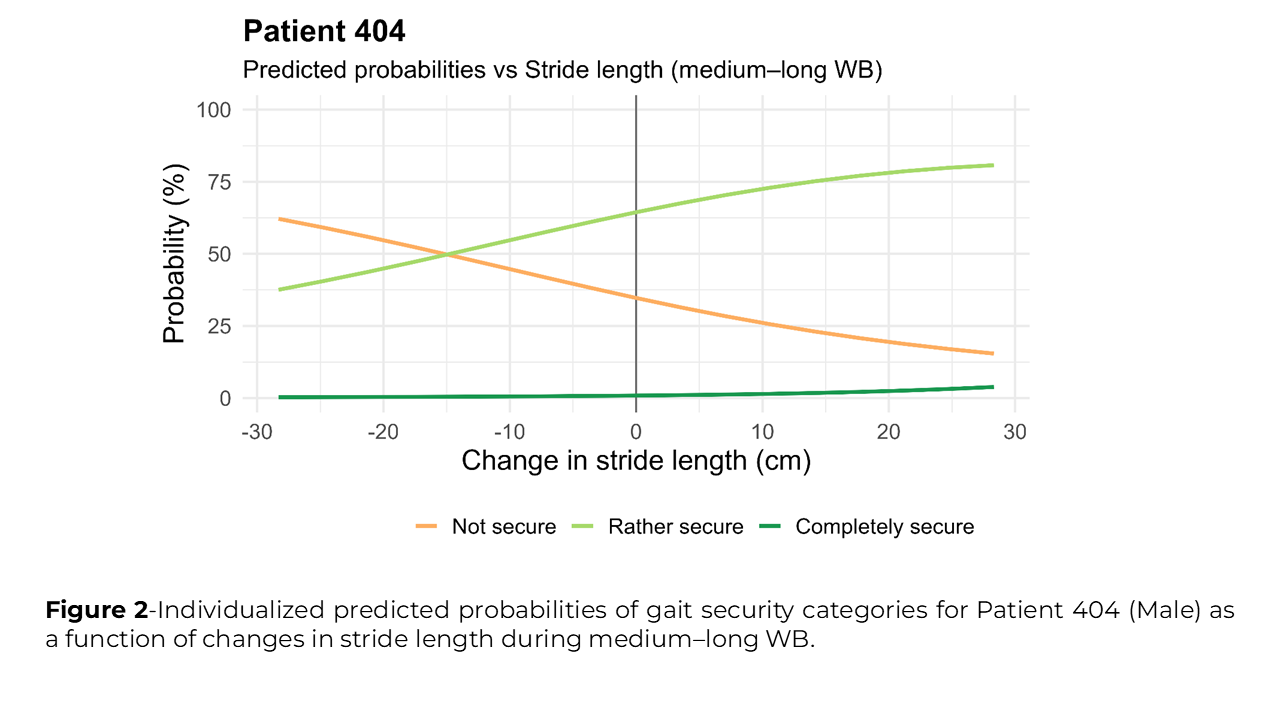
Figure 2
References: [1] Brozova H, Stochl J, Roth J, Ruzicka E. Fear of falling has greater influence than other aspects of gait disorders on quality of life in patients with Parkinson’s disease. Neuroendocrinol Lett 2009;30:453–457.
[2] Zolfaghari S, et al. Self-report versus clinician examination in early Parkinson’s disease. Mov Disord 2022;37:585–597. doi:10.1002/mds.28884
[3] Raccagni C, Sidoroff V, Paraschiv-Ionescu A, Roth N, Schönherr G, Eskofier B, et al. Effects of physiotherapy and home-based training in parkinsonian syndromes: protocol for a randomised controlled trial (MobilityAPP). BMJ Open 2024;14:e081317. doi:10.1136/bmjopen-2023-081317
[4] Kluge F, Del Din S, Cereatti A, Gaßner H, Hansen C, Helbostad JL, et al; Mobilise-D Consortium. Consensus based framework for digital mobility monitoring. PLoS One 2021;16:e0256541. doi:10.1371/journal.pone.0256541
[5] Vehtari A, Ojanen J. A survey of Bayesian predictive methods for model assessment, selection and comparison. Statist Surv 2012;6:142–228. doi:10.1214/12-SS102
To cite this abstract in AMA style:
F. Boschi, S. Sapienza, M. Giraitis, G. Zelimkhanov, F. Terranova, H. Gaßner, J. Goncalves, J. Klucken. Digital Mobility Outcomes for Modelling Self-Perceived Gait Security in People with Parkinsonian Disorders [abstract]. Mov Disord. 2026; 41 (suppl 1). https://www.mdsabstracts.org/abstract/digital-mobility-outcomes-for-modelling-self-perceived-gait-security-in-people-with-parkinsonian-disorders/. Accessed October 1, 2026.« Back to 2026 International Congress
MDS Abstracts - https://www.mdsabstracts.org/abstract/digital-mobility-outcomes-for-modelling-self-perceived-gait-security-in-people-with-parkinsonian-disorders/