
Objective: To describe the characteristics of functional neurological disorder (FND) in patients with anti-GAD65–associated autoimmune neurological disease (antiGAD65 AAND)
Background: The global prevalence of FND in the general population is 50–1600/100000 [1–2]. Prevalence is higher in individuals with coexisting neurological disorders (5700/100000) [3]. However, the characteristics of FND in patients with anti-GAD65 AAND are unknown
Method: Medical records of adult patients diagnosed with anti-GAD65 AAND at the University of Cincinnati Movement Disorders Center between 2001 and 2025 were reviewed. Demographic (sex, age) and clinical data (diagnosis, symptoms, physical exam, laboratory work up, and therapy) were retrospectively collected
Results: A total of 17 patients with anti-GAD65 AAND were identified with a mean age of 66.6 years (47–85) [table1]. Of these, 9 were women, 9 presented with stiff-person syndrome, and 8 had cerebellar ataxia. The mean time from symptom onset to diagnosis was 5.5 years (0–25). Fourteen received intravenous immunoglobulins (5 had no response, 3 mild, 2 moderate, and 3 had significant response), 3 rituximab (2 had mild response), and one mycophenolate mofetil with a moderate response.
Of the 17 patients, 4 (4 women with ataxia, mean age 66 [47-85]) were initially diagnosed with FND based on internal inconsistencies on examination. After anti-GAD65 results became available, the diagnosis was revised in 2 cases, leaving 2 patients with a persistent FND diagnosis. In one patient, the diagnosis of FND preceded the antibody positivity by 8 years, and in one it occurred 2 years after the diagnosis of anti-GAD65 AAND. Only one patient with a diagnosis of FND completed cognitive-behavioral therapy with a modest response.
Conclusion: FND may coexist with anti-GAD65-associated neurological syndromes and may also complicate the diagnostic process by preceding, accompanying, or mimicking autoimmune disease. In this series, functional features were identified in a subset of patients with anti-GAD65 positivity, particularly among women presenting with ataxia. This highlights the importance of carefully evaluating internal inconsistencies on examination while avoiding premature attribution of symptoms to either functional or autoimmune mechanisms. Recognition of potential overlap may help guide management when symptoms fail to respond to immunotherapy
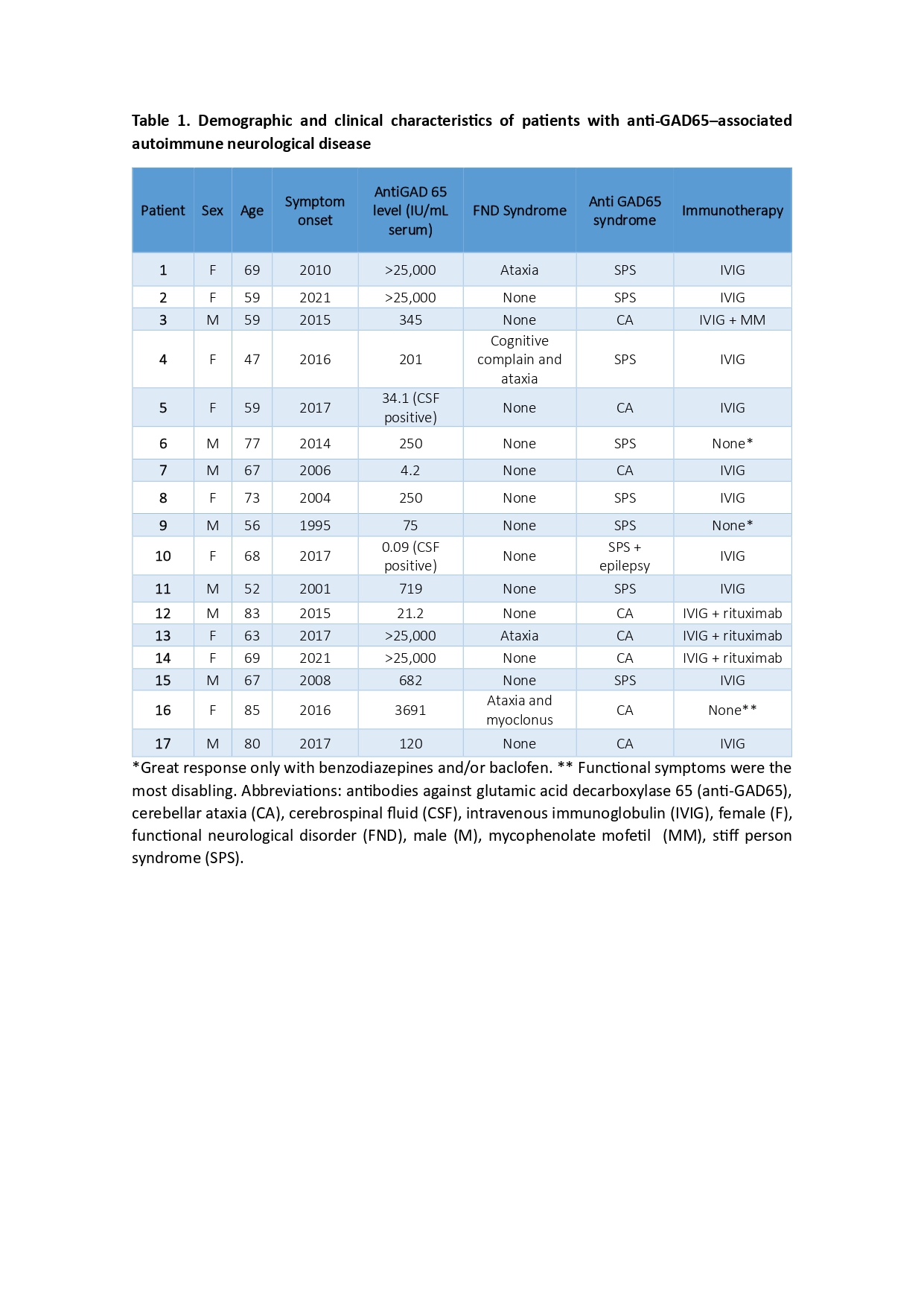
Table 1
References: 1. Finkelstein SA, Diamond C, Carson A, Stone J. Incidence and prevalence of functional neurological disorder: a systematic review. J Neurol Neurosurg Psychiatry. 2025;96(4):383-395. Published 2025 Mar 24. doi:10.1136/jnnp-2024-334767.
2. Kulikov V, Maurer Longitudinal epidemiological trends in functional neurological disorder (P10-5.016). Neurology. 2024. doi:10.1212/WNL.0000000000208509.
3. Jungilligens J, Marcinkowski E, Wehner T, Skodda S, Popkirov S. Functional Neurological Disorder Among Neurology In-Patients. Eur J Neurol. 2025;32(9):e70338. doi:10.1111/ene.70338
To cite this abstract in AMA style:
B. Talavera, M. García Huguet, Z. Yu, J. Patino, A. Lin, A. Espay. Functional Neurological Disorder And Anti-GAD65–Associated Autoimmune Neurological Disease: Diagnostic Overlap In A Retrospective Case Series [abstract]. Mov Disord. 2026; 41 (suppl 1). https://www.mdsabstracts.org/abstract/functional-neurological-disorder-and-anti-gad65-associated-autoimmune-neurological-disease-diagnostic-overlap-in-a-retrospective-case-series/. Accessed October 1, 2026.« Back to 2026 International Congress
MDS Abstracts - https://www.mdsabstracts.org/abstract/functional-neurological-disorder-and-anti-gad65-associated-autoimmune-neurological-disease-diagnostic-overlap-in-a-retrospective-case-series/