
Objective: To develop an easy-to use Comprehensive Motor Function Test (CMFT) that combines active MDS‑UPDRS motor tasks with continuous body landmark tracking in smartphone videos to derive digital motor phenotypes (dMPs), for clinically relevant quantification of motor function of People with Parkinson’s Disease (PwPD).
Background: PD is a progressive disorder with declining motor function in posture, balance, leg agility, and gait. Smartphone body landmark tracking tools can capture joint‑level motion, but their clinical value for generating meaningful dPMs still needs validation.
Method: CMFT approaches the assessment of MDS‑UPDRS Part III items 3.8 (leg agility), 3.9 (arising from chair), 3.13 (posture), and 3.10 (gait) [figure 1], with smartphone‑based body landmark tracking [figure 2], while PwPD perform these items in a sequence. Developed via clinically validated CMFT recordings from 39 PwPD (26% women; mean age 69.2±9.7 yrs; mean disease onset 10±5.9 yrs, recruited at Papanikolaou General Hospital/N. Greece PD Association, Thessaloniki, Greece), and further tested in CMFT recordings from 21 participants (AI‑PROGNOSIS dBM‑DEV study: 4 RBD, 5 HC, 12 PwPD; 43% women; mean age 64.3±9.2 yrs). X/Y landmark trajectories were automatically segmented [figure 3], yielding nine dMPs capturing joint‑angle characteristics. The latter were used to train machine learning (ML) models for predicting MDS‑UPDRS item scores and accuracy, precision, recall, and F1 metrics computed. Users’ perspectives were captured via a co-creation session
Results: The estimated absolute Spearman correlation of the CMFT dMPs with the MDS‑UPDRS items ranged from 0.42 (item 3.13) to 0.72 (item 3.8) with p<0.001. The SVM and KNN ML models achieved the best performance, with accuracies up to 0.8 precision/recall up to 0.72–0.78, and F1 scores up to 0.77 for item 3.9, while maintaining consistent performance across posture, gait, and leg‑agility items. Overall, 91% of participants were highly satisfied, emphasizing CMFT’s simplicity and usefulness.
Conclusion: The CMFT provides an objective, scalable digital approximation of key MDS‑UPDRS Part III motor items, enabling quantifiable assessment of posture and gait. It supports the transition from traditional in‑clinic examinations to automated, remotely deployable assessments, facilitating self‑monitoring of motor function by PwPD.
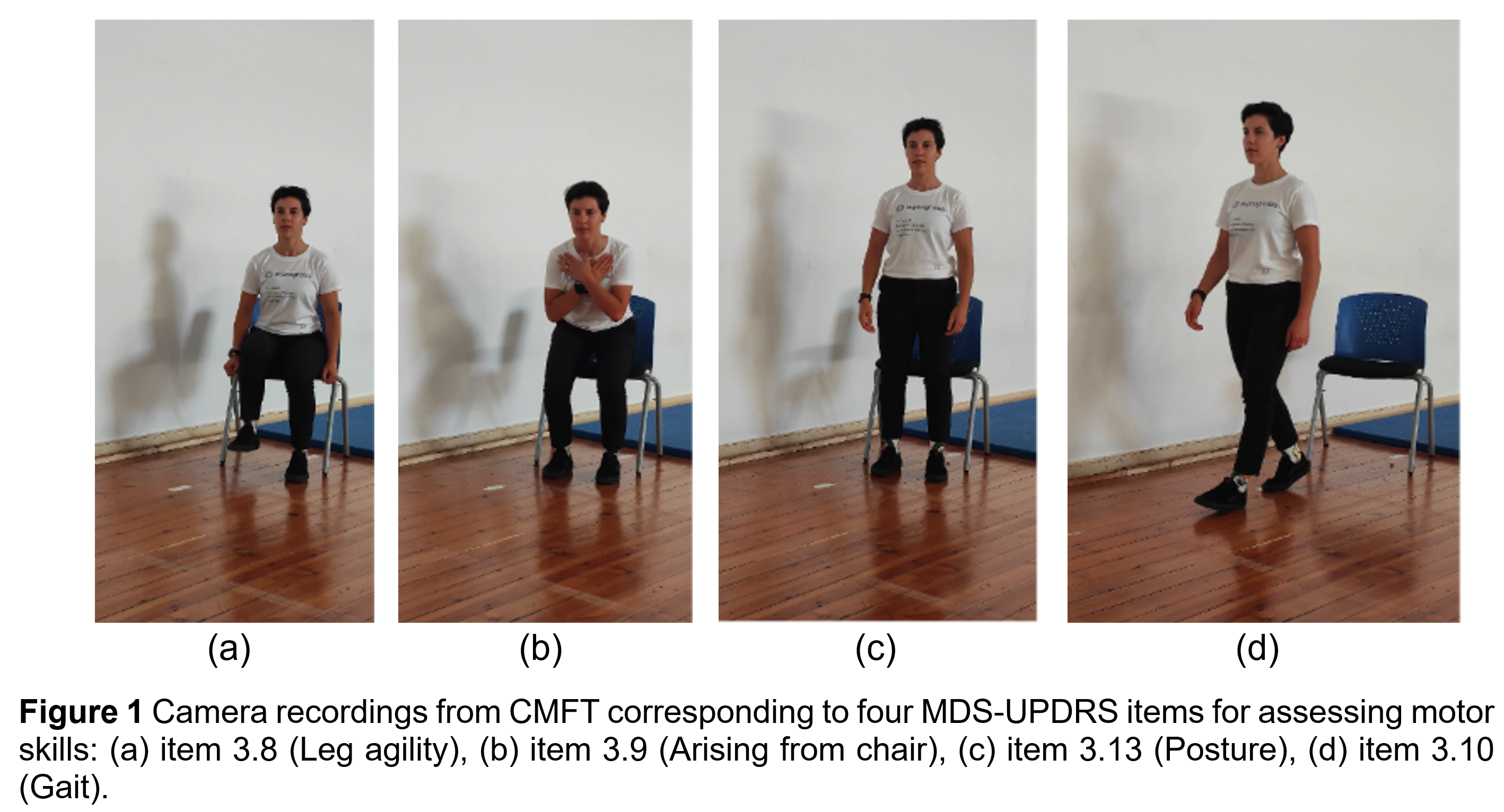
figure 1
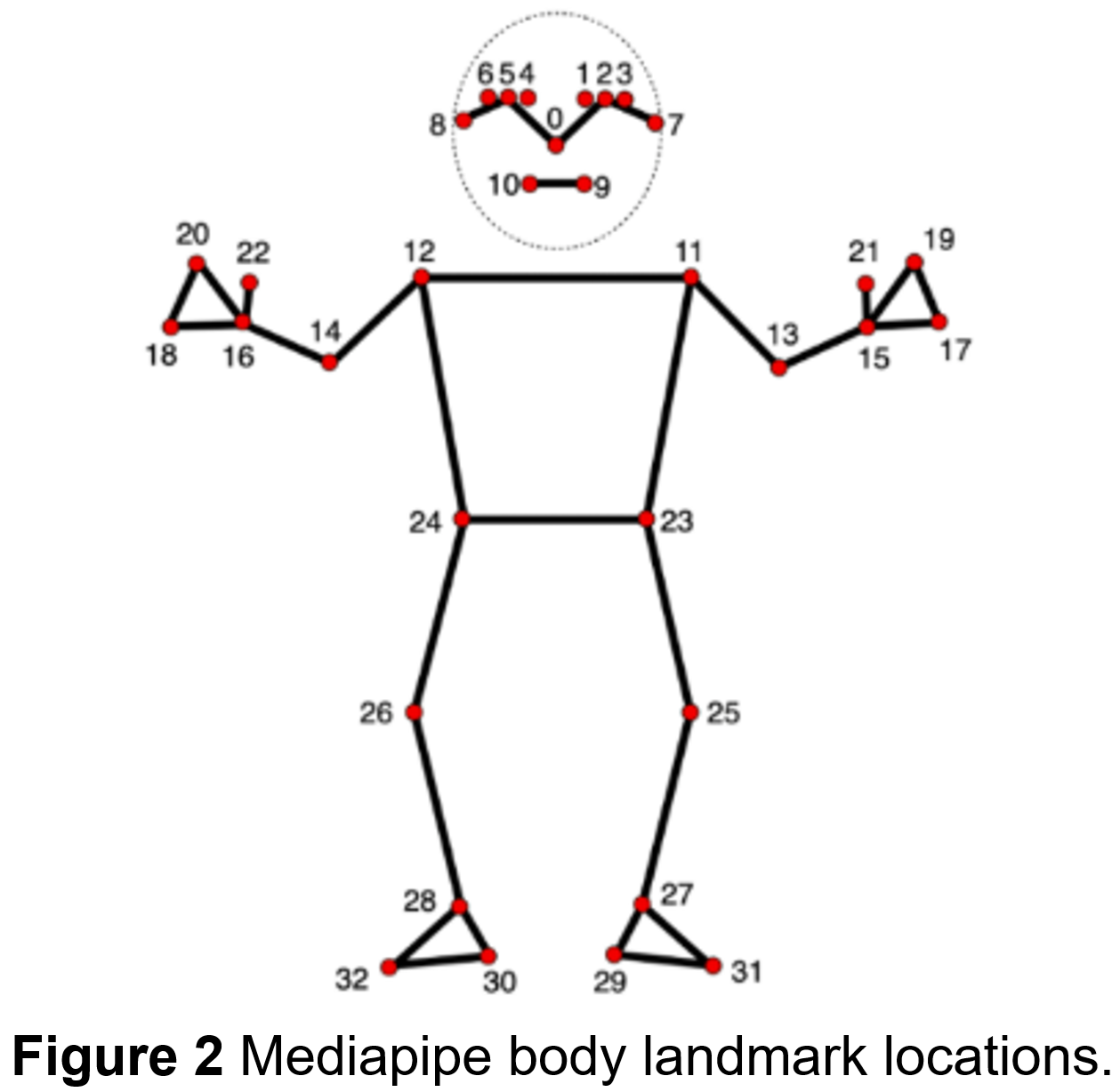
figure 2
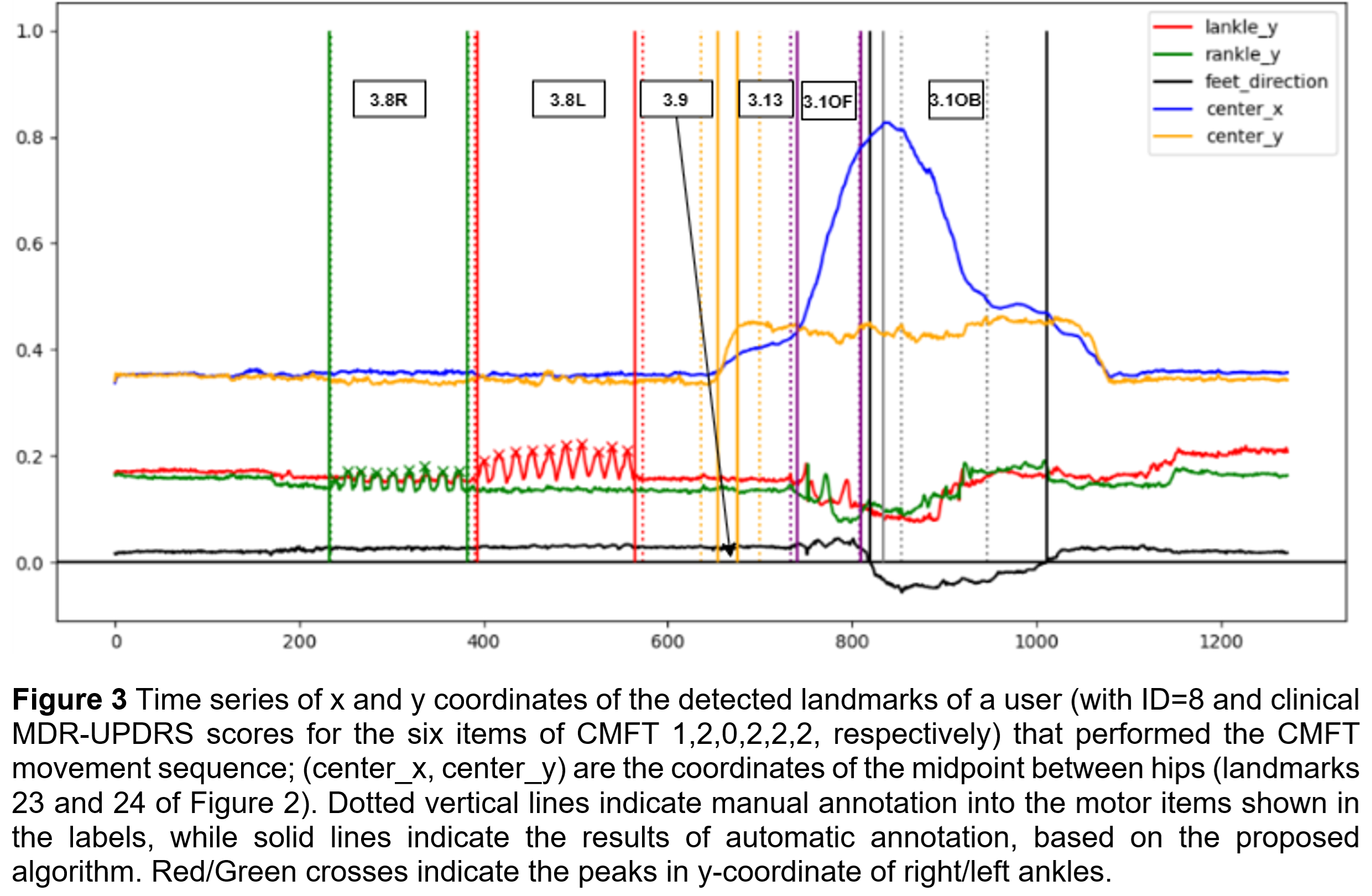
figure 3
To cite this abstract in AMA style:
N. Grammalidis, S. Dias, B. Alves, C. Giaralis, J. Zaras, K. Dimitropoulos, S. Bostantzopoulou-Kabouroglou, N. Del Campo, M. Kurtis, ML. Almarcha-Menargues, B. Falkenburger, T. Feige, N. Schnalke, A. Drif, M. Fabbri, S. Hadjidimitriou, L. Hadjileontiadis. Smartphone Video Derived Digital Motor Phenotypes of MDS UPDRS-Related Tasks via a Comprehensive Motor Function Test [abstract]. Mov Disord. 2026; 41 (suppl 1). https://www.mdsabstracts.org/abstract/smartphone-video-derived-digital-motor-phenotypes-of-mds-updrs-related-tasks-via-a-comprehensive-motor-function-test/. Accessed October 1, 2026.« Back to 2026 International Congress
MDS Abstracts - https://www.mdsabstracts.org/abstract/smartphone-video-derived-digital-motor-phenotypes-of-mds-updrs-related-tasks-via-a-comprehensive-motor-function-test/