
Objective: To develop a brain-targeted extracellular vesicle (EV) platform capable of delivering proteolysis-targeting chimeras (PROTACs) across the BBB and inducing degradation of pathogenic proteins in Parkinson’s disease.
Background: Therapeutic development for Parkinson’s disease is limited by poor drug delivery across the BBB. Extracellular vesicles (EVs) are promising carriers due to their biocompatibility and intrinsic transport capability, but their brain-targeting efficiency remains suboptimal. PROTACs enable targeted protein degradation but are difficult to deliver to the central nervous system. We hypothesized that EVs engineered with a BBB-targeting peptide and loaded with PROTAC cargo could enhance brain delivery and therapeutic efficacy.
Method: Clinical-grade MSC–EVs were isolated from 3D spheroid cultures. A multifunctional peptide containing a transferrin receptor–targeting T7 motif, transmembrane domain, and cell-penetrating peptide was designed for spontaneous membrane insertion and stable EV surface display. The LRRK2-targeting PROTAC XL01126 was passively encapsulated to generate dual-loaded engineered EVs. Peptide surface localization was verified by stochastic optical reconstruction microscopy. Cellular uptake and BBB penetration were evaluated using human brain endothelial cells and a transwell BBB model, and in vivo biodistribution and therapeutic efficacy were assessed in mice, including an MPTP-induced Parkinson’s disease model.
Results: Engineered T7-displaying EVs preserved vesicle morphology, size distribution, and canonical EV markers. Super-resolution imaging confirmed nanoscale membrane localization of the peptide. In vitro studies showed enhanced uptake by brain endothelial cells and improved transport across a BBB model compared with control EVs. In vivo imaging demonstrated increased brain accumulation and neuronal association after systemic administration. Dual-loaded EVs delivering the PROTAC compound induced robust LRRK2 degradation in the brains of MPTP-treated mice, outperforming free PROTAC and non-targeted EVs.
Conclusion: A dual-loaded EV platform that combines BBB-targeting surface engineering with intravesicular PROTAC delivery enhances brain accumulation and enables effective in vivo degradation of disease-associated proteins, supporting engineered MSC-EVs as a promising therapeutic delivery system for Parkinson’s disease.
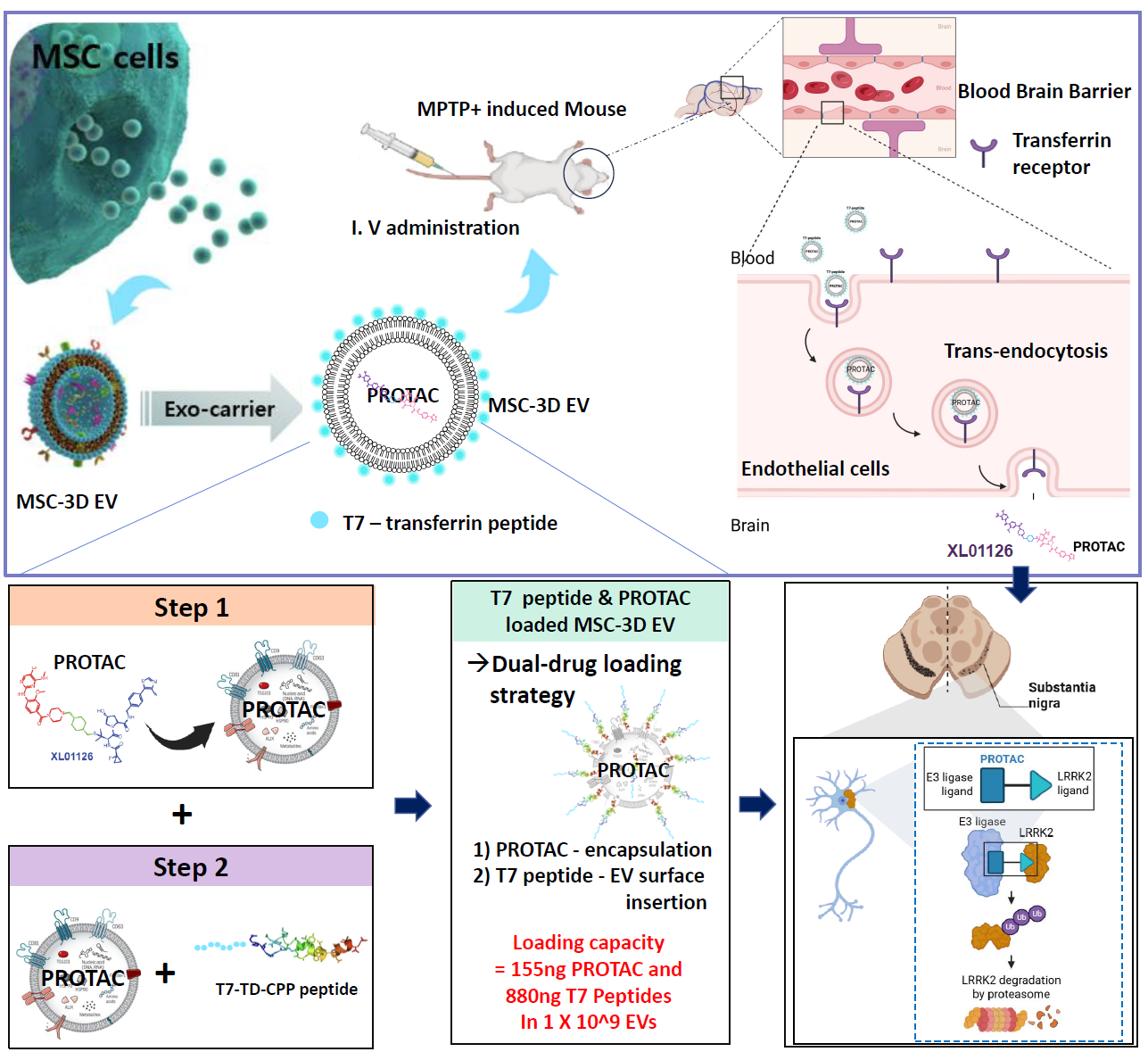
Figure abstract
To cite this abstract in AMA style:
JEK. Kim, YH. Yang, OYB. Bang. Brain-targeted dual-loaded extracellular vesicles enable PROTAC-mediated LRRK2 degradation in Parkinson’s disease [abstract]. Mov Disord. 2026; 41 (suppl 1). https://www.mdsabstracts.org/abstract/brain-targeted-dual-loaded-extracellular-vesicles-enable-protac-mediated-lrrk2-degradation-in-parkinsons-disease/. Accessed October 1, 2026.« Back to 2026 International Congress
MDS Abstracts - https://www.mdsabstracts.org/abstract/brain-targeted-dual-loaded-extracellular-vesicles-enable-protac-mediated-lrrk2-degradation-in-parkinsons-disease/