
Objective: To compare the innate immune responses and neurodegenerative marker induction in human microglia following infection with neurotropic vs. non-neurotropic Influenza A virus (IAV) under basal and primed conditions.
Background: IAV-induced neuroinflammation is a potential trigger for neurodegeneration. Microglia are the central nervous system (CNS) primary immune sensors, but how viral neurotropism and immune priming collectively drive microglial dysfunction and pathological markers like phosphorylated alpha-synuclein (p-syn129) remains unclear.
Method: Human microglial cells (HMC3) were infected with non-neurotropic A/PR/8/34 (PR8) or neurotropic A/NWS/33 (S33) (MOI 0.1). Immune priming was simulated via LPS pre-treatment (10 µg/mL, 24h). We quantified cytokines (ELISA), surface markers and viral nucleoprotein (NP) (flow cytometry), and p-syn129 expression (Western blot).
Results: Both strains induced significant but distinct activation profiles. PR8 upregulated cytokines and surface markers (CD40, CD68, CD86, CD206, HLA-II), with a notable TNF-α peak in non-primed cells. S33 elicited a more robust induction of CCL2, IL-6, and TNF-α, alongside significant upregulation of CD40, CD68, HLA-I, and CD206. LPS-primed S33-infected cells showed the highest CCL2 levels, indicating a synergistic inflammatory effect. Furthermore, S33 infection resulted in significantly higher viral NP expression and HLA-I presentation compared to PR8. Crucially, IAV infection induced p-syn129, with the neurotropic S33 strain eliciting significantly higher levels than PR8.
Conclusion: Microglial activation and proteotoxic stress are heavily modulated by viral neurotropism and the prior immunological state of the CNS. The superior replication and robust p-syn129 induction by the S33 strain suggest that neurotropic influenza is a potent driver of both acute neuroinflammation and protein pathology.
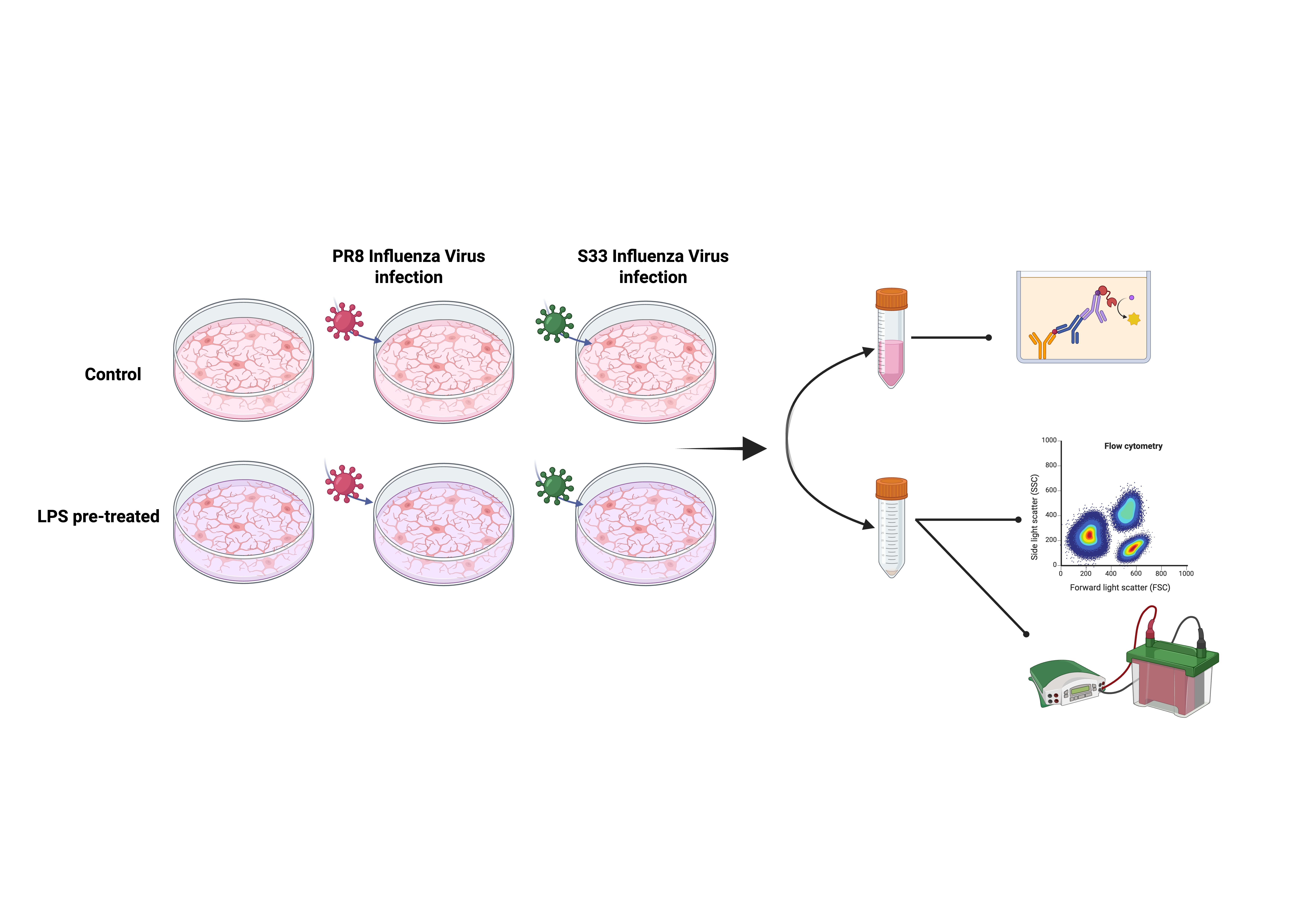
Experimental workflow of IAV infection in HMC3
To cite this abstract in AMA style:
L. Ho, D. Nguyen, E. Ko, Y. Kim. Differential Microglial Activation and p-Ser129 Alpha-Synuclein Induction by Neurotropic and Non-Neurotropic Influenza A Virus Strains [abstract]. Mov Disord. 2026; 41 (suppl 1). https://www.mdsabstracts.org/abstract/differential-microglial-activation-and-p-ser129-alpha-synuclein-induction-by-neurotropic-and-non-neurotropic-influenza-a-virus-strains/. Accessed October 1, 2026.« Back to 2026 International Congress
MDS Abstracts - https://www.mdsabstracts.org/abstract/differential-microglial-activation-and-p-ser129-alpha-synuclein-induction-by-neurotropic-and-non-neurotropic-influenza-a-virus-strains/