
Category: Parkinson's Disease (Other)
Objective: To identify the most informative speech tasks for detecting clinically relevant speech changes in Parkinson’s Disease (PD) and to develop a streamlined, data-driven assessment protocol.
Background: Speech impairment in PD substantially affects communication and quality of life. Current protocols are often too time-consuming. Thus, a data-driven reduction strategy is needed to improve clinical feasibility.
Method: 24 individuals with PD and 12 healthy controls (HC) performed various speech tasks (e.g., reading, vowel phonation, free speech, diadochokinesis) in German. Four speech therapists provided perceptual ratings using AMSD [1], GRBAS [2], and RBH [3,4]. Analysis focused on dimensions such as intelligibility, naturalness, voice quality, articulatory precision, tempo, monopitch and monoloudness. Task utility was quantified using a weighted score matrix reflecting clinical relevance, defined as the ability to (1) discriminate HC vs PD, (2) discriminate affected vs unaffected speakers with PD, and (3) reflect motor severity and patient-perceived impairment. Four criteria were applied:
1) Group Discrimination (30%): Sensitivity to clinical impairment/group membership measured via Hedges’ g effect sizes.
2) Classification Accuracy (20%): Diagnostic power determined through ROC-AUC analysis.
3) Clinical Correlation (30%): Spearman rank correlations between perceptual ratings and UPDRS-III scores to ensure tasks reflect motor severity.
4) Subjective Relevance (20%): Ecological validity assessed by correlating perceptual scores with patient self-perceived speech function (VAS scores).
Tasks with scores ≥3.0 out of max. 4.0 were defined as core protocol components. Task-set simulations identified combinations maximizing informativeness while minimizing redundancy.
Results: First results are presented in figure 1 and figure 2. So far, results identify naturalness and voice quality as primary clinical markers, with picture discription achieving the highest diagnostic power. The resulting optimized speech protocol will be presented at the congress.
Conclusion: The weighted ranking system provides a transparent, evidence-based instrument for protocol reduction. By prioritizing tasks that align with both clinical perception and patient self-assessment, we establish a condensed speech assessment protocol sensitive to motor severity and patient-perceived impairment while substantially improving clinical feasibility.
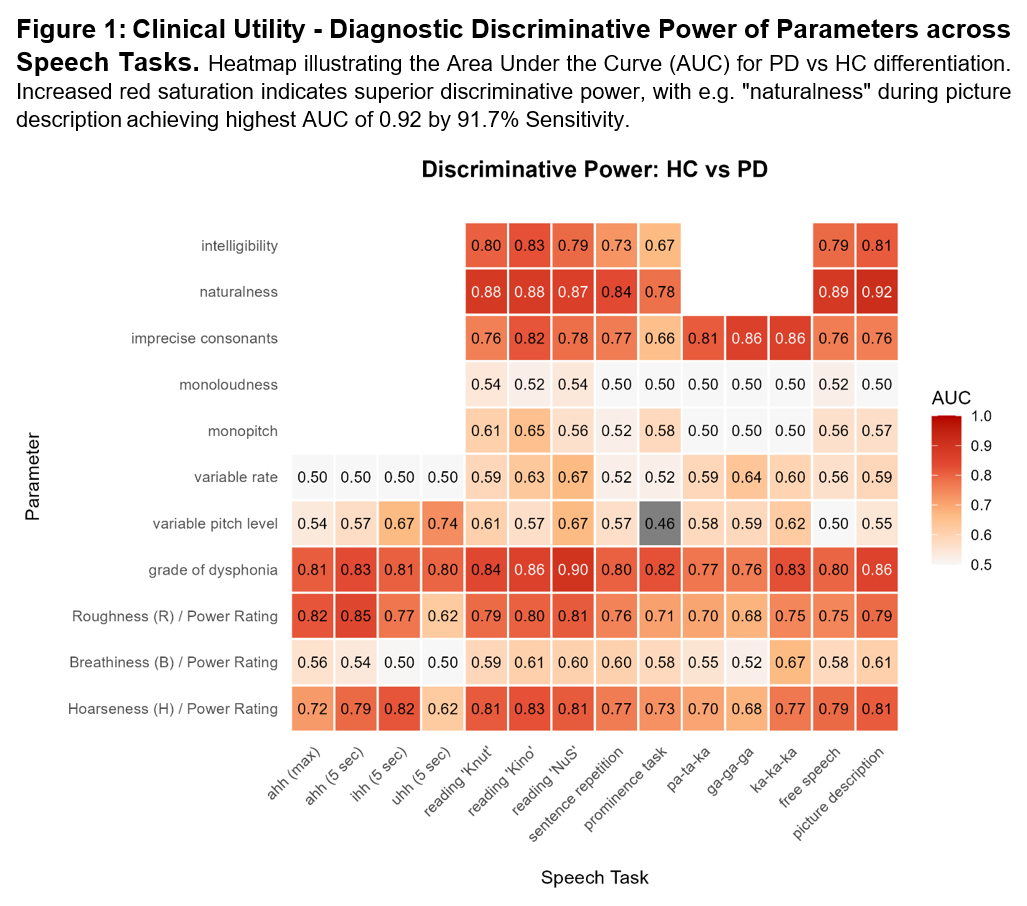
Figure 1
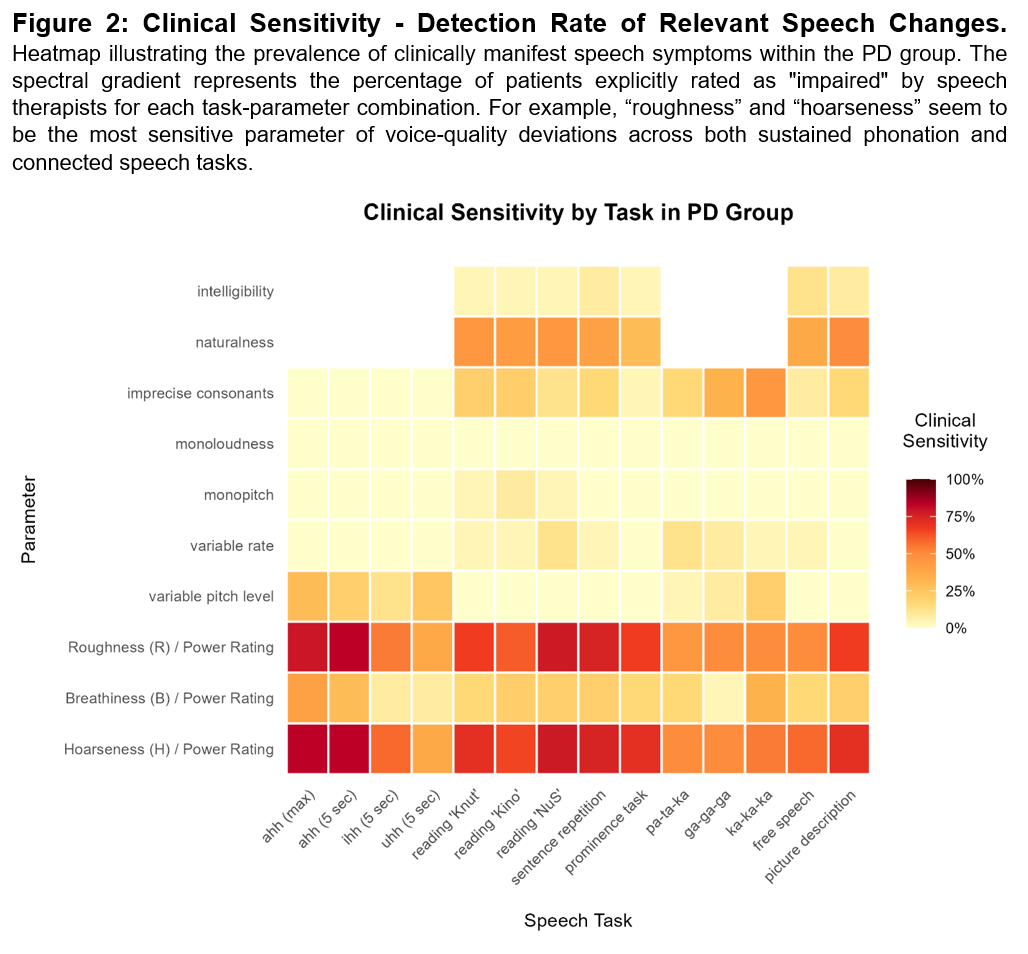
Figure 2
References: [1] Darley, F. L., Aronson, A. E., & Brown, J. R. (1969). Differential diagnostic patterns of dysarthria. J Speech Hear Res, 12(2), 246-269.
[2] Hirano, M. (1981). Psyco-acoustic evaluation of voice. Clinical examination of voice: disorders of human communication, 81-84.
[3] Nawka, T., Anders, L. C., & Wendler, J. (1994). Die auditive Beurteilung heiserer Stimmen nach dem RBH-System. Sprache Stimme Gehör, 18(3), 130-133.
[4] Friedrich, G., & Dejonckere, P. H. (2005). Das Stimmdiagnostik-Protokoll der European Laryngological Society (ELS)-erste Erfahrungen im Rahmen einer Multizenterstudie. Laryngorhinootologie, 84(10), 744-752.
To cite this abstract in AMA style:
T. Thies, I. Rubi-Fessen, J. Strelow, J. Tröger, D. Mücke, M. Barbe. Identifying Informative Speech Tasks for Detecting Clinically Relevant Changes in Parkinson’s Disease [abstract]. Mov Disord. 2026; 41 (suppl 1). https://www.mdsabstracts.org/abstract/identifying-informative-speech-tasks-for-detecting-clinically-relevant-changes-in-parkinsons-disease/. Accessed October 1, 2026.« Back to 2026 International Congress
MDS Abstracts - https://www.mdsabstracts.org/abstract/identifying-informative-speech-tasks-for-detecting-clinically-relevant-changes-in-parkinsons-disease/