
Category: Technology
Objective: To show that a consolidated patient specific workflow significantly improved operative efficiency and reduced personnel costs for deep brain stimulation (DBS) implantation, without compromise in stereotactic accuracy.
Background: Conventional frame-based workflows (FBW) for deep brain stimulation (DBS) implantation have demonstrated safety and accuracy for decades. Patient-specific frameless workflows (PSW) using custom platforms or robotics offer comparable accuracy and allow consolidation of operative stages.
Method: A retrospective single-institution analysis of DBS implantation was performed. Of 535 electrode placements in 357 patients (2006–2025), 58 consecutive procedures from 2023–2025 were analyzed, including matched FBW and PSW cohorts. All PSW cases used the STarFix system (FHC Inc., Bowdoin, ME). FBW consisted of three operative phases: MRI acquisition under anesthesia, electrode implantation, and implantable pulse generator (IPG) placement. In PSW, MRI acquisition, fiducial placement, and IPG implantation were consolidated into a single anesthetic episode followed by electrode implantation. Demographics were compared using Welch’s t-tests and chi-square tests. TDABC estimated personnel costs using staff wage rates and operative time. Targeting accuracy was assessed using postoperative CT fused to preoperative MRI to calculate tip-to-target, radial, projection, and angular error.
Results: Fifty-eight procedures were analyzed (30 FBW, 28 PSW). Baseline characteristics were similar between cohorts, with no differences in age, comorbidities, length of stay, or operative time. Consolidation reduced hospital-based care episodes by 33%. TDABC showed no cost differences during MRI acquisition. During electrode implantation, personnel costs were lower with PSW for surgeons ($1,692 vs $1,040; p = .01) and anesthesiologists ($1,435 vs $883; p = .01). Total personnel cost per case was lower with PSW ($2,786 vs $1,879; p = .02). Tip-to-target error was reduced with PSW (2.33 ± 1.30 mm vs 3.48 ± 1.42 mm; p < .001), while radial, projection, and angular errors were similar.
Conclusion: A consolidated patient-specific workflow reduces personnel costs and hospital-based care episodes without increasing operative time or compromising targeting accuracy. Workflow reorganization may represent a strategy to improve value in DBS care delivery.
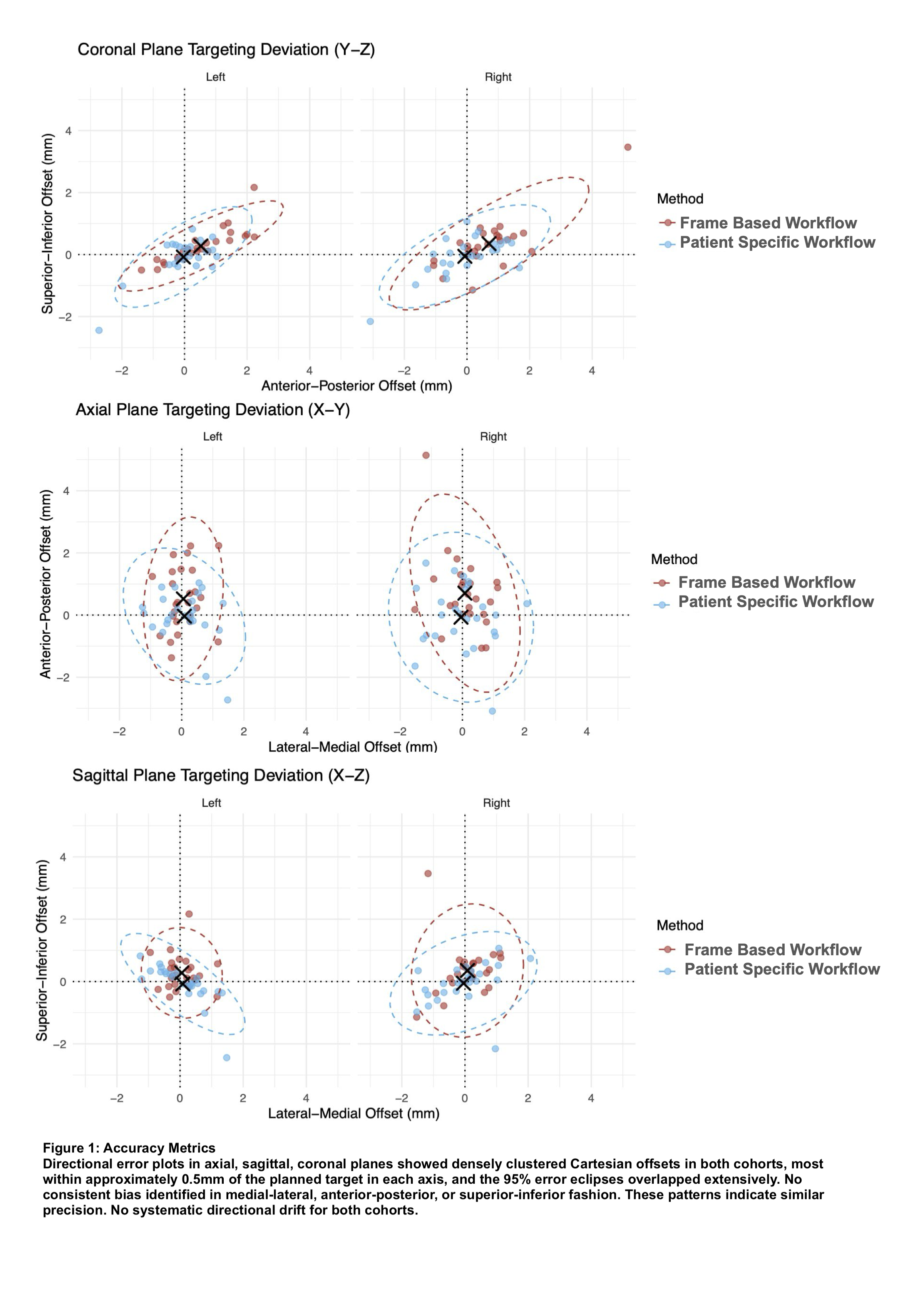
Figure 1. Accuracy Metrics

Table 1

Table 2
To cite this abstract in AMA style:
A. Goyal, B. Dong, A. Bansal, M. Marsans, S. Srivatsal, F. Farrokhi. Reducing Cost and Operative Time in DBS with a Consolidated Workflow: A Time-Driven Activity-Based Costing Analysis [abstract]. Mov Disord. 2026; 41 (suppl 1). https://www.mdsabstracts.org/abstract/reducing-cost-and-operative-time-in-dbs-with-a-consolidated-workflow-a-time-driven-activity-based-costing-analysis/. Accessed October 1, 2026.« Back to 2026 International Congress
MDS Abstracts - https://www.mdsabstracts.org/abstract/reducing-cost-and-operative-time-in-dbs-with-a-consolidated-workflow-a-time-driven-activity-based-costing-analysis/