
Objective: To investigate whether individual metabolic components are associated with motor, cognitive, and functional outcomes in Parkinson’s disease (PD).
Background: Metabolic syndrome has been proposed as a potential modifier of PD progression, but results remain inconsistent. The influence of individual metabolic components on clinical severity in PD is not well established.
Method: We conducted an observational analysis using data from the Parkinson’s Progression Markers Initiative (PPMI). Clinical outcomes included motor symptoms assessed with the Movement Disorder Society–Unified Parkinson’s Disease Rating Scale (MDS-UPDRS), cognitive performance measured with the Montreal Cognitive Assessment (MoCA), depressive symptoms evaluated using the Geriatric Depression Scale (GDS), and functional status assessed with the Schwab and England scale. Multiple linear regression models were performed to explore associations between metabolic variables (triglycerides, high-density lipoprotein cholesterol, fasting glucose, and body mass index) and clinical outcomes, adjusting for age and sex. Artificial intelligence tools were used to assist in statistical analysis workflows and language editing.
Results: A total of 154 patients with PD were included. Metabolic syndrome was not associated with differences in motor, cognitive, non-motor, or functional outcomes. However, exploratory regression analyses suggested potential associations between metabolic components and disease severity. Exploratory analyses showed that higher triglyceride levels were associated with worse motor severity (MDS-UPDRS part III; β = 0.089, p = 0.036), while higher fasting glucose levels were correlated with lower cognitive performance (MoCA; Spearman r = −0.78, p = 0.014).
Conclusion: While metabolic syndrome as a composite diagnosis was not associated with clinical outcomes, individual metabolic components may relate to specific aspects of PD severity. These findings suggest that metabolic alterations may influence motor and cognitive manifestations of PD and warrant further investigation in longitudinal studies.
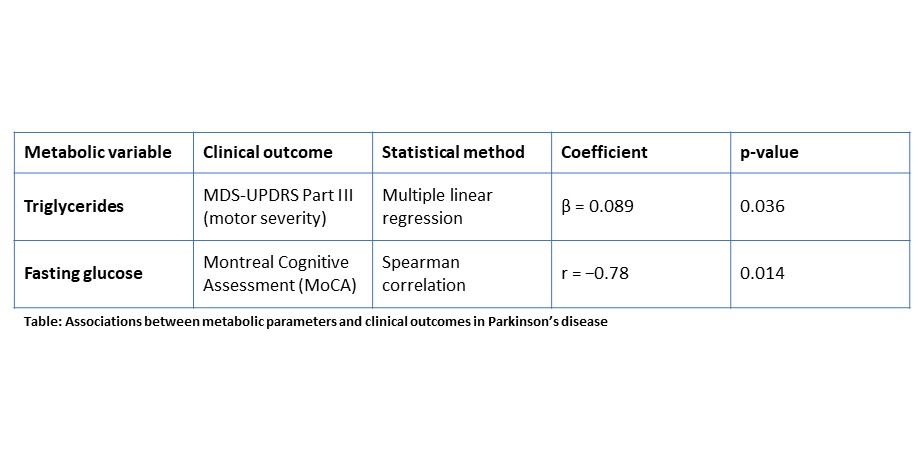
Metabolic parameters and clinical outcomes in PD
To cite this abstract in AMA style:
TLD. Denicol, MPF. Felippe, GGA. Dal Alba, CMD. Dagostini, JSL. León, AH. Hilbig, CMR. Rieder. Metabolic Syndrome is not Associated with Parkinson’s Disease Severity, but Individual Metabolic Components May Be [abstract]. Mov Disord. 2026; 41 (suppl 1). https://www.mdsabstracts.org/abstract/metabolic-syndrome-is-not-associated-with-parkinsons-disease-severity-but-individual-metabolic-components-may-be/. Accessed October 1, 2026.« Back to 2026 International Congress
MDS Abstracts - https://www.mdsabstracts.org/abstract/metabolic-syndrome-is-not-associated-with-parkinsons-disease-severity-but-individual-metabolic-components-may-be/