
Objective: To identify data-driven spatiotemporal trajectories of brain atrophy across the Lewy body disease spectrum and establish their relationship to clinical heterogeneity, core symptom profiles, and risk of cognitive impairment and iRBD phenoconversion.
Background: Parkinson’s disease (PD), dementia with Lewy bodies (DLB) and isolated rapid eye movement (REM) sleep behaviour disorder (iRBD) constitute a clinicopathological Lewy body spectrum defined by α-synuclein aggregation and overlapping motor, non-motor and neuropsychiatric features.(1) This overlap has driven efforts to reconceptualise Lewy body disorders within unified biological staging frameworks.(2)
Method: We analysed a multi-cohort international dataset comprising 1,373 participants (506 healthy controls, 294 DLB, 129 iRBD, and 444 PD patients) with T1-weighted MRI, recruited across seven cohorts and 12 centres. Volumetric features were selected using a hybrid data-driven and a priori evidence-based approach. We applied the Subtyping and Staging Inference algorithm(3,4) to identify spatiotemporal patterns of atrophy across all Lewy body diseases, modelling disease progression as piecewise-linear z-score trajectories at thresholds (z=0.5,1,2).
Results: Four subtypes were identified (Fig 1), with subtype A showing early cortico-limbic and late basal ganglia involvement (41.8%), subtype B—early basal ganglia and late limbic degeneration (30.3%), subtype C—early temporo-limbic and late basal ganglia involvement (17.3%), and subtype D showing early basal ganglia-cingulate degeneration with late cortical atrophy (10.6%). These anatomical differences translated into meaningful clinical variation. Longitudinal analysis showed that PD patients in subtype A had a significantly higher risk of developing mild cognitive impairment (hazard ratio=2.91, p=0.007). Furthermore, subtypes with early limbic involvement (A and C) showed higher prevalence of visual hallucinations (VH) than the early basal ganglia subtypes (B and D) (p<0.001). In PD, VH were associated with reduced amygdala volume (Fig 3), with a sharp increase in prevalence once amygdala atrophy exceeded a z-score of 1.
Conclusion: Imaging-derived atrophy subtypes capture distinct yet overlapping trajectories that explain variation in cognition, core symptoms, and phenoconversion risk. These findings support a transdiagnostic, biologically grounded framework for diagnosis and precision medicine in LBD.
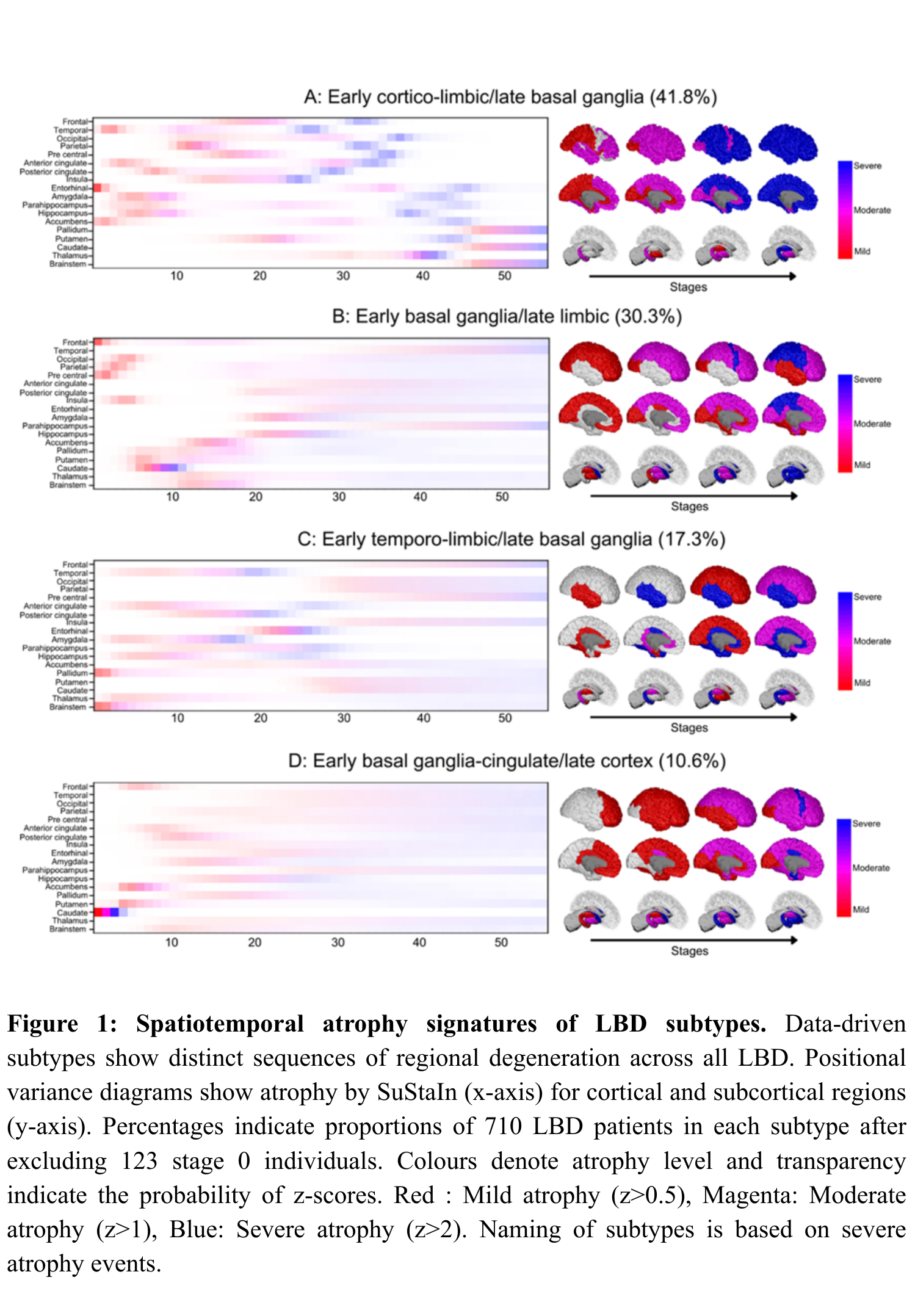
Figure 1
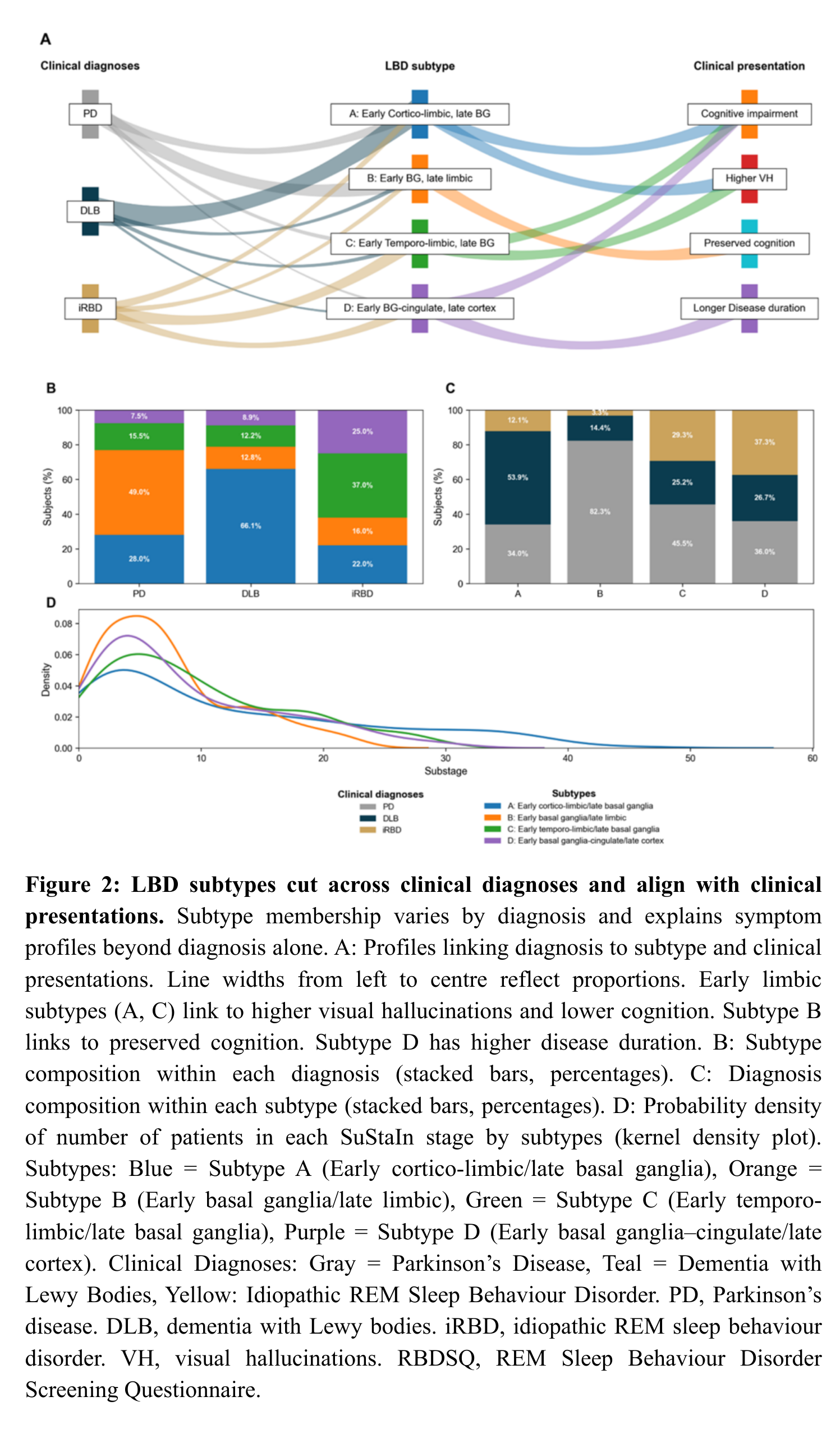
Figure 2
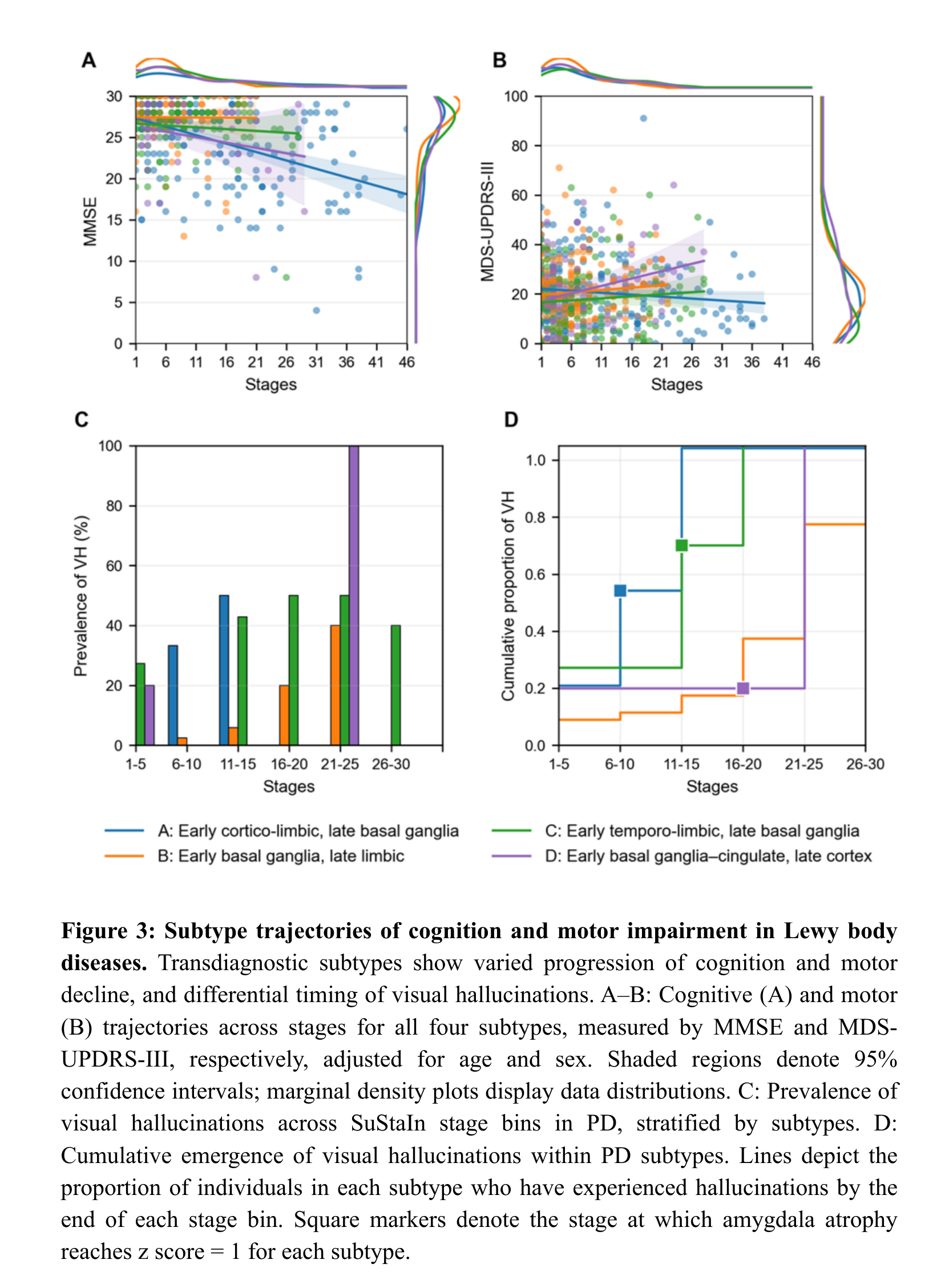
Figure 3
References: 1. D. Berg, R. B. Postuma, B. Bloem, P. Chan, B. Dubois, T. Gasser, C. G. Goetz, G. M. Halliday, J. Hardy, A. E. Lang, I. Litvan, K. Marek, J. Obeso, W. Oertel, C. W. Olanow, W. Poewe, M. Stern, G. Deuschl, Time to Redefine PD? Introductory Statement of the MDS Task Force on the Definition of Parkinson’s Disease. Movement Disorders 29, 454 (2014).
2. E. Matar, G. M. Halliday, Biological effects of pathologies in Lewy body diseases: why timing matters. Lancet Neurol 24, 441–455 (2025).
3. L. M. Aksman, P. A. Wijeratne, N. P. Oxtoby, A. Eshaghi, C. Shand, A. Altmann, D. C. Alexander, A. L. Young, pySuStaIn: A Python implementation of the Subtype and Stage Inference algorithm. SoftwareX 16 (2021).
To cite this abstract in AMA style:
A. Konuri, G. Leal, T. Transcend Consortium, G. Halliday, S. Lewis, R. Weil, R. Landin-Romero, C. Lambert, N. Oxtoby, E. Matar. Data-driven Trajectories of Atrophy Explain Clinical Heterogeneity Across Lewy Body Diseases [abstract]. Mov Disord. 2026; 41 (suppl 1). https://www.mdsabstracts.org/abstract/data-driven-trajectories-of-atrophy-explain-clinical-heterogeneity-across-lewy-body-diseases/. Accessed October 1, 2026.« Back to 2026 International Congress
MDS Abstracts - https://www.mdsabstracts.org/abstract/data-driven-trajectories-of-atrophy-explain-clinical-heterogeneity-across-lewy-body-diseases/