
Category: Parkinson's Disease: Surgical Therapy
Objective: To compare Volumes of Tissue Activated (VTA) locations and motor outcomes in Parkinson’s Disease (PD) patients across three programming strategies: manual image-guided programming (mIGP), automated image-guided programming (aIGP), clinician-optimized automated IGP (oaIGP) using the DBS Illumina 3DTM algorithm.
Background: Deep Brain Stimulation (DBS) programming involves a trial-and-error process, requiring multiple programming visits to maximize benefits and minimize side effects.
Image-guided programming (IGP) has shown that using patient-specific anatomy to guide stimulation location can lead to shorter programming times (1,2), fewer programming sessions (3), and improved outcomes (4,5)
Advances in DBS programming software have allowed for assisted creation of patient-specific volumes of tissue activated (VTAs) based on user-defined anatomical targets (6).
Method: Retrospective, single center, unblinded
25 PD patients with bilateral STN DBS implants, programmed with manual IGP (n=12) or with automated IGP (n=13)
mIGP cohort was manually programmed by a clinician using IGP.
aIGP cohort was initially programmed using DBS Illumina 3DTM software, with settings subsequently optimized by a clinician (oaIGP) during initial (IP) or follow-up programming. Outcomes were assessed ~1 week after initial programming.
VTAs from IP and follow-up programming for each cohort were aggregated and normalized using Brainlab QuentryTM for DBS Analytics platform.
MDS-UPDRS III motor scores were recorded for the Meds On/Off and DBS On/Off conditions
Results: Aggregated VTA locations shown in normalized STN brain space. Lighter areas of the heatmap indicate greater VTA overlap in that anatomical location. (Fig 1)
Box plot of the MDS-UPDRS III scores. Percent reduction of DBS Off/Meds Off to DBS On/Meds Off for each method was 54.91% for mIGP and 70.13% for aIGP (Fig 2)
Conclusion: VTAs created by aIGP are concentrated in target area and visually mimic anatomical location manually stimulated by a clinician for the initial programming
Average MDS-UPDRS III scores and % improvement over baseline in aIGP cohort were superior to those in mIGP cohort, highlighting aIGP with DBS Illumina 3DTM as an effective DBS programming method.
Clinician-optimized aIGP settings (oaIGP) resulted in further improved symptom control and fewer side effects.
Despite similar VTA locations, aIGP-generated stimulation settings may contribute to improved outcomes compared with mIGP.
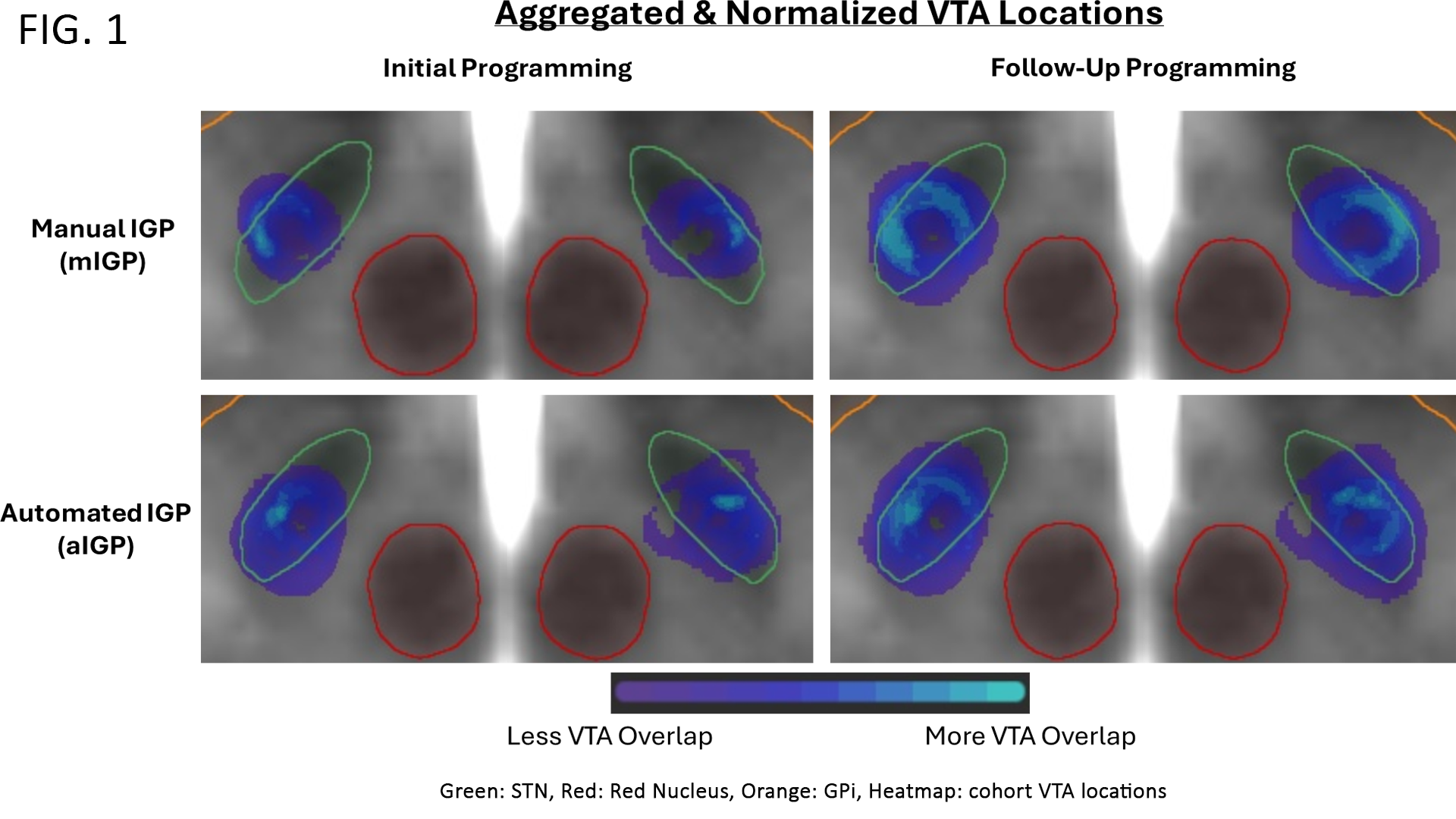
FIG. 1
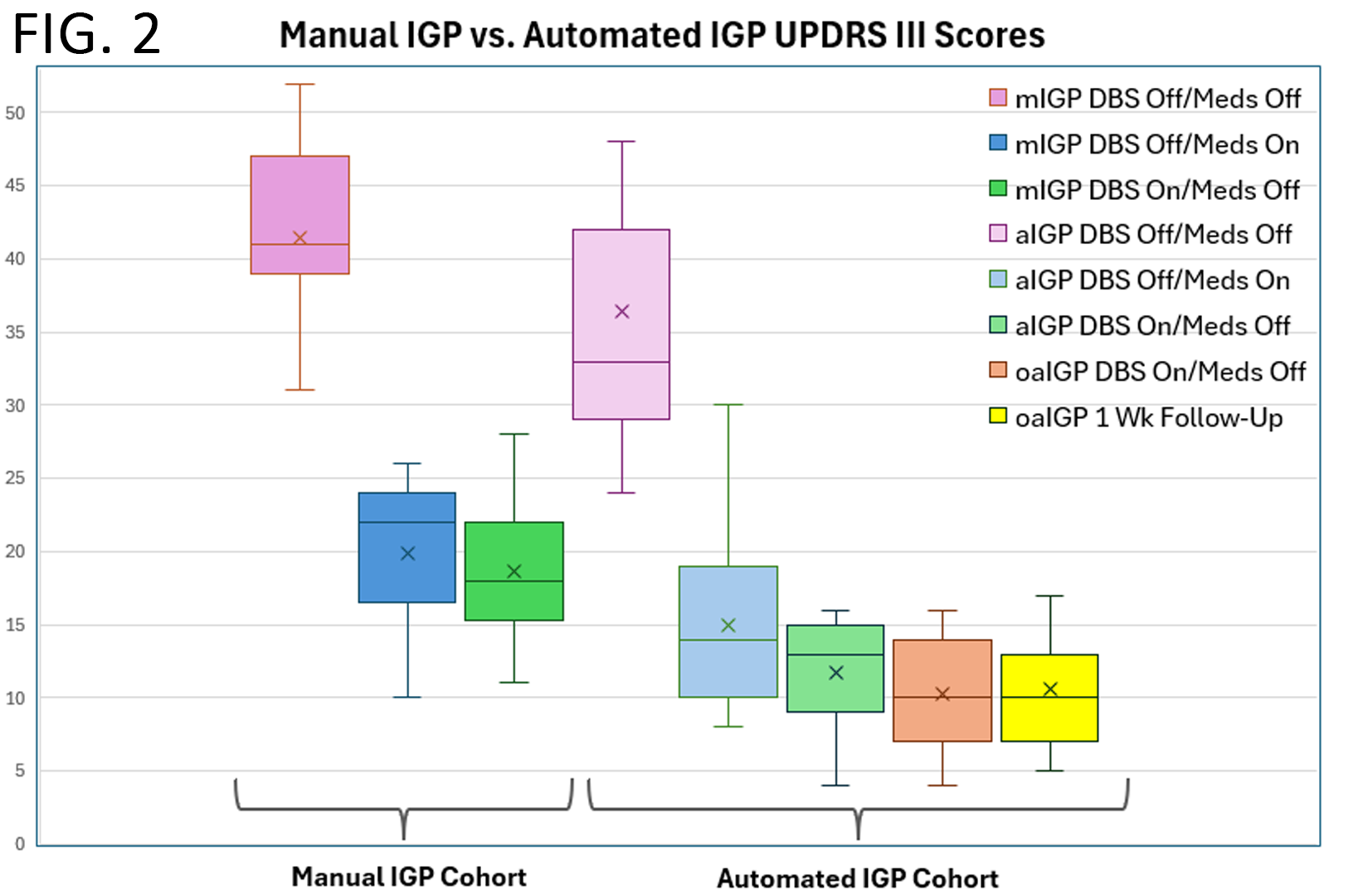
FIG. 2
References: 1. Lange Et al. (2021). Reduced Programming Time and Strong Symptom Control Even in Chronic Course Through Imaging-Based DBS Programming. Frontiers in Neurology.
2. Aldred, Et al. (2024). Assessment of lmage-guided Programming (IGP) on Bilateral STN and GPi Deep Brain Stimulation Programming Time (P1-3.003). Neurology.
3. Aubignat M Et al. (2024). Imaging-Guided Subthalamic Nucleus Deep Brain Stimulation Programming for Parkinson Disease: A Real-Life Pilot Study. Neurol Clin Pract.
4. Torres V Et al. (2024). Image-guided programming deep brain stimulation improves clinical outcomes in patients with Parkinson’s disease. NPJ Parkinsons Dis.
5. Umemura A Et al. (2025). Image-guided optimization of current steering in STN-DBS for Parkinson’s disease. Front Neurol.
6. Malekmohammadi M Et al. (2022). Automated optimization of deep brain stimulation parameters for modulating neuroimaging-based targets. J Neural Eng.
To cite this abstract in AMA style:
H. Lee, E. Crawford, R. Anderson, J. Dicicco, P. Stepan, R. Bargloski, M. Gourley. Automated Image-guided Programming for DBS Matches Expert Clinician Programming [abstract]. Mov Disord. 2026; 41 (suppl 1). https://www.mdsabstracts.org/abstract/automated-image-guided-programming-for-dbs-matches-expert-clinician-programming/. Accessed October 1, 2026.« Back to 2026 International Congress
MDS Abstracts - https://www.mdsabstracts.org/abstract/automated-image-guided-programming-for-dbs-matches-expert-clinician-programming/