
Category: Huntington's Disease
Objective: To determine whether ERP markers of anticipatory semantic prediction and post-target integration detect early functional brain changes in asymptomatic Huntingtin gene-expansion carriers (HGEC) compared with healthy controls
Background: Early dysfunction of fronto-striatal circuits in Huntington’s disease (HD) may disrupt predictive processes. Language comprehension relies strongly on predictive mechanisms, making linguistic tasks particularly sensitive to subtle brain changes. Semantic prediction ERP paradigms allow dissociating anticipatory prediction-related negativities preceding an expected word and the post-target N400 associated with semantic integration
Method: We studied 21 asymptomatic HGEC (HD-ISS 0/1) and 16 healthy controls. EEG was recorded during a sentence-reading task to assess predictive negative potential (PNP) before target onset and N400 after target onset. ERP amplitudes were analyzed with age-adjusted linear mixed-effects models across regions of interest and conditions (highly vs low constrained contexts with congruent or incongruent target words). We also compared the ability of ERP-derived measures and striatal volumes to discriminate HGEC from controls using logistic regression and ROC analyses
Results: N400 amplitudes showed the expected condition effect in centroparietal and central regions (both p<0.001), with no group effect or group×condition interaction. In contrast, PNP revealed significant group×condition interactions for the high versus low constraint contrast in frontocentral (χ²=5.13, p=0.024) and central regions (χ²=5.16, p=0.023). HGEC showed greater pre-target negativity for highly constrained contexts, whereas controls showed no reliable effect. This difference was strongest in the final pre-target window (-200 to 0 ms) [figure1]. PNP-derived models significantly discriminated HGEC from controls (frontocentral OR=0.28, p=0.033, AUC=0.845; central OR=0.21, p=0.019, AUC=0.857), whereas caudate (OR=0.71, p=0.367, AUC=0.761)) and putamen (OR=0.73, p=0.460, AUC=0.761) volumes showed lower discrimination
Conclusion: Asymptomatic HGEC show increased anticipatory neural activity during semantic prediction while post-target N400 remains preserved. This pattern outperformed striatal volumes in discriminating HGEC from controls and may reflect greater recruitment of predictive processes, possibly related to early inefficiency in fronto-striatal circuits
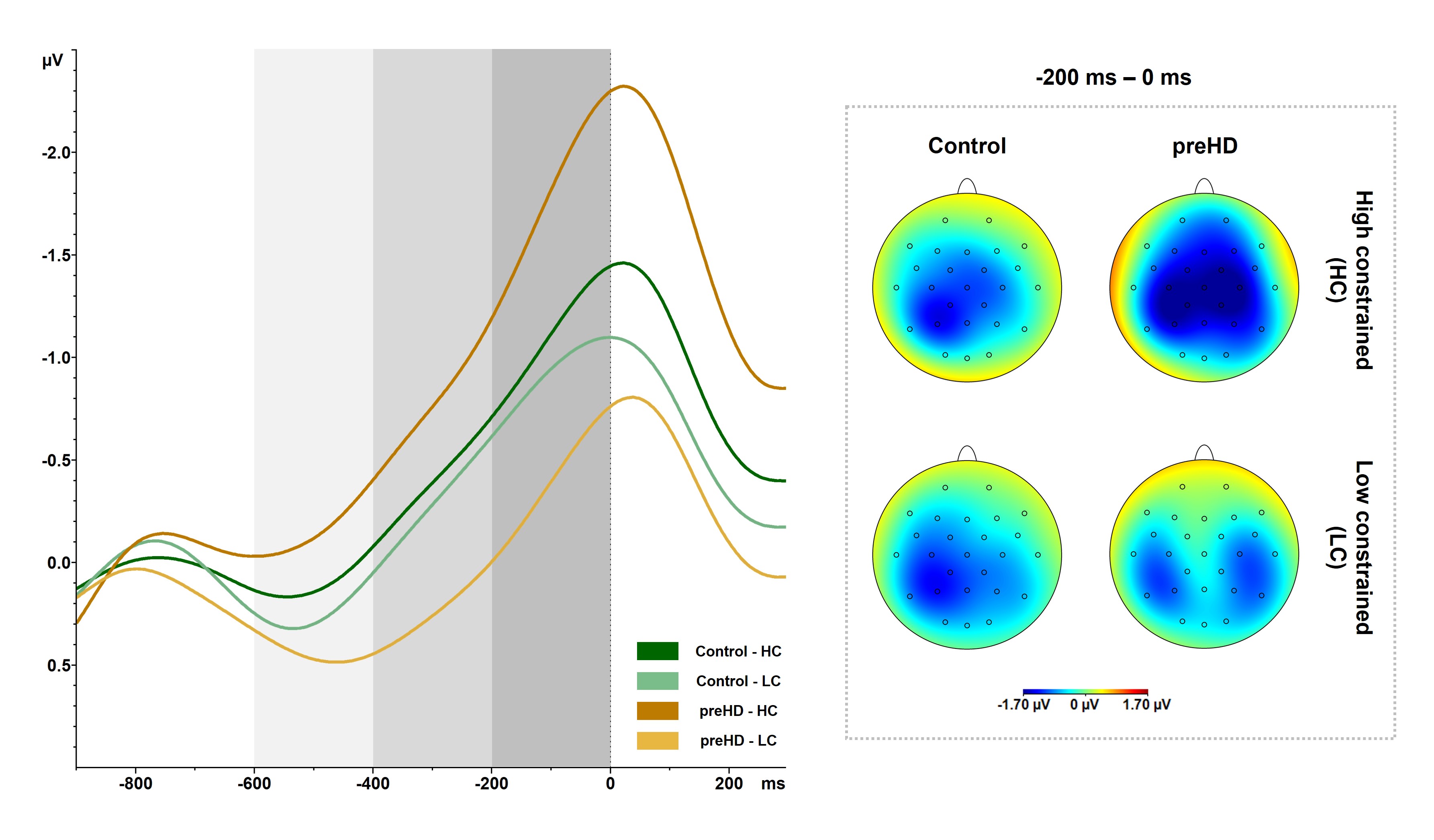
Figure 1
To cite this abstract in AMA style:
A. Puig-Davi, L. Perez-Carasol, C. Franch-Marti, J. Perez-Perez, G. Olmedo-Saura, J. Rodriguez-Antiguedad, L. Bojtos, I. Ruiz-Barrio, J. Pagonabarraga, J. Kulisevsky, S. Martinez-Horta. Anticipatory Language Prediction ERPs Detect Early Neurophysiological Changes in Asymptomatic Huntington’s Disease [abstract]. Mov Disord. 2026; 41 (suppl 1). https://www.mdsabstracts.org/abstract/anticipatory-language-prediction-erps-detect-early-neurophysiological-changes-in-asymptomatic-huntingtons-disease/. Accessed October 1, 2026.« Back to 2026 International Congress
MDS Abstracts - https://www.mdsabstracts.org/abstract/anticipatory-language-prediction-erps-detect-early-neurophysiological-changes-in-asymptomatic-huntingtons-disease/