
Category: MSA, PSP, CBS: Neuroimaging
Objective: To characterize the clinical profile, disease progression, and their associations with neuroimaging biomarkers in patients with Progressive Supranuclear Palsy (PSP).
Background: PSP encompasses a spectrum of clinical phenotypes beyond the classical Richardson syndrome (PSP-RS), with heterogeneous clinical progression. However, the relationship between neuroimaging biomarkers and disease severity or progression remains incompletely understood.
Method: Twenty-five patients with possible or probable PSP were assessed for demographic data, predominant phenotype, disease milestones, the PSP Rating Scale (PSPRS), Addenbrooke’s Cognitive Examination–Revised (ACE-R), Frontal Assessment Battery (FAB), and Functional Activities Questionnaire (FAQ). Seventeen patients underwent brain FDG-PET and MRI on a hybrid PET/MRI scanner. Quantitative group analyses were performed using SPM12 and compared with 17 age-matched healthy controls using voxel-based methods. Regions showing significant metabolic differences between groups were identified, and the SUVr of each corresponding clusters cointaining the statistically significant voxels were extracted as regions of interest (ROIs) using the MarsBaR toolbox. Clinical–imaging associations were examined using linear regression models comparing clinical scores with regional ROIs, adjusted for age and education, and visualized using partial correlation analyses.
Results: Patients had a median age of 71 years (interquartile range [IQR] 66–75), and 11 (44%) were female. Median age at symptom onset was 66 years (IQR 61–71), and median disease duration was 4.7 years (IQR 3.3–5.9). Assessment scores showed median PSPRS 49 (IQR 24–60), ACE-R 72 (IQR 53–84), FAB 8 (IQR 5–13), and FAQ 16 (IQR 2–22). Within the 17 patients that underwent PET-MRI, adjusted linear regression analyses indicated that higher metabolic signal in the left supplementary motor area (SMA) was associated with lower PSPRS scores (β = −11.1, p = 0.027) [figure 1] and showed a trend toward lower functional impairment on the FAQ (β = −5.60, p = 0.051) [figure 2].
Conclusion: This preliminary analysis characterizes the clinical spectrum of an ongoing Brazilian PSP cohort and suggests that metabolic changes in the supplementary motor area may be associated with disease severity and functional impairment. Further analyses will investigate clinical, biofluid, and imaging biomarkers in this population.
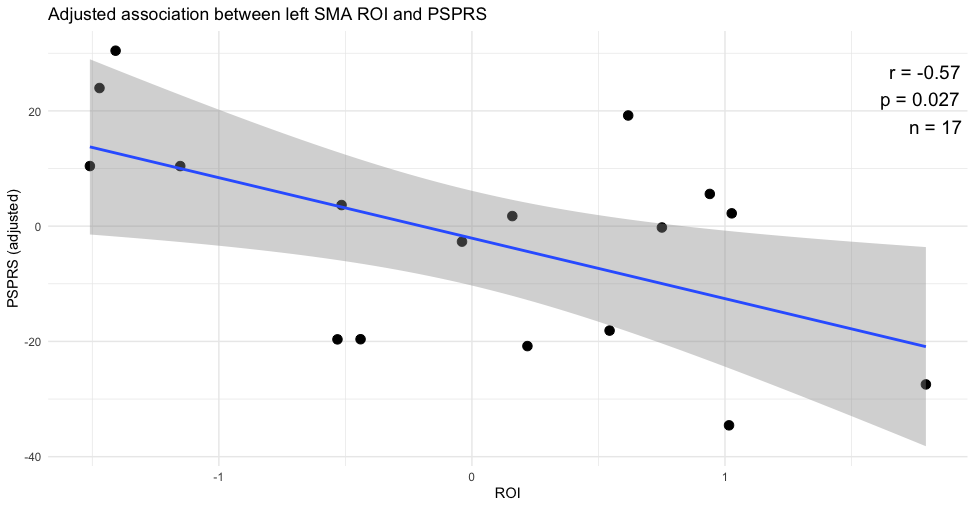
Figure 1
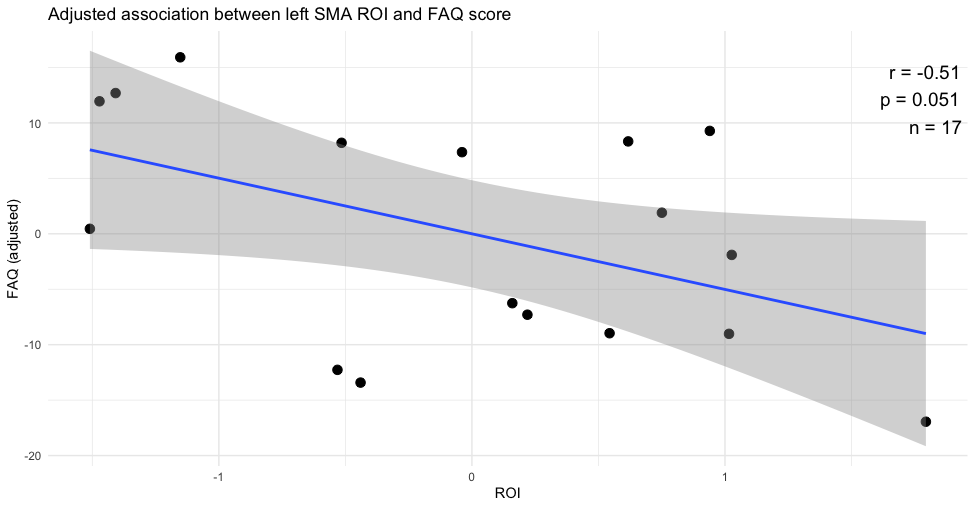
Figure 2
References: 1. Wang B, Wang H, Kang Y, et al. Spatial Metabolic Covariance Networks in Progressive Supranuclear Palsy: Implications for Symptomatology and Their Neural Basis. Mov Disord. 2026 Feb;41(2):478-488.
2. Ali F, Clark H, Machulda M, et al. Patterns of brain volume and metabolism predict clinical features in the progressive supranuclear palsy spectrum. Brain Commun. 2024 Jul 16;6(4):fcae233.
3. Wang H, Wang B, Liao Y, et al. Identification of metabolic progression and subtypes in progressive supranuclear palsy by PET molecular imaging. Eur J Nucl Med Mol Imaging. 2025 Feb;52(3):823-835.
To cite this abstract in AMA style:
M. Oliveira, V. Maciel, G. Martins, C. Carneiro, C. Buchpiguel, A. Coutinho, J. Parmera, E. Barbosa. Associations Between FDG-PET Regional Metabolism and Clinical Severity in Progressive Supranuclear Palsy [abstract]. Mov Disord. 2026; 41 (suppl 1). https://www.mdsabstracts.org/abstract/associations-between-fdg-pet-regional-metabolism-and-clinical-severity-in-progressive-supranuclear-palsy/. Accessed October 1, 2026.« Back to 2026 International Congress
MDS Abstracts - https://www.mdsabstracts.org/abstract/associations-between-fdg-pet-regional-metabolism-and-clinical-severity-in-progressive-supranuclear-palsy/