
Objective: TTo investigate the frequency, clinical characteristics, and disease trajectory of patients with MSA presenting without dysautonomia and to compare their course with patients showing autonomic involvement.
Background: MSA is a rare neurodegenerative disorder characterized by a varying spectrum of parkinsonism, cerebellar syndrome, and autonomic dysfunction. Neuropathologically, it is defined by glial cytoplasmic inclusions containing misfolded alpha-synuclein and degeneration of multiple neural systems.
The 2022 Movement Disorder Society (MDS) criteria introduced the possibility of diagnosing clinically probable MSA based solely on motor symptoms without dysautonomia. Under earlier criteria, patients with isolated parkinsonism or cerebellar syndrome would not have met the diagnostic threshold despite later pathological confirmation. Consequently, this subgroup has been underrepresented in natural history studies. This study examined the distribution and progression of MSA without autonomic dysfunction in an autopsy-confirmed cohort.
Method: A retrospective multicenter cohort of autopsy-confirmed MSA patients from international brain banks was analyzed. Only cases with sufficient longitudinal clinical documentation were included. Clinical data were extracted using standardized chart reviews according to the 2022 MDS-MSA criteria.
Patients were grouped by initial symptom complex: autonomic (A), parkinsonian (P), or cerebellar (C). Disease progression was assessed by analyzing the emergence of additional symptom complexes and the interval between onset and development of a second and later third symptom. Patients without dysautonomia were compared with matched patients with autonomic involvement.
Results: The cohort included 140 patients (mean onset age 62.3 ± 8.9 years; 44% female). At onset, 58% presented without dysautonomia.
Overall, 51% developed all three symptom complexes.
Twelve patients (9%) remained free of dysautonomia. Compared with matched patients with autonomic symptoms, they showed longer disease duration (8.1 ± 2.1 vs. 6.3 ± 2.6 years; p = 0.035).
Conclusion: A substantial proportion of MSA patients initially present without dysautonomia. A subgroup remains motor-dominant and shows longer disease duration, suggesting a potentially slower disease course. These findings support the expanded MDS-MSA criteria and highlight the importance of including motor-only MSA patients in future studies.
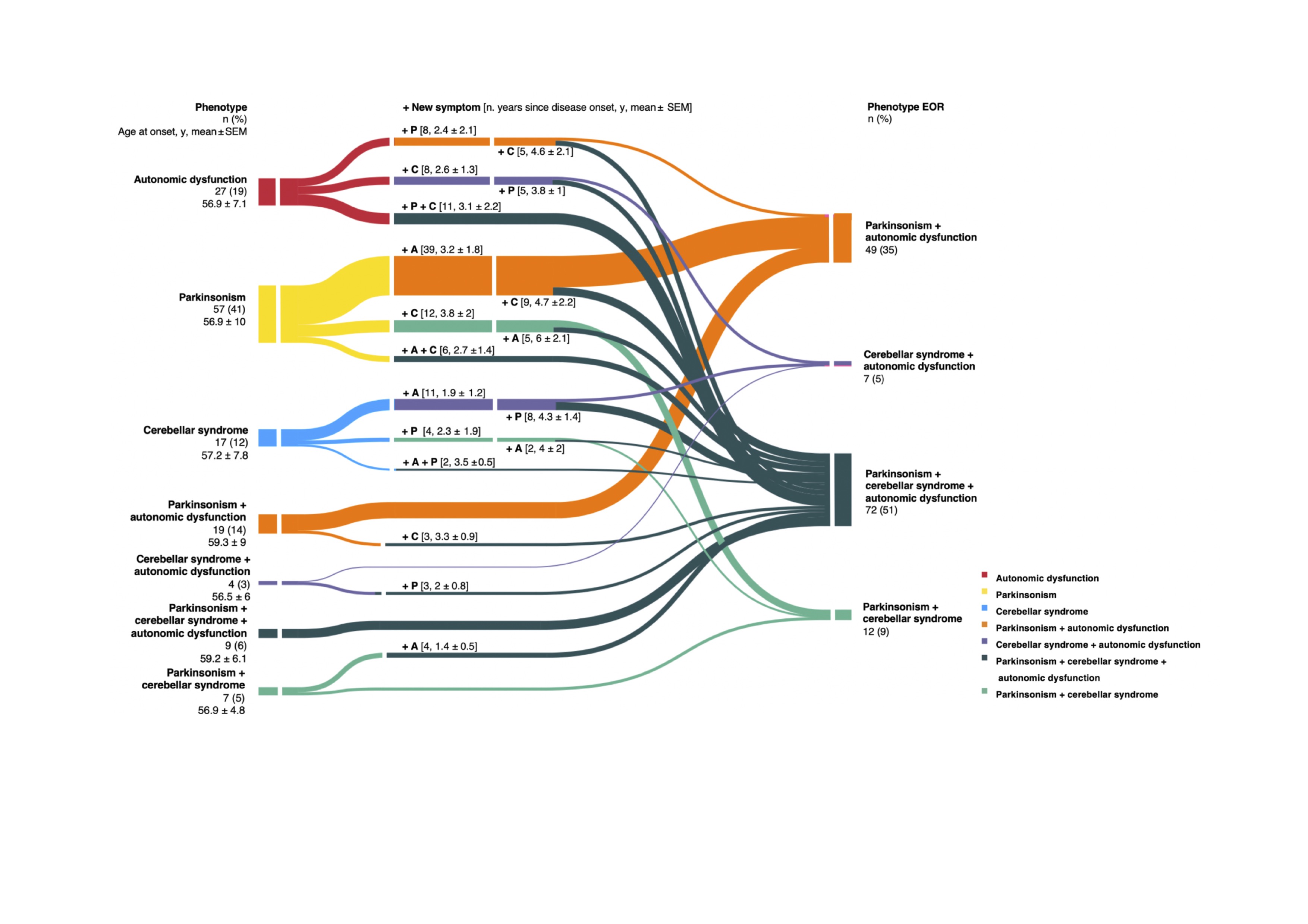
Development of Clinical MSA Phenotypes.
To cite this abstract in AMA style:
I. Wilkens, V. Ruf, Y. Compta, C. Troakes, J. Cohen, E. Lee, C. Nilsson, E. Englund, J. Levin, A. Pantelyat, J. Seemiller, S. Berger, J. van Swieten, E. Dopper, A. Rozemuller, G. Kovacs, N. Bendahan, A. Lang, G. Höglinger, F. Hopfner. Multiple System Atrophy Without Dysautonomia [abstract]. Mov Disord. 2026; 41 (suppl 1). https://www.mdsabstracts.org/abstract/multiple-system-atrophy-without-dysautonomia/. Accessed October 1, 2026.« Back to 2026 International Congress
MDS Abstracts - https://www.mdsabstracts.org/abstract/multiple-system-atrophy-without-dysautonomia/