
Category: Parkinson’s Disease: Clinical Trials
Objective: This study evaluates the characteristics of clinical studies in Parkinson’s disease to identify factors associated with early discontinuation.
Background: Clinical studies in Parkinson’s disease are vulnerable to discontinuation and failure to disseminate results, representing significant sources of research waste and limiting progress in evidence-based care. Understanding factors associated with trial discontinuation may help improve study design, resource allocation, and research transparency.
Method: We searched ClinicalTrials.gov for all clinical studies related to Parkinson’s disease registered up to February 2026. Data on enrollment size, study location, funding source, and intervention type were extracted. Factors associated with study discontinuation were evaluated using binomial logistic regression analysis.
Results: A total of 3,993 eligible clinical studies were identified. Of these, 3,608 (90.4%) were completed, while 385 (9.6%) were discontinued. Our analysis demonstrated that studies with small sample sizes (<100 participants) were significantly more likely to be discontinued (OR = 0.34, 95% CI 0.24–0.51; P < 0.001). No significant association was observed between discontinuation and study location (single-center vs. multicenter) (OR = 1.19, 95% CI 0.86–1.64; P = 0.30). Similarly, industry-funded studies did not significantly differ from non-industry funded studies regarding discontinuation risk (OR = 0.77, 95% CI 0.55–1.10; P = 0.15). Regarding intervention type, genetic studies demonstrated a higher likelihood of discontinuation compared with other intervention categories (OR = 3.6, 95% CI 1.1–11.8; P = 0.035).
Conclusion: A substantial proportion of Parkinson’s disease studies are discontinued early, with small sample size and genetic interventions being key predictors. Non-dissemination bias raises ethical concerns regarding participant risk without advancing knowledge. Strengthening feasibility planning, recruitment, and transparent reporting can reduce research waste and improve study impact.
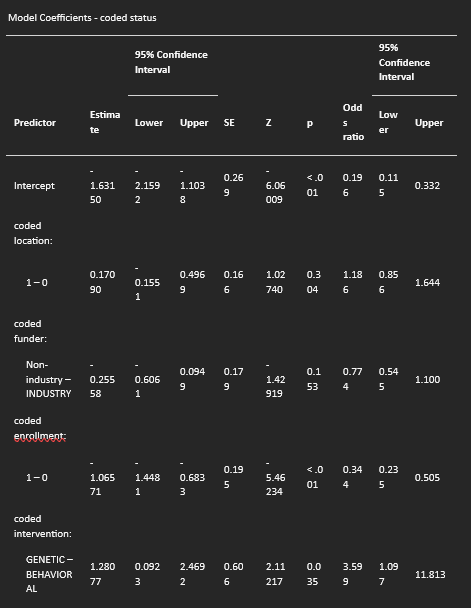
Figure 1
To cite this abstract in AMA style:
Y. Alnomani, A. Mady. Discontinuation of Parkinson’s Disease Clinical Studies: A Cross-Sectional Analysis [abstract]. Mov Disord. 2026; 41 (suppl 1). https://www.mdsabstracts.org/abstract/discontinuation-of-parkinsons-disease-clinical-studies-a-cross-sectional-analysis/. Accessed October 1, 2026.« Back to 2026 International Congress
MDS Abstracts - https://www.mdsabstracts.org/abstract/discontinuation-of-parkinsons-disease-clinical-studies-a-cross-sectional-analysis/