
Objective: To identify directional relationships among motor and non-motor symptoms in people with Parkinson’s disease (PD) using Bayesian Network analysis and to identify central variables that may serve as rehabilitation targets.
Background: PD involves complex interactions among motor impairment, fatigue, anxiety, depression, pain, sleep disturbance, cognition, and physical activity. Conventional correlation-based approaches can detect associations but cannot determine directionality. Bayesian Network analysis provides a framework for modeling conditional dependencies and identifying hub variables within multidomain symptom networks.
Method: Cross-sectional data from 54 individuals with idiopathic PD were analyzed. Variables included age, disease duration, physical activity, exercise behavior, walking capacity, balance, cognition, anxiety, depression, pain severity, pain interference, sleep quality, and fatigue. Bayesian Networks were estimated using the Hill-Climbing algorithm with Gaussian BIC scoring. Bootstrap analysis (100 resamples) assessed edge stability, and linear regression quantified relationship strengths.
Results: The PD network comprised 13 nodes and 16 directed edges, with 68.8% of edges showing bootstrap stability >50%. Anxiety emerged as the main hub, directly influencing total fatigue (β=2.248, p<0.001), pain interference (β=0.385, p<0.001), and balance (β=-1.250, p<0.001). Age directly predicted lower physical activity (β=-123.212, p<0.001) and poorer balance (β=-0.549, p<0.001). Pain interference was associated with greater pain severity and worse cognition.
Conclusion: Bayesian Network analysis identified anxiety as a central intervention target in PD, with links to fatigue, pain interference, and balance. Age also played an important role in physical activity and balance. These findings support personalized rehabilitation approaches targeting central hub variables in PD.
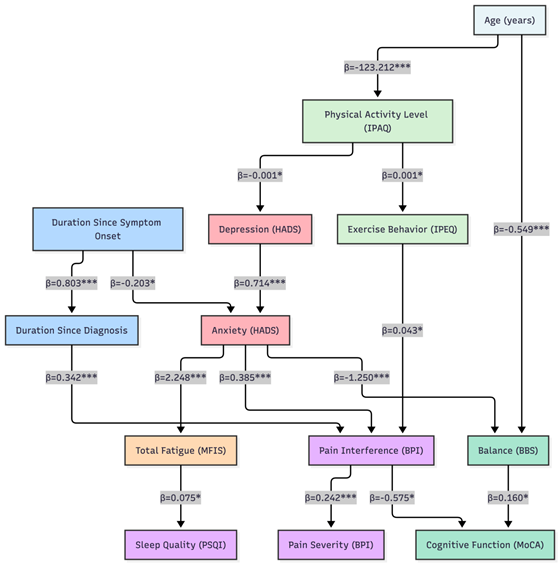
Bayesian Analysis Network of Parkinson’s cohort.
References: Kumaresan M, Khan S. Spectrum of Non-Motor Symptoms in Parkinson’s Disease. Cureus. 2021;13:e13275.
Bojtos L, Rodríguez-Antigüedad J, Pagonabarraga J, et al. Fatigue and neuropsychiatric symptoms in Parkinson’s disease: a narrative review. Front Neurol. 2025;16:1670644.
Deng Q, Duan Y, Yang Z, et al. Symptom Networks and Associations with Quality of Life in Patients with Early to Mid-Stage Parkinson’s Disease: A Network Analysis. Degener Neurol Neuromuscul Dis. 2025;15:101.
Bhalsing KS, Abbas MM, Tan LCS. Role of Physical Activity in Parkinson’s Disease. Ann Indian Acad Neurol. 2018;21:242.
Chaudhuri KR, Schapira AH. Non-motor symptoms of Parkinson’s disease: dopaminergic pathophysiology and treatment. Lancet Neurol. 2009;8:464–474.
Buhmann C, Wrobel N, Grashorn W, et al. Pain in Parkinson disease: a cross-sectional survey of its prevalence, specifics, and therapy. J Neurol. 2017;264:758–769.
To cite this abstract in AMA style:
A. Al-Sharman, H. Khalil, D. Malouche, S. Kanaan, M. Kim, N. Saad, M. Abdelrazeq. Bayesian Network Analysis of Directional Relationships Among Motor and Non-Motor Symptoms in Parkinson’s Disease [abstract]. Mov Disord. 2026; 41 (suppl 1). https://www.mdsabstracts.org/abstract/bayesian-network-analysis-of-directional-relationships-among-motor-and-non-motor-symptoms-in-parkinsons-disease/. Accessed October 1, 2026.« Back to 2026 International Congress
MDS Abstracts - https://www.mdsabstracts.org/abstract/bayesian-network-analysis-of-directional-relationships-among-motor-and-non-motor-symptoms-in-parkinsons-disease/