
Objective: To evaluate the association between serum vitamin D levels and clinical responsiveness to levodopa in patients with Parkinson disease and to explore potential relationships with gastrointestinal symptoms and disease severity.
Background: Vitamin D has been implicated in neuroprotective mechanisms and regulation of dopaminergic pathways. Vitamin D receptors are expressed in dopaminergic neurons of the substantia nigra, suggesting a potential role in the pathophysiology of Parkinson disease (PD). Previous studies have shown that vitamin D deficiency is common in PD and may be associated with increased disease risk, motor severity, and non-motor symptoms, including gastrointestinal dysfunction. However, the relationship between vitamin D status and responsiveness to dopaminergic therapy remains insufficiently explored.
Method: We conducted a cross-sectional study including 43 patients with Parkinson disease. Serum vitamin D levels were evaluated in relation to clinical response to levodopa therapy. Patients were categorized into two groups according to levodopa responsiveness: good response and reduced or absent response. Vitamin D levels were compared between groups using descriptive statistical analysis.
Results: Among the 43 patients included in the analysis, 18 demonstrated a good levodopa response, while 25 showed reduced or absent response. Patients with good levodopa responsiveness tended to have higher vitamin D levels compared with those with reduced response (mean 18.5 vs 16.7 ng/mL). Although the difference did not reach statistical significance, likely due to the modest sample size, a trend toward higher vitamin D levels in patients with better dopaminergic responsiveness was observed.
Conclusion: Lower vitamin D levels may be associated with reduced responsiveness to levodopa in Parkinson disease. Although preliminary, these findings suggest that vitamin D status may contribute to clinical variability in dopaminergic treatment response. Further studies with larger cohorts are needed to clarify the potential role of vitamin D in treatment outcomes and disease progression in PD.
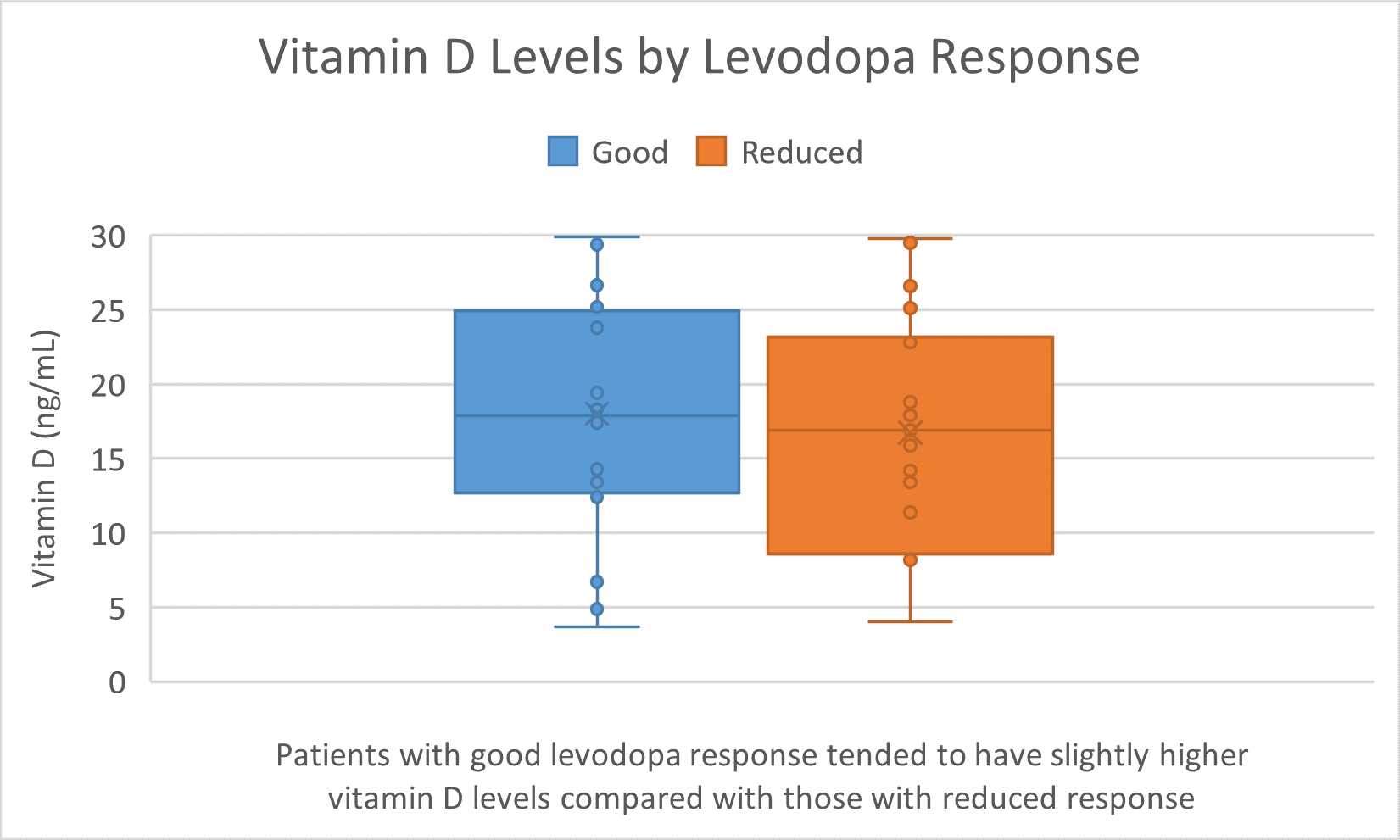
Vitamin D Levels by Levodopa Response
References: Suzuki M et al. Randomized Double Blind Trial of Vitamin D Supplementation in Parkinson Disease. American Journal of Clinical Nutrition. 2013.
Shen L, Ji HF. Vitamin D Deficiency and Parkinson Disease A Systematic Review and Meta Analysis. Neuroscience Letters. 2015.
Liu R et al. Vitamin D From Different Sources Is Inversely Associated With Parkinson Disease. Movement Disorders. 2015.
Zhang H et al. Association Between Vitamin D Status and Parkinson Disease A Meta Analysis. Neuroscience Letters. 2019.
Barichella M, Garrì F, Caronni S, Bolliri C, Zocchi L, Macchione MC, Ferri V, Calandrella D, Pezzoli G. Vitamin D Status and Parkinson’s Disease. Brain Sci. 2022 Jun 16;12(6):790. doi: 10.3390/brainsci12060790. PMID: 35741675; PMCID: PMC9221008.
To cite this abstract in AMA style:
G. Saidakhmetova, ZH. Myrzayev, G. Mussagaliyeva, D. Bagautdinov, CH. Shashkin. Vitamin D Status and Levodopa Responsiveness in Parkinson Disease and Association With Gastrointestinal Symptoms [abstract]. Mov Disord. 2026; 41 (suppl 1). https://www.mdsabstracts.org/abstract/vitamin-d-status-and-levodopa-responsiveness-in-parkinson-disease-and-association-with-gastrointestinal-symptoms/. Accessed October 1, 2026.« Back to 2026 International Congress
MDS Abstracts - https://www.mdsabstracts.org/abstract/vitamin-d-status-and-levodopa-responsiveness-in-parkinson-disease-and-association-with-gastrointestinal-symptoms/