
Category: Tremor
Objective: This study aims to describe the onset, etiology, phenomenology, treatments, treatment response, and outcomes in patients with Holmes tremor secondary to structural brain lesions.
Background: Holmes tremor is a rare movement disorder characterized by a low-frequency, resting, postural, and intention tremor. It typically develops weeks to years following injury to the dentato–rubro–thalamic pathway. While cerebrovascular disease is the most frequently reported etiology, infections, especially in tuberculosis-endemic regions, may also lead to it. However, reports from Southeast Asia, particularly Indonesia, are still limited.
Method: Three patients with Holmes tremor evaluated at a national referral center in Indonesia were included in this study. Clinical history, neurological examinations, tremor phenomenology, and neuroimaging findings were reviewed. Etiologies, treatments, treatment responses, and outcomes were analyzed.
Results: Three patients, aged 42 to 56 years, developed delayed tremor following structural brain lesions. In two cases, tremor developed after thalamic strokes, with onset ranging from one month to one year post-stroke. The third patient developed tremor several years after tuberculous meningitis. Neuroimaging revealed calcified lesions in the midbrain and pons, consistent with prior granulomatous infection. In all cases, tremor manifested contralateral to the brain lesion and predominantly affected the upper limb. The tremor consisted of a low-frequency resting, postural, and intentional component, with irregular amplitude, and worsened with voluntary or goal-directed movements, consistent with Holmes tremor features.
All patients received pharmacological treatment for symptom management with significant response; however, one patient required ventral intermediate nucleus (VIM) thalamotomy due to inadequate response to medication. Over approximately three years of follow-up, tremor severity remained stable. Two patients experienced mild impairments in daily activities, while one had moderate disability.
Conclusion: All Holmes tremor patients who were included in this study had lesions in critical regions of the dentato–rubro–thalamic pathway. Thalamic strokes were the most common etiology, whereas infection-related tremor had a longer latency to onset. Early diagnosis is very important and may facilitate a more accurate diagnosis, leading to comprehensive management.
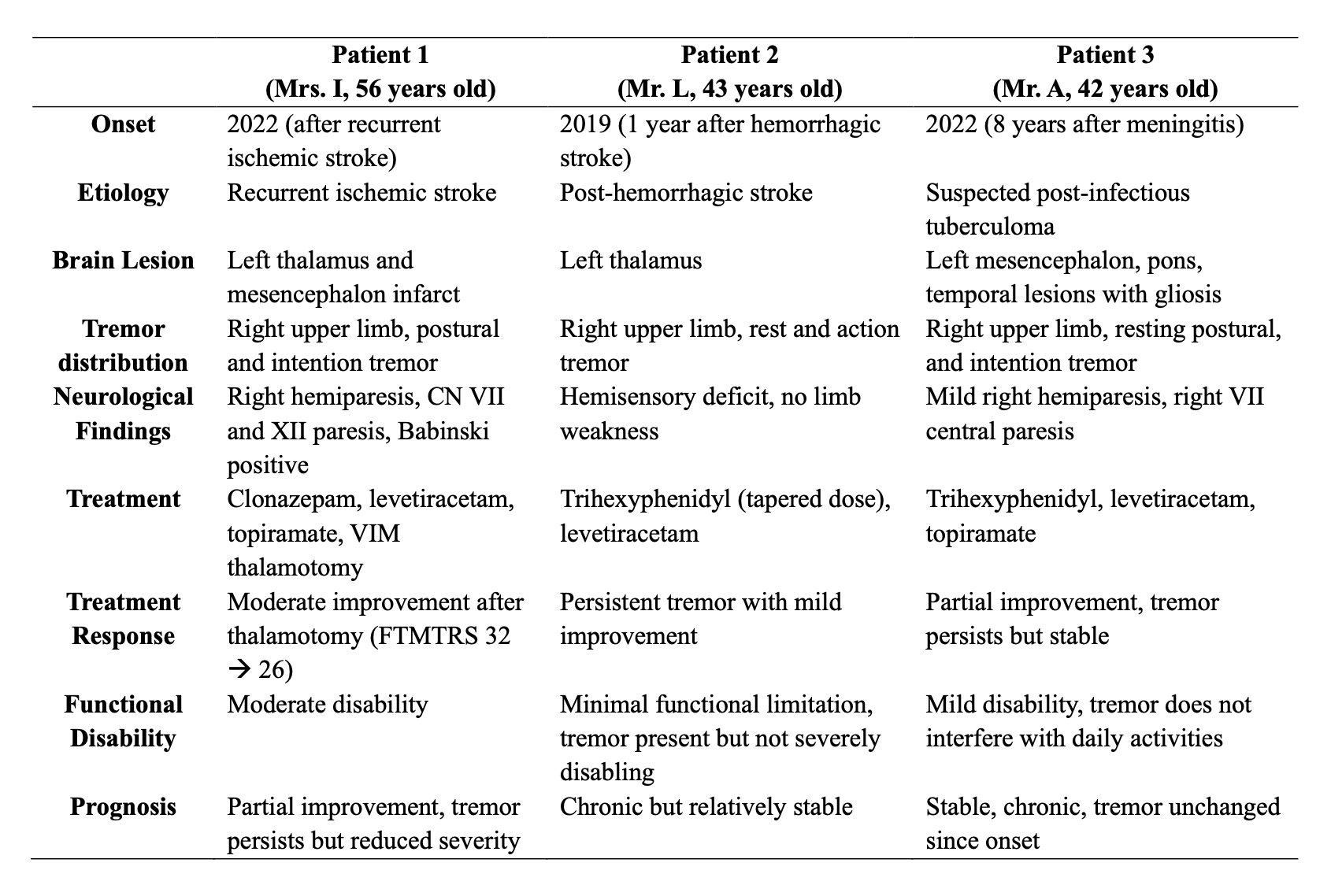
Summary of three case series of Holmes tremor
To cite this abstract in AMA style:
D. Prameswari, A. Tiksnadi, F. Abdat, D. Tunjungsari. Holmes Tremor Secondary to Structural Brain Lesions: A Case Series from a Tertiary National Referral Hospital [abstract]. Mov Disord. 2026; 41 (suppl 1). https://www.mdsabstracts.org/abstract/holmes-tremor-secondary-to-structural-brain-lesions-a-case-series-from-a-tertiary-national-referral-hospital/. Accessed October 1, 2026.« Back to 2026 International Congress
MDS Abstracts - https://www.mdsabstracts.org/abstract/holmes-tremor-secondary-to-structural-brain-lesions-a-case-series-from-a-tertiary-national-referral-hospital/