
Objective: This study aimed to assess the prevalence of olfactory dysfunction in patients with Parkinson’s disease using the Alcohol Sniff Test in a single-center clinical setting.
Background: Olfactory dysfunction is a common non-motor symptom of Parkinson’s Disease. However, studies in Indonesian patients remain limited, where practical tools such as the Alcohol Sniff Test are locally used for olfactory assessment.
Method: This single-center descriptive observational study included 30 patients diagnosed with Parkinson’s Disease between October and December 2025. Olfactory function was assessed using the Alcohol Sniff Test and classified as anosmia, hyposmia, or normosmia. Clinical characteristics evaluated included sex, age, body mass index (BMI), disease duration, Hoehn and Yahr Scale stage, Montreal Cognitive Assessment Indonesian Version score, Unified Parkinson’s Disease Rating Scale Part III score, and non-motor symptoms assessed using a locally adapted Indonesian assessment tool.
Results: Thirty patients were included with a mean age of 60.23 ± 10.56 years; 16 (53.3%) were male. Thirteen patients (43.3%) were overweight. Disease duration ranged from 0.8 to 19 years (median 4 years), and most patients were at stage 2 of the Hoehn and Yahr Scale (53.3%). Olfactory dysfunction was identified in 11 patients (36.7%), including 10 with hyposmia (90.9%) and one with anosmia (9.1%) (Table1). The mean Montreal Cognitive Assessment Indonesian Version score was lower in patients with olfactory dysfunction (18.18 ± 4.26) compared with those without (20.63 ± 4.17). The mean Unified Parkinson’s Disease Rating Scale Part III score was higher in patients with olfactory dysfunction (30.26 ± 19.05) than in those without (17.73 ± 15.26). Patients with olfactory dysfunction showed the highest non-motor symptom scores in the attention/memory (27.3%) and urinary (27.3%) domains, whereas those without olfactory dysfunction had the highest scores in the perceptual mood/cognition (26.3%) and sleep/fatigue (26.3%) domains.
Conclusion: The Alcohol Sniff Test identified a relatively low prevalence of olfactory dysfunction in patients with Parkinson’s Disease compared with global reports. These findings highlight the need for culturally appropriate olfactory assessment tools using locally familiar odors in Indonesia.
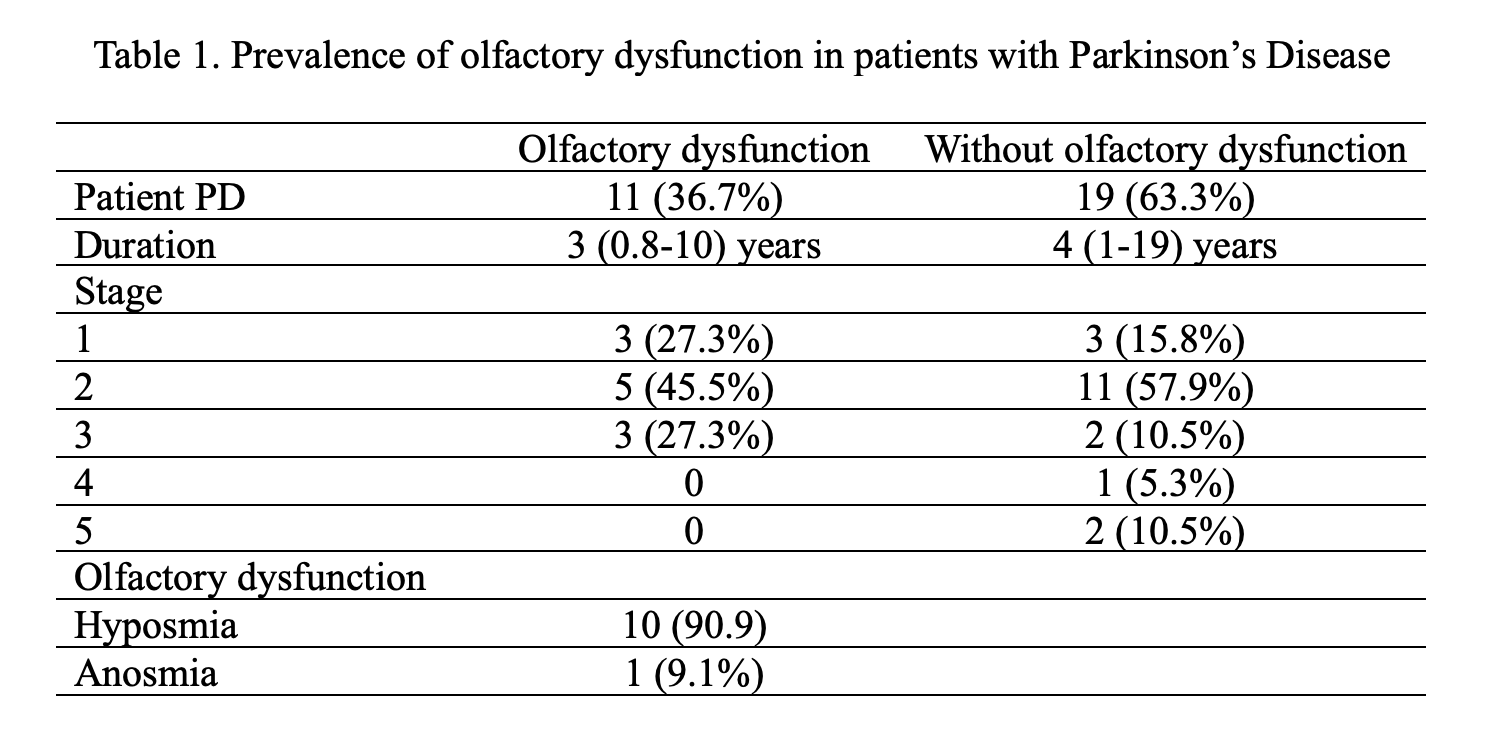
Table 1.
To cite this abstract in AMA style:
S. Marisdina, U. Manurung. Olfactory Dysfunction in Parkinson’s Disease: A Single-Center Study Using the Alcohol Sniff Test [abstract]. Mov Disord. 2026; 41 (suppl 1). https://www.mdsabstracts.org/abstract/olfactory-dysfunction-in-parkinsons-disease-a-single-center-study-using-the-alcohol-sniff-test/. Accessed October 1, 2026.« Back to 2026 International Congress
MDS Abstracts - https://www.mdsabstracts.org/abstract/olfactory-dysfunction-in-parkinsons-disease-a-single-center-study-using-the-alcohol-sniff-test/