
Objective: Identify Parkinson’s Disease (PD) prognostic subtypes using baseline fluid biomarkers.
Background: Machine learning has enabled approaches to clustering PD subjects into subgroups based on shared characteristics [1-6] with only a small subset using fluid biomarkers in combination with complex datasets for prediction modeling of clinical outcomes [7,8]. We hypothesized that machine learning could prognostically cluster PD subjects based on baseline fluid biomarkers independent of baseline clinical data.
Method: Utilized baseline and one-year serum and CSF biomarkers from early state PD participants of the PPMI cohort [9]. The K-means for joint longitudinal data (klm3D) cluster model included normalized baseline and a one-year change in fluid biomarkers concentration after removal of highly correlated biomarkers [10]. Two clusters Cluster were defined based on the Calinski Harabatz score [11]. Cluster validation was performed using a fitted linear mixed effects models with p-value correction for motor and non-motor outcomes over a 13 year follow up.
Results: There were significant differences between clusters for CSF biomarkers including amyloid beta (ABeta 1-42), alpha-synuclein, and phosphorylated Tau (pTau) concentrations at baseline and one year, with lower values for Cluster A (n = 209) compared to higher values for Cluster B (n = 70), with no significant difference in the only serum biomarker (NfL).Between Cluster A and B, there were significant changes in total scores per year between clusters over a 13 year follow up for MOCA (Montreal Cognitive Assessment), ESS (Epworth Sleepiness Scale), QUIP (Questionnaire for Impulsive-Compulsive Disorders in Parkinson’s Disease), SFTANIM (Semantic Fluency Animals Only), NPIRTOT (MDS-UPDRS PI Rater Completed items 1 to 6), NPIPTOT (MDS-UPDRS PI Patient Questionnaire items 7 to 13), as well as the MSEALDG (Modified Schwab England Activities of Daily Living) with Cluster B showing worse outcomes across all significant measures except for NPIPTOT (Figure 2).
Conclusion: Independent of baseline clinical data, the classifier identified concentrations of ABeta 1-42, alpha-synuclein, and phosphorylated Tau to be the main features which predicted clinical decline. This is consistent with prior literature which observed that coexistence of multiple neuropathological changes is associated with poorer clinical outcomes during life [12-14].
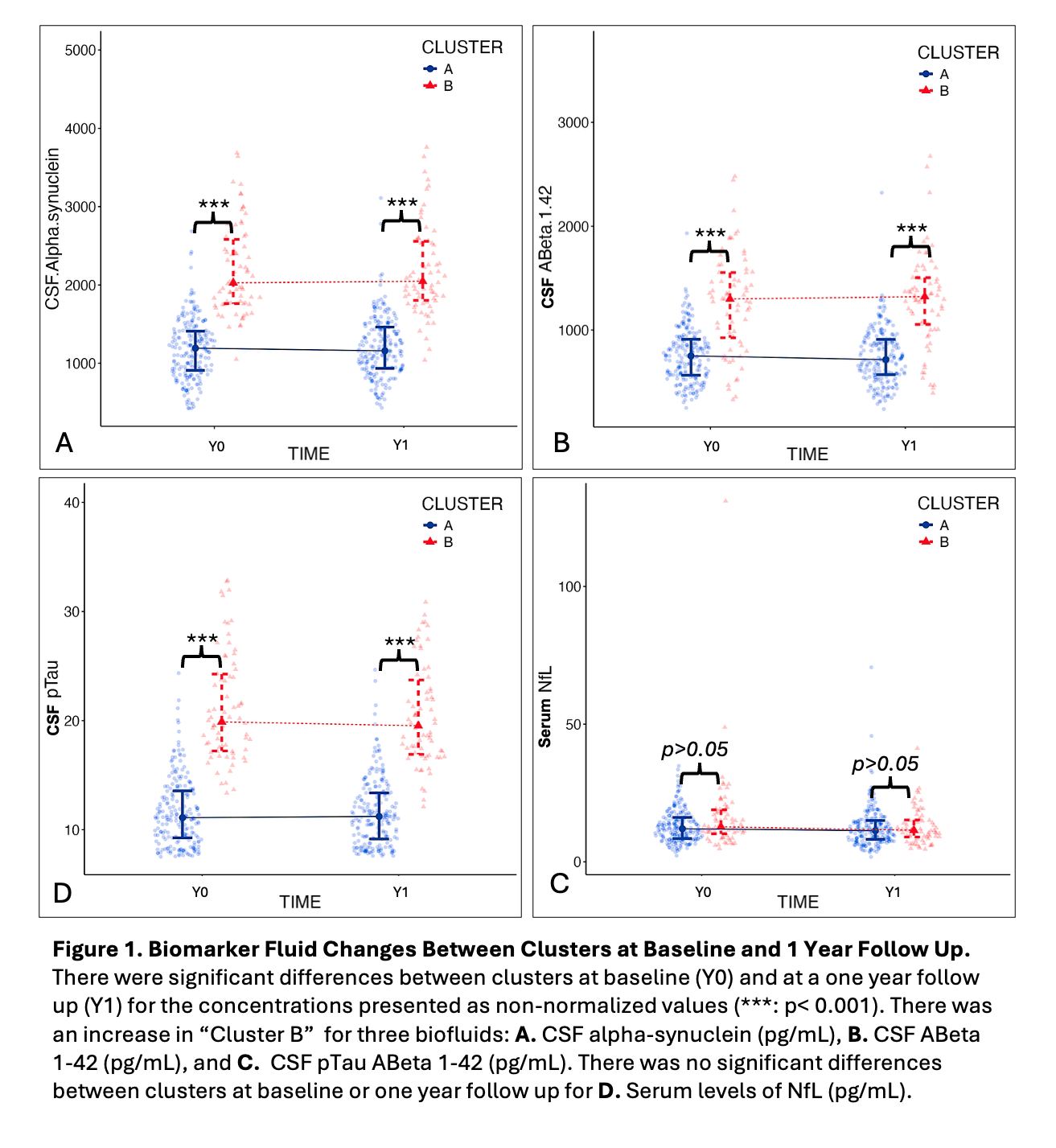
Biomarker Changes Between Clusters BL and 1 Year
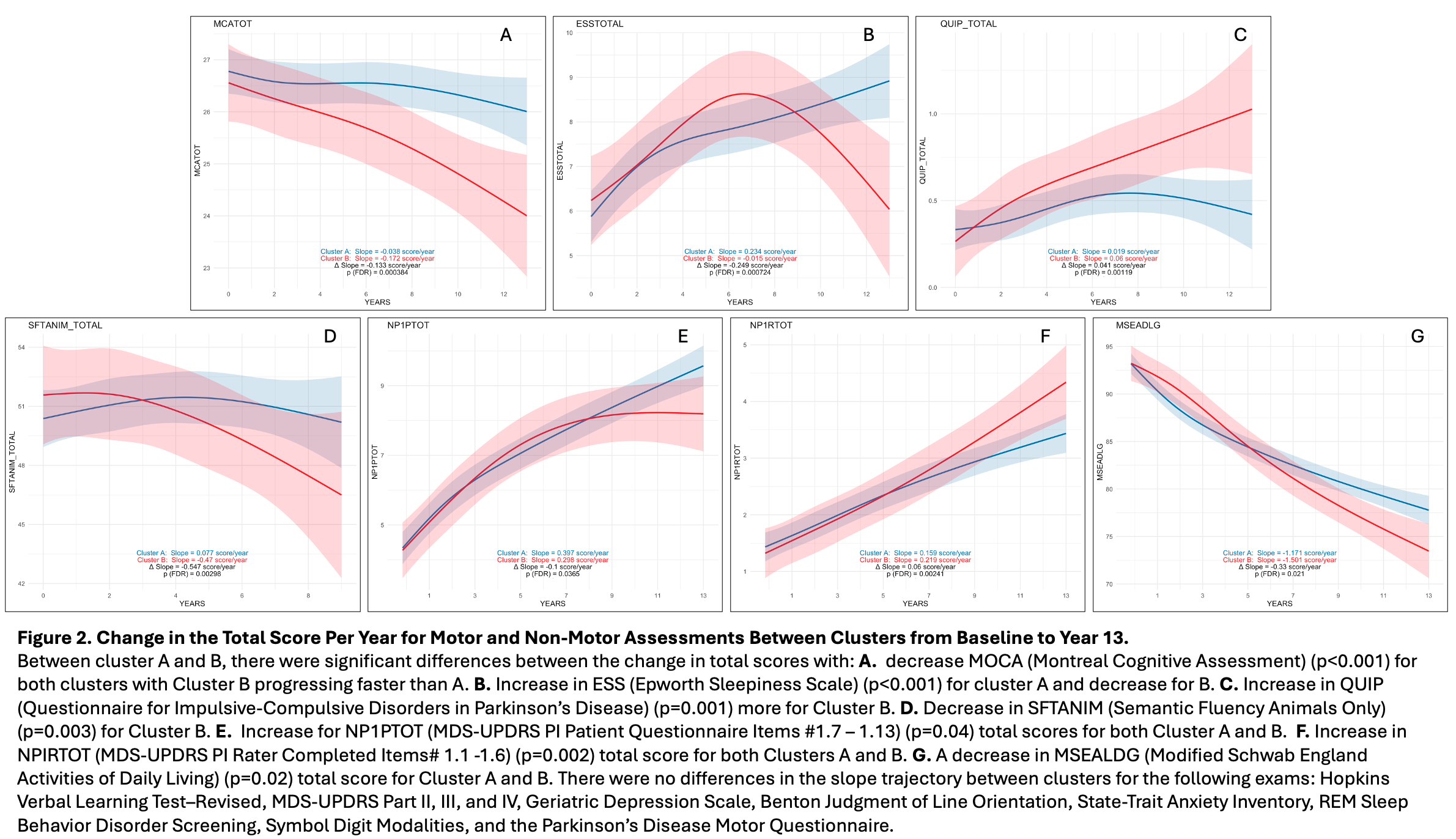
Motor & Non-Motor Assessments Between Clusters
References: [1]. Lawton M, Ben-Shlomo Y, May MT, et al. Developing and validating Parkinson’s disease subtypes and their motor and cognitive progression. J Neurol Neurosurg Psychiatry. 2018;89(12):1279-1287. doi:10.1136/jnnp-2018-318337.
[2]. Lewis, S. J. G., Foltynie, T., Blackwell, A. D., Robbins, T. W., Owen, A. M., & Barker, R. A. (2005). Heterogeneity of Parkinson’s disease in the early clinical stages using a data driven approach. Journal of Neurology, Neurosurgery, and Psychiatry, 76(3), 343–348. https://doi.org/10.1136/jnnp.2003.033530
[3]. Factor, S. A., Scullin, M. K., Sollinger, A. B., Land, J. O., Wood-Siverio, C., Zanders, L., Freeman, A., Bliwise, D. L., & Goldstein, F. C. (2014). Freezing of gait subtypes have different cognitive correlates in Parkinson’s disease. Parkinsonism & Related Disorders, 20(12), 1359–1364. https://doi.org/10.1016/j.parkreldis.2014.09.023
[4]. Lawton, M., Ben-Shlomo, Y., May, M. T., Baig, F., Barber, T. R., Klein, J. C., Swallow, D. M. A., Malek, N., Grosset, K. A., Bajaj, N., Barker, R. A., Williams, N., Burn, D. J., Foltynie, T., Morris, H. R., Wood, N. W., Grosset, D. G., & Hu, M. T. M. (2018). Developing and validating Parkinson’s disease subtypes and their motor and cognitive progression. Journal of Neurology, Neurosurgery, and Psychiatry, 89(12), 1279–1287. https://doi.org/10.1136/jnnp-2018-318337
[5]. Johansson, M. E., van Lier, N. M., Kessels, R. P. C., Bloem, B. R., & Helmich, R. C. (2023). Two-year clinical progression in focal and diffuse subtypes of Parkinson’s disease. NPJ Parkinson’s Disease, 9(1), 29. https://doi.org/10.1038/s41531-023-00466-4
[6]. Eisinger, R. S., Martinez-Ramirez, D., Ramirez-Zamora, A., Hess, C. W., Almeida, L., Okun, M. S., & Gunduz, A. (2020). Parkinson’s disease motor subtype changes during 20 years of follow-up. Parkinsonism & Related Disorders, 76, 104–107. https://doi.org/10.1016/j.parkreldis.2019.05.024
[7]. Dadu, A., Satone, V., Kaur, R., Hashemi, S. H., Leonard, H., Iwaki, H., Makarious, M. B., Billingsley, K. J., Bandres‐Ciga, S., Sargent, L. J., Noyce, A. J., Daneshmand, A., Blauwendraat, C., Marek, K., Scholz, S. W., Singleton, A. B., Nalls, M. A., Campbell, R. H., & Faghri, F. (2022). Identification and prediction of Parkinson’s disease subtypes and progression using machine learning in two cohorts. Npj Parkinson’s Disease, 8(1), Article 1. https://doi.org/10.1038/s41531-022-00439-z
[8]. Shakya, S., Prevett, J., Hu, X., & Xiao, R. (2022). Characterization of Parkinson’s Disease Subtypes and Related Attributes. Frontiers in Neurology, 13, 810038. https://doi.org/10.3389/fneur.2022.810038
[9] Parkinson Progression Marker Initiative. The Parkinson Progression Marker Initiative (PPMI). Prog Neurobiol. 2011 Dec;95(4):629-35. doi: 10.1016/j.pneurobio.2011.09.005. Epub 2011 Sep 14. PMID: 21930184; PMCID: PMC9014725.
[10]. Genolini, C., Alacoque, X., Sentenac, M., & Arnaud, C. (2015). kml and kml3d: R Packages to Cluster Longitudinal Data. Journal of Statistical Software, 65(4), 1–34. https://doi.org/10.18637/jss.v065.i04
[11]. Calinski, T. and Harabasz, J. (1974) A Dendrite Method for Cluster Analysis: Communications in Statistics. Theory and Methods, 3, 1-27.
http://dx.doi.org/10.1080/03610927408827101
[12]. Irwin DJ, Lee VM, Trojanowski JQ. Parkinson’s disease dementia: convergence of α-synuclein, tau and amyloid-β pathologies. Nat Rev Neurosci. 2013 Sep;14(9):626-36. doi: 10.1038/nrn3549. Epub 2013 Jul 31. PMID: 23900411; PMCID: PMC4017235.
[13]. De Pablo-Fernández E, Lees AJ, Holton JL, Warner TT. Prognosis and Neuropathologic Correlation of Clinical Subtypes of Parkinson Disease. JAMA Neurol. 2019;76(4):470–479. doi:10.1001/jamaneurol.2018.4377
[14]. Terrelonge M Jr, Marder KS, Weintraub D, Alcalay RN. CSF β-Amyloid 1-42 Predicts Progression to Cognitive Impairment in Newly Diagnosed Parkinson Disease. J Mol Neurosci. 2016 Jan;58(1):88-92. doi: 10.1007/s12031-015-0647-x. Epub 2015 Sep 2. PMID: 26330275; PMCID: PMC4738011.
To cite this abstract in AMA style:
C. Mcintyre, N. Maki, J. Li, J. Ruiz Tejeda, R. Rajmohan, N. Phielipp. Identifying Parkinson’s Disease Subtypes Using Fluid Biomarkers Clustering in the PPMI Cohort [abstract]. Mov Disord. 2026; 41 (suppl 1). https://www.mdsabstracts.org/abstract/identifying-parkinsons-disease-subtypes-using-fluid-biomarkers-clustering-in-the-ppmi-cohort/. Accessed October 1, 2026.« Back to 2026 International Congress
MDS Abstracts - https://www.mdsabstracts.org/abstract/identifying-parkinsons-disease-subtypes-using-fluid-biomarkers-clustering-in-the-ppmi-cohort/