
Category: Palliative Care
Objective: This study evaluates the effectiveness of structured outpatient palliative care combined with standard care compared to standard care alone at 3 and 6 months for individuals with atypical Parkinsonian syndrome (APS).
Background: While outpatient palliative care has shown benefits in Parkinson’s disease, its role in APS remains unexplored. Given the rapid disease progression and complex care needs in APS, evaluating a structured outpatient palliative care model is essential to address unmet clinical and caregiver needs.
Method:
This pragmatic, randomised, single-centre, open-label, controlled trial with blinded endpoint assessment (PROBE) involves 150 adults with clinically established or probable APS (as per the diagnostic criteria) and significant palliative needs [Figure 1]. Participants will be randomly assigned in a 1:1 ratio to receive either standard neurological care alone or structured outpatient palliative care in addition to standard treatment. The multidisciplinary team will deliver the intervention every three months over six months [Figure 2], focusing on systematic symptom assessment, personalised management of physical and psychosocial concerns, caregiver counselling, and supportive care planning. The primary outcomes are changes in quality of life, measured by the PDQ-39, and caregiver burden, measured by the ZBI. Secondary outcomes include symptom burden (ESAS-PD), psychological distress (HADS), caregiver satisfaction(FAMCARE-6), motor severity (MDS-UPDRS), global clinical improvement (CGI-I), and healthcare utilization [Figure 3]. Data analysis will follow intention-to-treat principles with appropriate statistical comparisons.
Results: The study has received approval from the Institutional Ethics Committee of the All-India Institute of Medical Sciences (AIIMS/SA5438) and is registered with the Clinical Trials Registry of India (CTRI/2026/01/100316). Participant recruitment began in March 2026 and will continue until mid-2028.
Conclusion: This is the first randomised controlled trial of multidisciplinary outpatient neuropalliative care focusing solely on individuals with APS. By assessing both patient-centred and caregiver-centred outcomes, the study could inform future care models and help integrate palliative care into routine management pathways for APS, especially in resource-limited health systems.
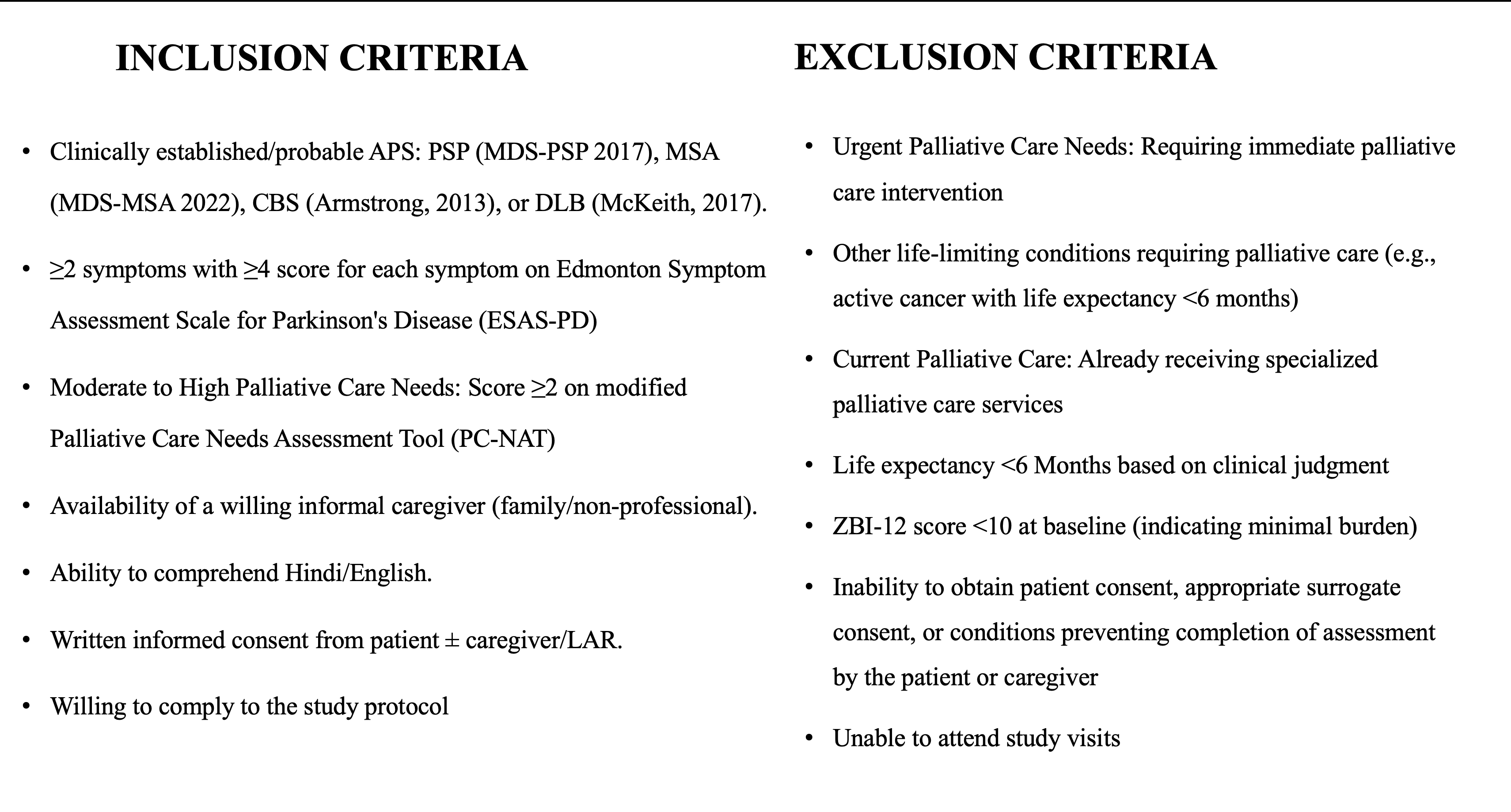
Inclusion and Exclusion Criteria
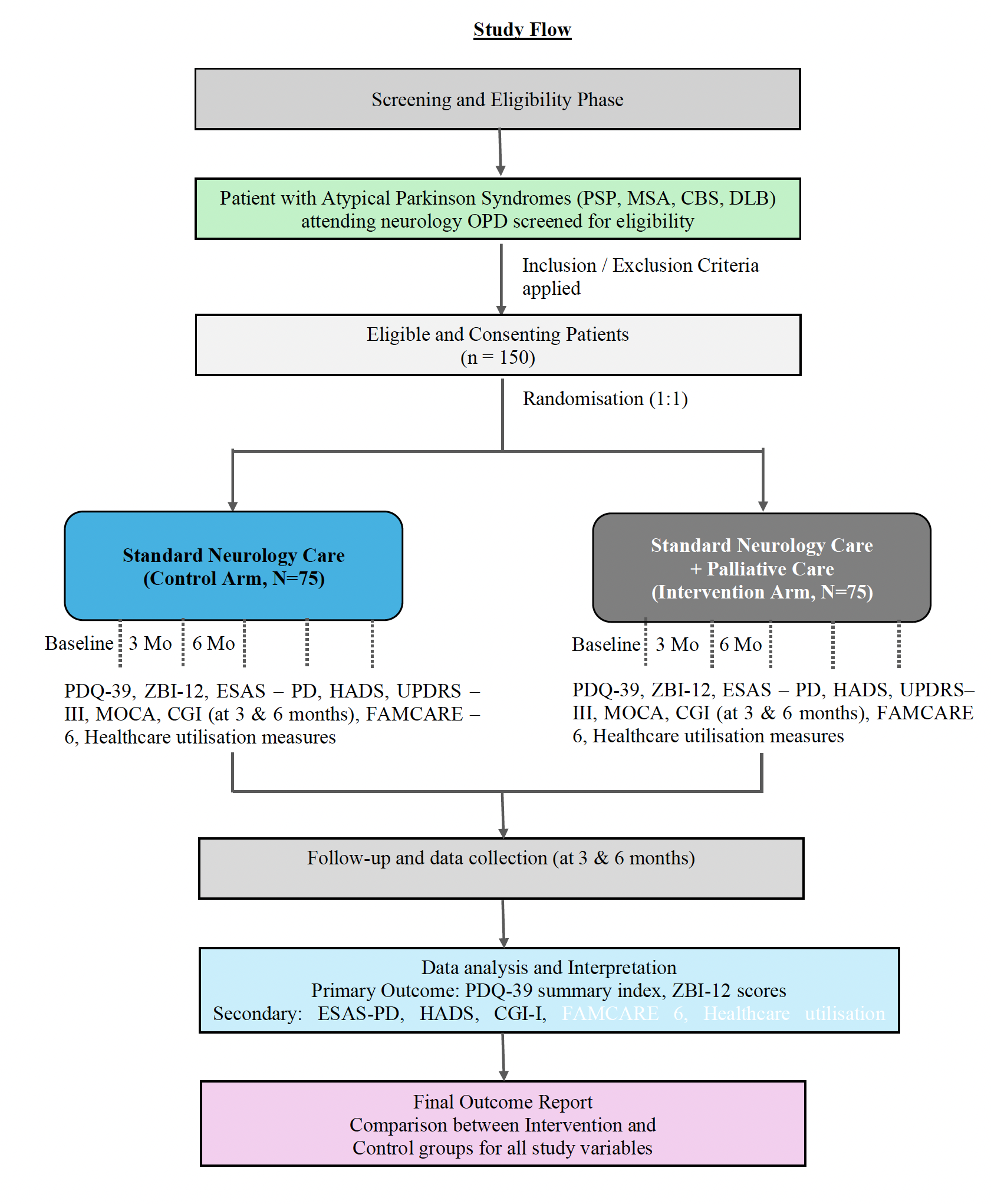
Study Flowchart
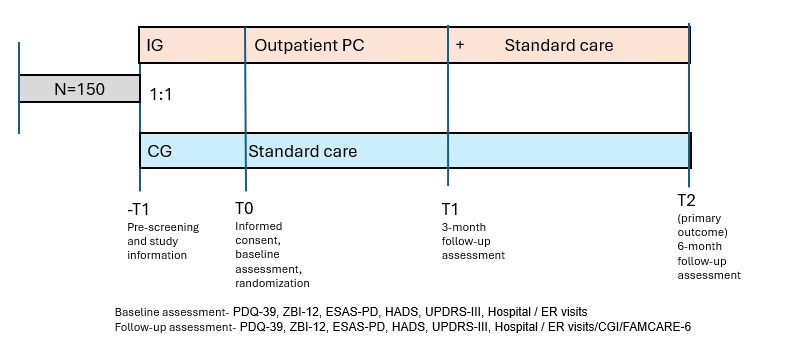
Outcome Measures
References: 1. Kluger BM, Miyasaki J, Katz M, et al. Comparison of Integrated Outpatient Palliative Care With Standard Care in Patients With Parkinson Disease and Related Disorders: A Randomized Clinical Trial. JAMA Neurol. 2020 May 1;77(5):551-560.
2. O’Shea N, Kwan J, Venkatesan A. Neurological update: the palliative care landscape for atypical parkinsonian syndromes. Journal of Neurology. 2023;270:1189–1198.
3. Katz M. Palliative Care for Parkinson’s Spectrum Disorders: An Emerging Approach. Neurotherapeutics. 2020 Oct;17(4):1456-1463.
To cite this abstract in AMA style:
R. Kamra, D. Radhakrishnan, N. Gupta, A. Upadhyay, R. Rajan, A. Elavarasi, A. Das, D. Garg, A. Agarwal, A. Pandit, M. Singh, S. Mishra, A. Srivastava. Efficacy of Combining Outpatient Palliative Care with Standard Care on Quality of Life and Caregiver Burden in Atypical Parkinsonian Syndrome – A Randomised Controlled Trial [abstract]. Mov Disord. 2026; 41 (suppl 1). https://www.mdsabstracts.org/abstract/efficacy-of-combining-outpatient-palliative-care-with-standard-care-on-quality-of-life-and-caregiver-burden-in-atypical-parkinsonian-syndrome-a-randomised-controlled-trial/. Accessed October 1, 2026.« Back to 2026 International Congress
MDS Abstracts - https://www.mdsabstracts.org/abstract/efficacy-of-combining-outpatient-palliative-care-with-standard-care-on-quality-of-life-and-caregiver-burden-in-atypical-parkinsonian-syndrome-a-randomised-controlled-trial/