
Category: Drug-Induced Movement Disorders
Objective: RLS can be treated with NEDA, generally in lower dosing than PD. We review a case of HD possibly caused by the DA treatment for RLS with pramipexole, with the aim to highlight a potential risk and further evaluate the regulatory background.
Background: Non ergot dopamine agonists (NEDA) used for the treatment of Parkinson’s disease (PD) can cause head drop (HD), reported mostly in Asian patients (1). It is suggested that necrotizing myopathy with muscle enzyme increment can be the mechanism of action (2). It is however, not verified if treatment of restless legs syndrome (RLS) with NEDA can also cause HD.
Method: A 79-year-old previously healthy man, who had received pramipexole for 8 years for RLS, presented with head drop. For years observed for a family history of DM2, started metformin 3 months ago.
Experienced a subacute development of head drop forward over 2-3 months beginning about 5 months ago with subsequently head turn to the left (and still forward) with concomitant muscle pain in the posterior neck muscles.
Results: Clinic: Muscle atrophy of the mm sternocleidomastoid and in the mm sin splenius/ trapezoid region. Hypertrophy of mm dxt splenius/trapezoid region.
EMG with no signs of dystonia in the neck muscles.
With a decreased dose of pramipexole the patient reported improvement of HD, the head still in forward position, but able to turn to both sides about 10-15 degrees more. He did however then have a severe relapse of RLS and had to increase the dose again, which caused worsening of the HD symptoms.
Product information (PIs) from The European Medicines Agency (EMA) (for centrally authorized products (CAPs)) or the Health Products Regulatory Authority (HPRA) for three marketed NEDAs (pramipexole, ropinirole, and rotigotine) -were searched for mentions of HD (or related terms). All three had the indications PD and RLS. The risk of HD was mentioned for pramipexole and rotigotine in relation to PD. In the warning section and the undesirable effects section respectively.
Conclusion: Our case, with a subjectively observed positive re-and de-challenge, supports the suggestion that NEDAs prescribed for RLS can cause HD.
We conclude that the use of DAs for the treatment of RLS is often effective, but attention must be paid to safety.
This case shows that ADRs are clinically relevant, and a bridging/collaboration between clinic and regulation is necessary.
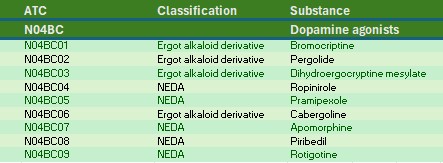
Dopamnie Agonists OVerview
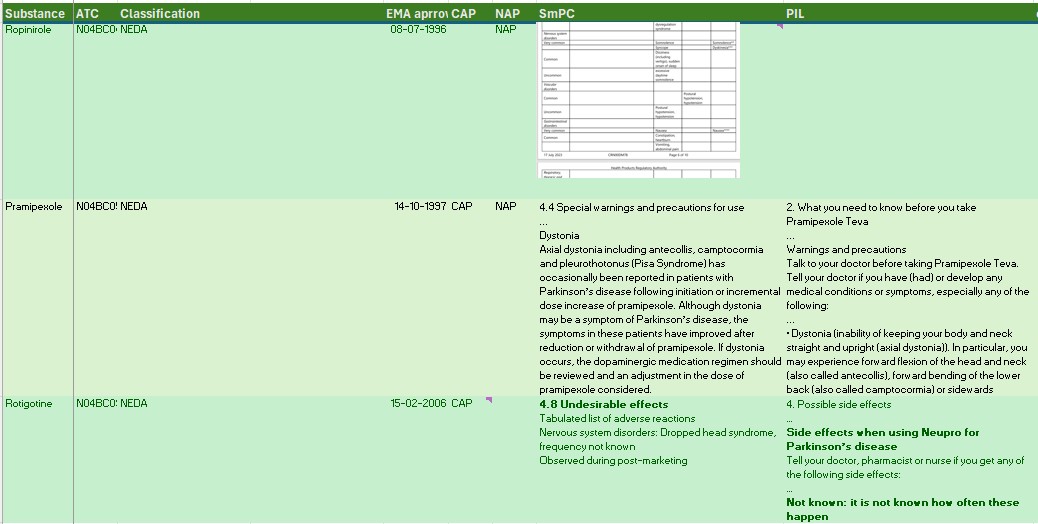
NEDA SmPC and PIL
References: 1. Kashihara K, Ohno M, Tomita S. Dropped head syndrome in Parkinson’s dis-ease. Movement Disorders. 2006;21(8):1213–6. doi:10.1002/mds.20948
2. Mangiardi M, Magliozzi A, Colosimo C, Marsili L. Dropped Head Syndrome: The Importance of Neurophysiology in Distinguishing Myasthenia Gravis from Par-kinson’s Disease. Biomedicines. 2024 Aug;12(8):1833. doi:10.3390/biomedicines12081833
To cite this abstract in AMA style:
AK. Stark, P. Mcgettigan, HB. Biernat, A. Lokkegaard. Case of Head Drop as an Adverse Drug Reaction to Dopamine Agonists and Regulatory Evaluation [abstract]. Mov Disord. 2026; 41 (suppl 1). https://www.mdsabstracts.org/abstract/case-of-head-drop-as-an-adverse-drug-reaction-to-dopamine-agonists-and-regulatory-evaluation/. Accessed October 1, 2026.« Back to 2026 International Congress
MDS Abstracts - https://www.mdsabstracts.org/abstract/case-of-head-drop-as-an-adverse-drug-reaction-to-dopamine-agonists-and-regulatory-evaluation/