
Category: Parkinsonism (Other)
Objective: To report a case carrying a rare splice-site mutation in the SLC20A2 gene presenting as early-onset, levodopa-responsive parkinsonism.
Background: Primary Familial Brain Calcification (PFBC) is a neurodegenerative disorder with high clinical heterogeneity, ranging from asymptomatic calcification to diverse movement disorders. While SLC20A2 mutations are the most frequent genetic cause, the relationship between specific genotypes and treatment response, particularly to levodopa, remains poorly defined.
Method: We report a 48-year-old female with a progressive bradykinesia and rigidity, predominantly on the left side for one year. Brain CT and MRI revealed extensive, symmetrical calcifications in the bilateral basal ganglia, dentate nuclei, and subcortical white matter. Metabolic and infectious causes were excluded. Genetic analysis was conducted via Whole Exome Sequencing (WES) and mitochondrial DNA sequencing.
Results: Genetic testing identified a heterozygous splice-acceptor variant in SLC20A2: NM_001257180.2:c.935-1G>A. Although this specific variant was previously associated with paroxysmal dystonia in a younger cohort, our patient presented with a distinct parkinsonian phenotype. Notably, despite the common perception of levodopa resistance in PFBC, the patient exhibited a remarkable response to low-dose levodopa (LEDD 200mg), with the UPDRS-III score improving by 51% (from 35 to 17).
Conclusion: Our findings underscore the potential for excellent levodopa responsiveness in certain PFBC-associated parkinsonism, justifying a trial of dopaminergic therapy regardless of the extent of calcification.
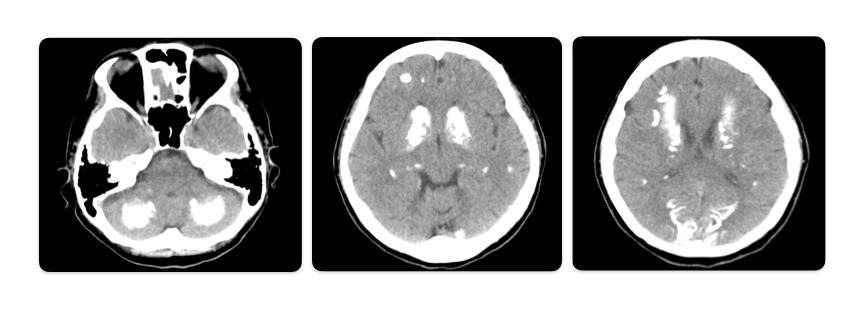
Fig 1. Brain CT (2024)
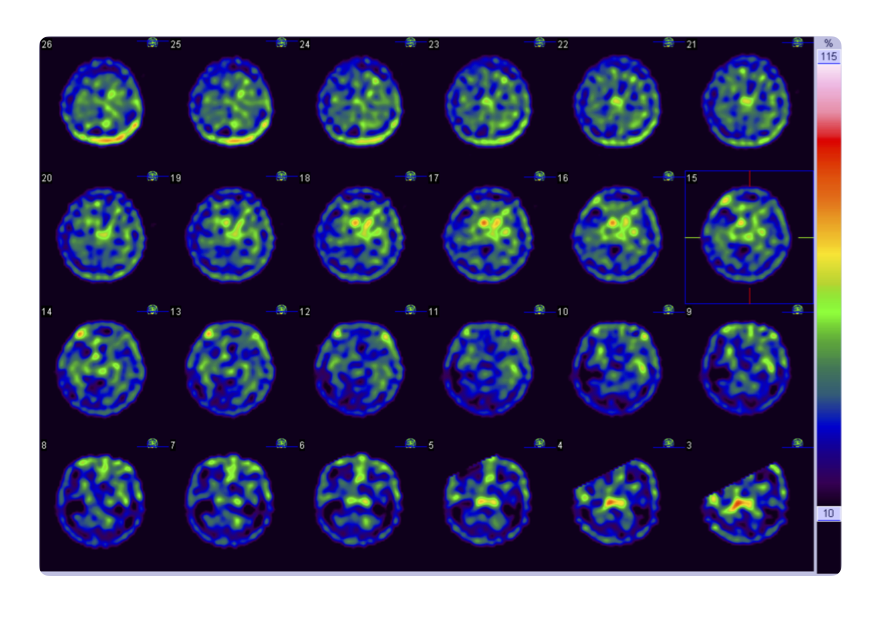
Fig 2. Trodat-1 scan (2025)
References: 1. Yamada, M., et al., Evaluation of SLC20A2 mutations that cause idiopathic basal ganglia calcification in Japan. Neurology, 2014. 82(8): p. 705-12.
2. Wang, C., et al., Mutations in SLC20A2 link familial idiopathic basal ganglia calcification with phosphate homeostasis. Nat Genet, 2012. 44(3): p. 254-6.
3. Koyama, S., et al., Clinical and radiological diversity in genetically confirmed primary familial brain calcification. Sci Rep, 2017. 7(1): p. 12046.
4. Tadic, V., et al., Primary familial brain calcification with known gene mutations: a systematic review and challenges of phenotypic characterization. JAMA Neurol, 2015. 72(4): p. 460-7.
5. Chen, W.J., et al., Novel SLC20A2 mutations identified in southern Chinese patients with idiopathic basal ganglia calcification. Gene, 2013. 529(1): p. 159-62.
To cite this abstract in AMA style:
H. Sytwu, H. Chiang. SLC20A2 Splice-Site Mutation (c.935-1G>A) Presenting as levodopa-responsive parkinsonism: Expanding the Phenotypic Spectrum of Primary Familial Brain Calcification [abstract]. Mov Disord. 2026; 41 (suppl 1). https://www.mdsabstracts.org/abstract/slc20a2-splice-site-mutation-c-935-1ga-presenting-as-levodopa-responsive-parkinsonism-expanding-the-phenotypic-spectrum-of-primary-familial-brain-calcification/. Accessed October 1, 2026.« Back to 2026 International Congress
MDS Abstracts - https://www.mdsabstracts.org/abstract/slc20a2-splice-site-mutation-c-935-1ga-presenting-as-levodopa-responsive-parkinsonism-expanding-the-phenotypic-spectrum-of-primary-familial-brain-calcification/