
Category: Tremor
Objective: To investigate the acute and sustained effects of two peripheral electrical stimulation strategies on motor unit activity of wrist flexors and extensors in individuals with essential tremor (ET).
Background: Sensory peripheral electrical stimulation is a promising approach for suppressing hand tremors in ET(1). Open-loop stimulation (OLS), which delivers stimulation at the individual’s tremor frequency, is currently available for at-home treatment(3). We developed closed-loop stimulation (CLS) that adaptively targets the antagonist muscle based on real-time electromyographic (EMG) activity(2)(Fig 1). Both strategies have demonstrated sustained tremor suppression(2, 3), but their effects on the neural drive to the muscles receiving the tremorgenic drive remain unclear. The coefficient of variation (CoV) of motor unit (MU) discharge rate quantifies synaptic noise in neural drive and has been linked to force fluctuations(4). Increased MU discharge variability has been reported in movement disorders(5), but its response to electrical stimulation interventions is unknown
Method: Five individuals with ET (Age=66±13) (Table 1) underwent three interventions: CLS, OLS and control (CON, no stimulation), separated by three-week washout periods. CLS and OLS were delivered transcutaneously at the wrist of the tremorgenic side for 40 minutes. High-density EMG was recorded from extensor carpi radialis (ECR) and flexor carpi radialis (FCR) during two postural tasks (arms extended forward and flexed near the chest) before, immediately after, and 24 hours after each intervention. Linear mixed-effects models tested the effects of Time (Pre, Post, Post24) and Intervention (CLS, OLS, CON) on the CoV of MU discharge rate, with participant and MU as random effects.
Results: 336 MUs from ECR and 293 MUs from FCR were analyzed (Table 1). Following CLS, the CoV of MU discharge rate in ECR decreased at Post24 compared with Pre and Post (both p<0.001). Similar reductions were observed in FCR (p<0.026) (Fig 2). No changes were observed after OLS or CON (p>0.133).
Conclusion: CLS reduced MU discharge variability in wrist muscles 24 hours after stimulation, suggesting reduced synaptic noise in the neural drive. These findings provide neurophysiological evidence supporting sustained tremor suppression following CLS and suggest potential neuroplastic effects at the spinal level.
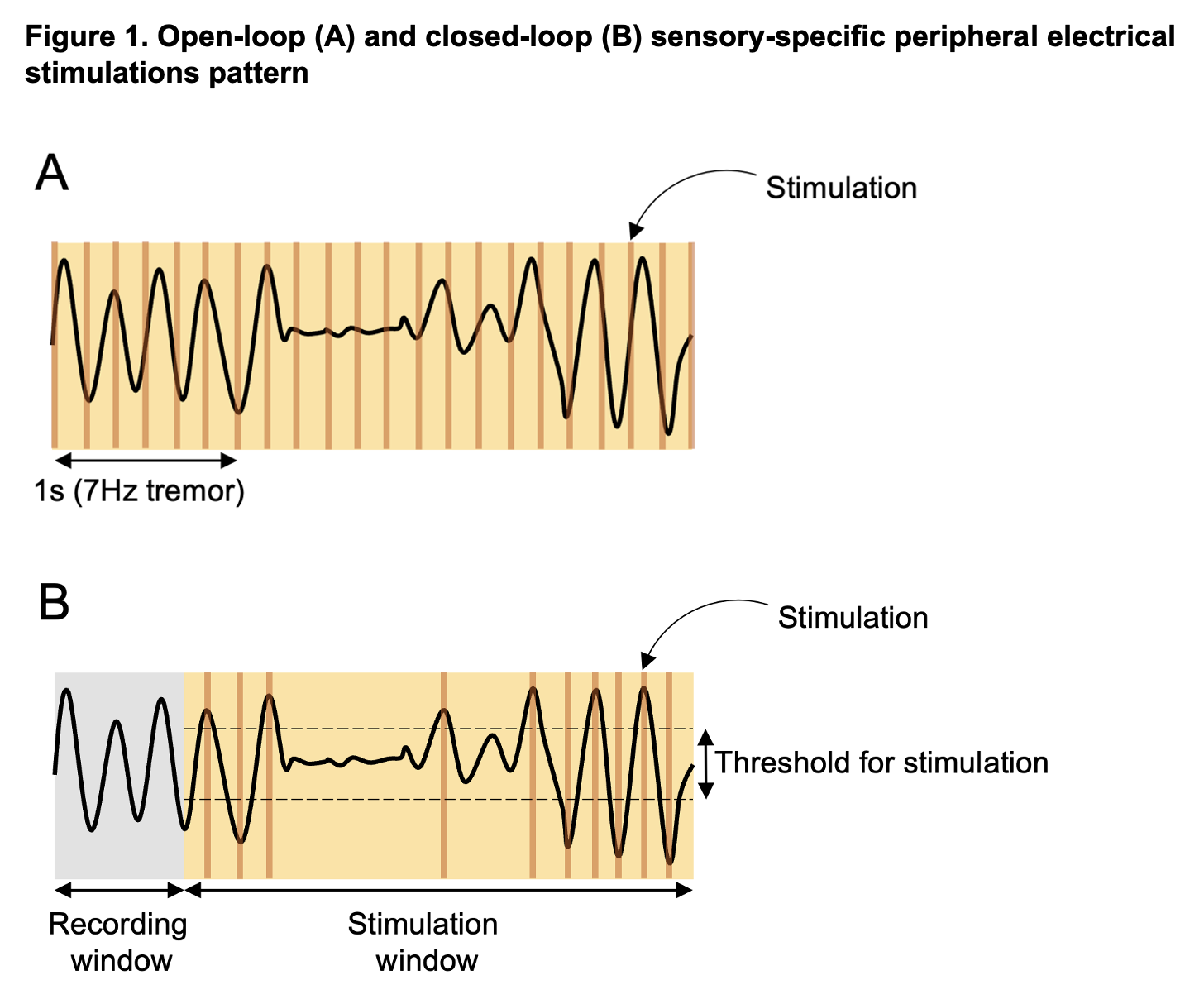
Figure 1
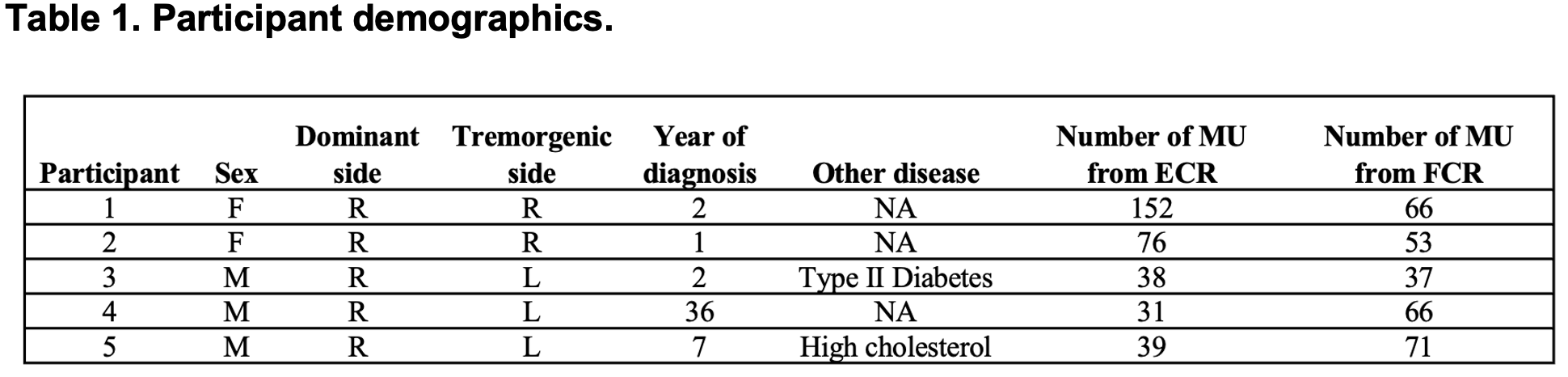
Table 1
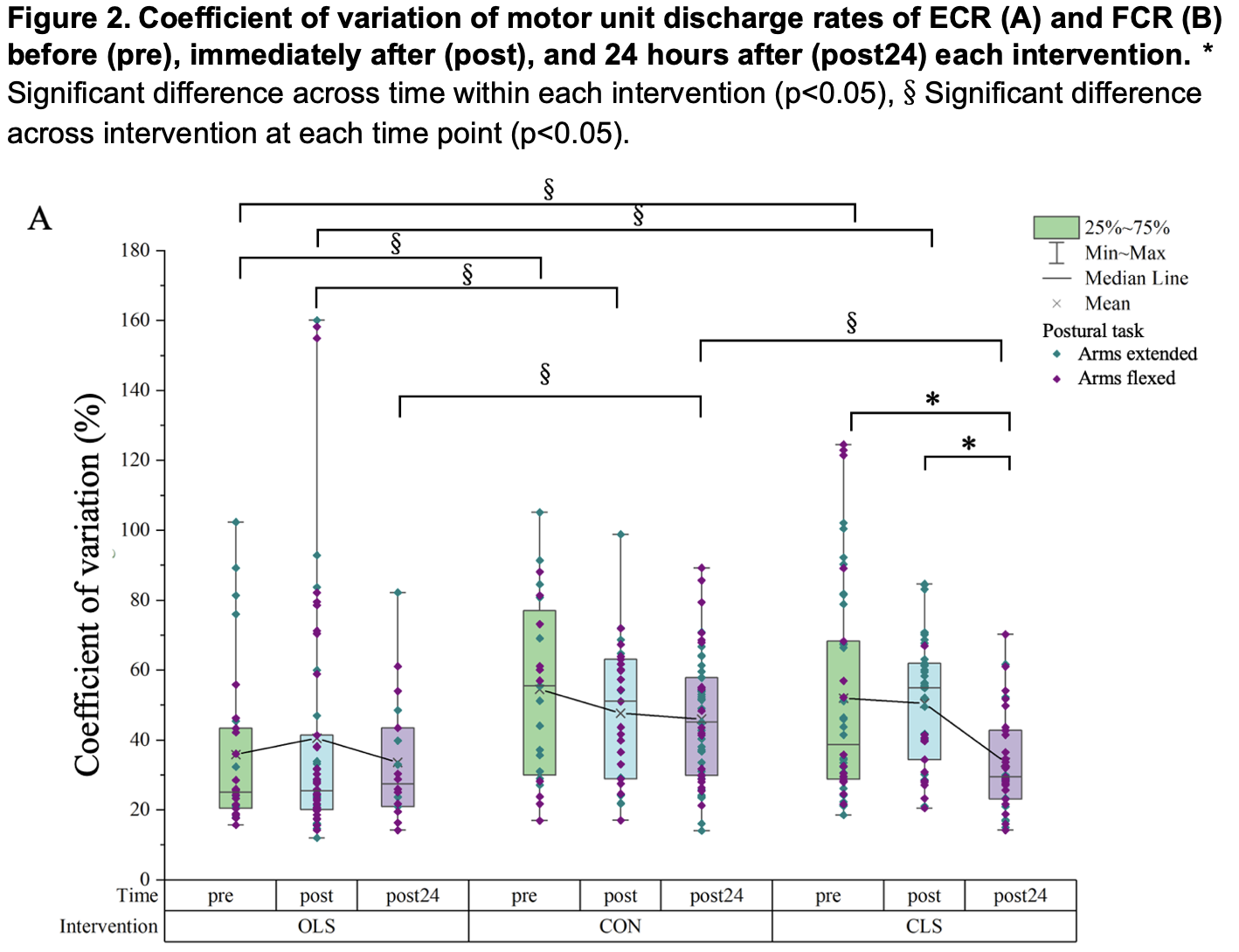
Figure 2A
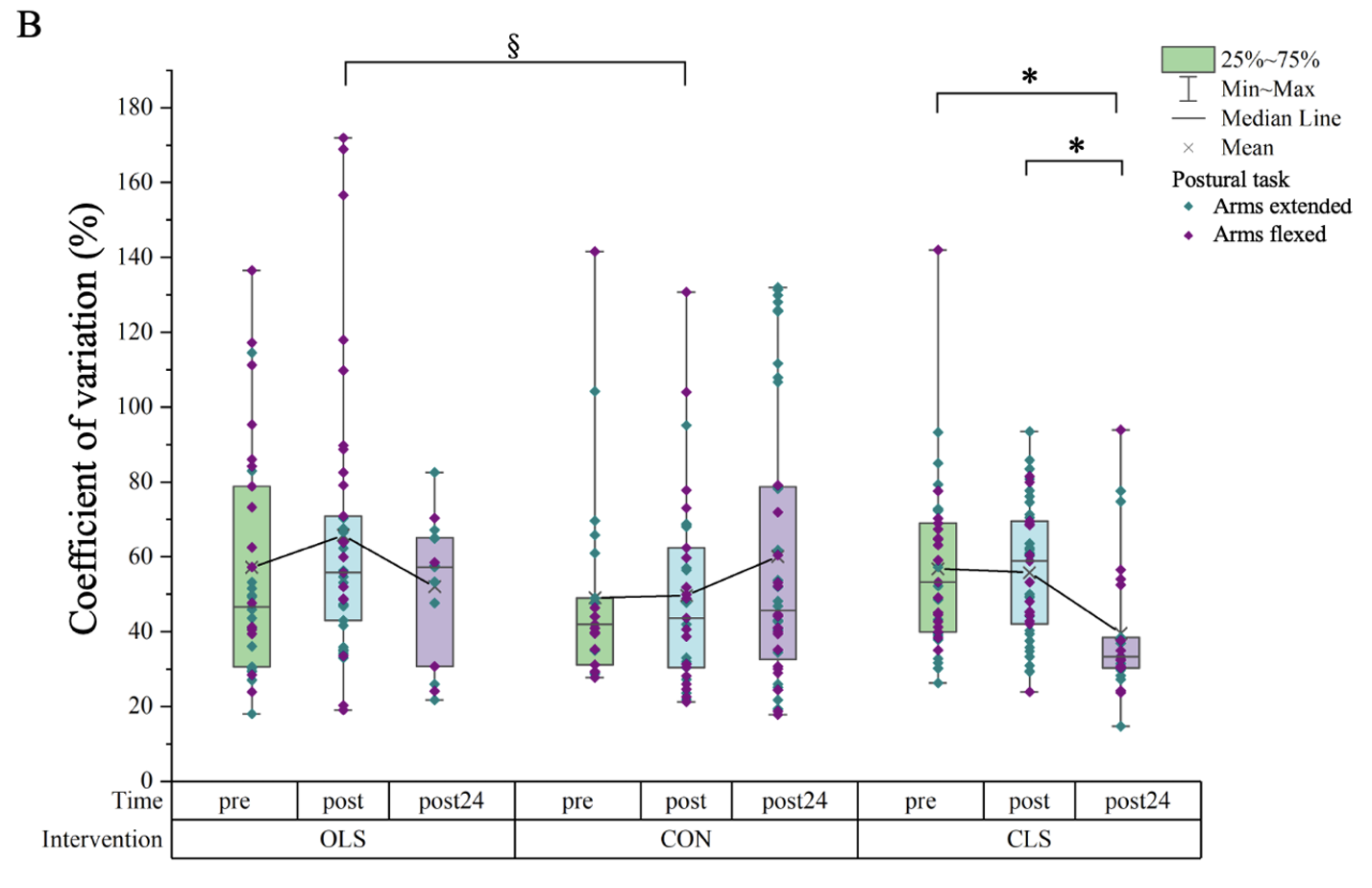
Figure 2B
References: 1. Pascual-Valdunciel A, Hoo GW, Avrillon S, Barroso FO, Goldman JG, Hernandez-Pavon JC, Pons JL. Peripheral electrical stimulation to reduce pathological tremor: a review. J NeuroEngineering Rehabil 18: 33, 2021. doi: 10.1186/s12984-021-00811-9.
2. Pascual-Valdunciel A, Gonzalez-Sanchez M, Muceli S, Adan-Barrientos B, Escobar-Segura V, Perez-Sanchez JR, Jung MK, Schneider A, Hoffmann K-P, Moreno JC, Grandas F, Farina D, Pons JL, Barroso FO. Intramuscular Stimulation of Muscle Afferents Attains Prolonged Tremor Reduction in Essential Tremor Patients. IEEE Trans Biomed Eng 68: 1768–1776, 2021. doi: 10.1109/TBME.2020.3015572.
3. Isaacson SH, Peckham E, Tse W, Petrossian MT, Soileau MJ, Lew M, Dietiker C, Luthra N, Agarwal P, Dhall R, Morgan J, Shamim EA, Shill HA, Pagan FL, Khemani P, Tate J, Luo L, Ondo W, Hallett M, Lu C, Rosenbluth KH, Delp SL, Pahwa R. Underlying Tremor Improvement with Consistent Use of Transcutaneous Afferent Patterned Stimulation in Patients with Essential Tremor. Tremor Hyperkinetic Mov 16: 1, 2026. doi: 10.5334/tohm.1091.
4. Tvrdy T, Henry M, Enoka RM. Influence of the variability in motor unit discharge times and neural drive on force steadiness during submaximal contractions with a hand muscle. J Neurophysiol 133: 697–708, 2025. doi: 10.1152/jn.00333.2024.
5. Wilson JM, Thompson CK, McPherson LM, Zadikoff C, Heckman CJ, MacKinnon CD. Motor Unit Discharge Variability Is Increased in Mild-To-Moderate Parkinson’s Disease. Front Neurol 11: 477, 2020. doi: 10.3389/fneur.2020.00477.
To cite this abstract in AMA style:
X. Yu, N. Kurukuti, H. Hassanlouei, G. Hoo, E. Roth, J. Pons. Reduced Motor Unit Discharge Variability of Wrist Muscles 24 Hours After Closed-Loop Electrical Stimulation in Essential Tremor [abstract]. Mov Disord. 2026; 41 (suppl 1). https://www.mdsabstracts.org/abstract/reduced-motor-unit-discharge-variability-of-wrist-muscles-24-hours-after-closed-loop-electrical-stimulation-in-essential-tremor/. Accessed October 1, 2026.« Back to 2026 International Congress
MDS Abstracts - https://www.mdsabstracts.org/abstract/reduced-motor-unit-discharge-variability-of-wrist-muscles-24-hours-after-closed-loop-electrical-stimulation-in-essential-tremor/