
Category: Parkinson's Disease: Surgical Therapy
Objective: To study retrospectively the neuropsychiatric profile and its evolution in patients with Parkinson’s disease undergoing bilateral Subthalamic Deep Brain Stimulation
Background: Deep brain stimulation (DBS) of the subthalamic nucleus (STN) is an established therapeutic option for patients with Parkinson’s disease (PD. While its motor benefits are well documented, less is known about the longitudinal trajectory of neuropsychiatric symptoms following surgery. This study aimed to evaluate the temporal evolution of neuropsychiatric features in PD patients undergoing STN-DBS from the preoperative period to postoperative follow-up
Method: We conducted a hospital-based retrospective observational study of PD patients who underwent STN-DBS between 1999 and 2024, with a minimum postoperative follow-up of six months. Neuropsychiatric assessment was done using Beck Anxiety Inventory (BAI), Beck Depression Inventory (BDI) and the cognitive assessment by Montreal Cognitive Assessment (MoCA) and Addenbrooke’s Cognitive Examination (ACE), administered preoperatively and repeated at six months. A proportional study of neuropsychiatric symptoms pre and post DBS (last assessment done at 2025) was done using McNemar test
Results: A total of 271 ( Male = 170; 62.7% and female = 101; 37.3%) patients were retrospectively assessed. The mean age at onset of disease was 45 years (SD – 9.15 years). The mean age at surgery is 55.38 years (SD- 10.34 years). The mean duration of PD at surgery was 11.75 years. The mean age at onset of disorders of affect was 53.3 years (SD- 9.24 years), disorders of motivation was 52 years (SD- 10.09 years), disorders of perception and thinking was 53.5 years (SD- 11.07 years), disorders of sleep was 50.6 years (SD- 7.52 years). The mean number of years of education was 12.9 years. There was a statistically significant (Figure 1) in certain domains. There was no significant difference in proportion noted in mood disorder, delusions, hallucinations, psychosis, Impulse control disorders, apathy and excessive daytime sleepiness.
Conclusion: Although STN-DBS provides substantial motor and quality-of-life benefits, patients with pre-existing psychiatric conditions were found to have an improvement in their depression, anxiety and insomnia. Our study is the first largest study with 271 participants and 25 years of experience
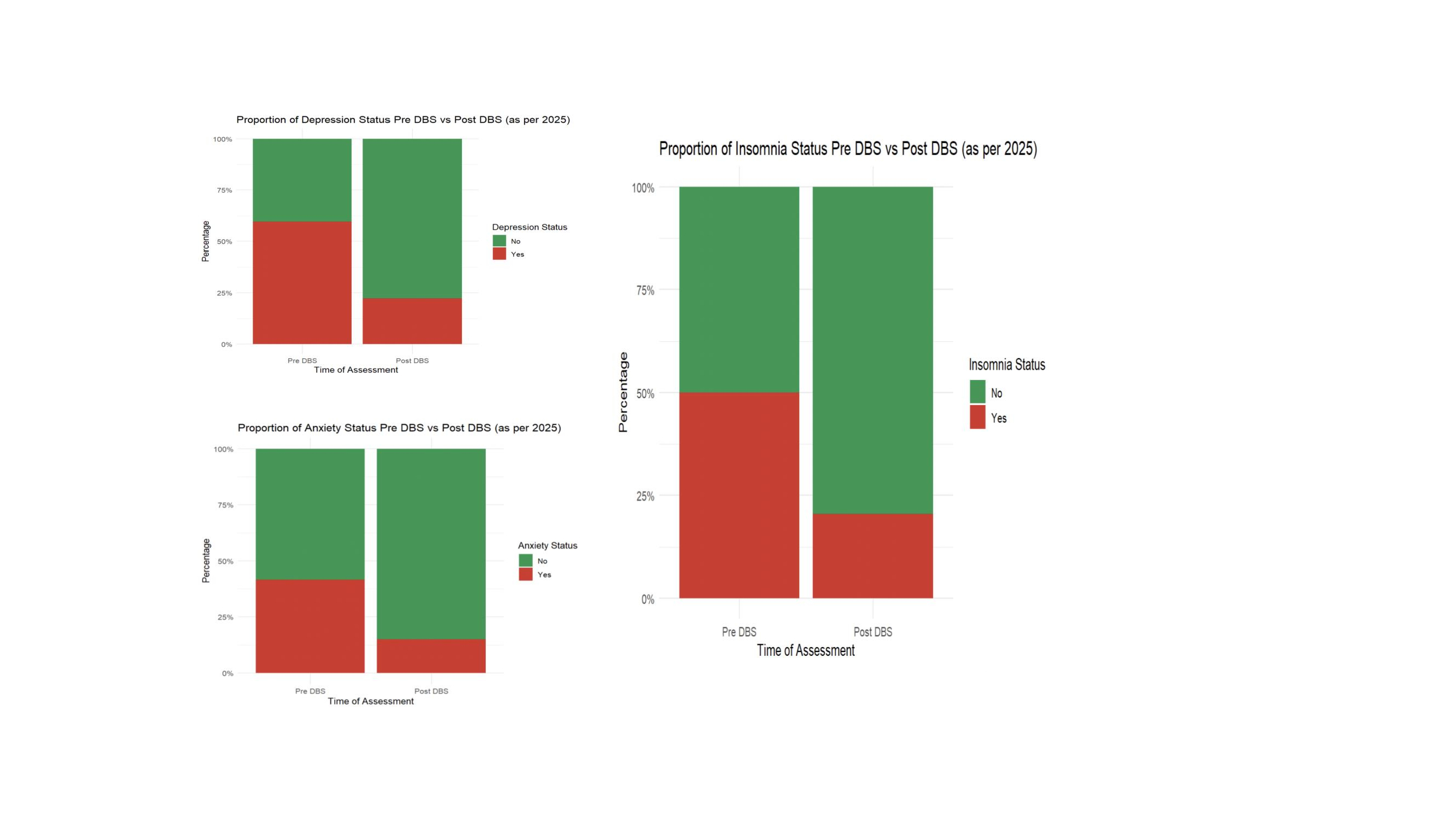
Figure 1
References: 1. Krishnan S, Pisharady KK, Rajan R, Sarma SG, Sarma PS, Kishore A. Predictors of dementia-free survival after bilateral subthalamic deep brain stimulation for Parkinson’s disease. Neurol India. 2019;67(2):459–66.
2. Mosley PE, Marsh R. The Psychiatric and Neuropsychiatric Symptoms After Subthalamic Stimulation for Parkinson’s Disease. J Neuropsychiatry Clin Neurosci. 2015 Jan;27(1):19–26.
To cite this abstract in AMA style:
H. S, S. Sachithanandan, D. P, A. Vijayaraghavan, S. Krishnan. Neuropsychiatric profile and its evolution in patients with Parkinson’s disease undergoing bilateral Subthalamic Deep Brain Stimulation – a retrospective study [abstract]. Mov Disord. 2026; 41 (suppl 1). https://www.mdsabstracts.org/abstract/neuropsychiatric-profile-and-its-evolution-in-patients-with-parkinsons-disease-undergoing-bilateral-subthalamic-deep-brain-stimulation-a-retrospective-study/. Accessed October 1, 2026.« Back to 2026 International Congress
MDS Abstracts - https://www.mdsabstracts.org/abstract/neuropsychiatric-profile-and-its-evolution-in-patients-with-parkinsons-disease-undergoing-bilateral-subthalamic-deep-brain-stimulation-a-retrospective-study/