
Objective: To compare the reduction in levodopa equivalent daily dose (LEDD) in patients with Parkinson’s disease treated with continuous subcutaneous apomorphine infusion versus bilateral subthalamic nucleus deep brain stimulation (STN-DBS) six months after initiation of advanced therapy.
Background: Parkinson’s disease is a progressive neurodegenerative disorder characterized by degeneration of dopaminergic neurons in the substantia nigra, producing motor symptoms such as bradykinesia, rigidity, and resting tremor, along with multiple non-motor manifestations that significantly affect quality of life (1). Long-term levodopa therapy frequently leads to motor fluctuations and dyskinesias related to pulsatile dopaminergic stimulation (2). When optimized medical therapy fails, advanced treatments such as continuous apomorphine infusion and deep brain stimulation are used to improve symptom control and reduce dopaminergic medication requirements (2,3,4).
Method: We conducted a descriptive, analytical longitudinal cohort study at a tertiary referral center in Mexico. Patients with Parkinson’s disease and motor fluctuations were included in two groups: continuous subcutaneous apomorphine infusion or bilateral STN-DBS. The primary outcome was reduction in LEDD at six months. Secondary outcomes included changes in MDS-UPDRS, Non-Motor Symptoms Scale (NMSS), and Parkinson’s Disease Questionnaire-39 (PDQ-39). Statistical analyses included paired and independent comparisons and multivariate linear regression.
Results: Both therapies produced improvements in motor and non-motor domains. Patients treated with STN-DBS showed greater reductions in UPDRS scores (Figure 1) and dopaminergic medication requirements, consistent with previous reports (4,5). Apomorphine infusion also improved motor symptoms, non-motor manifestations, and quality of life (Figure 2), although LEDD reduction was smaller.
Conclusion: Both therapies improved clinical outcomes and reduced dopaminergic medication at six months. STN-DBS produced greater LEDD reduction, whereas apomorphine infusion remains an effective non-surgical alternative for patients who are not candidates for DBS. Further studies with larger samples and longer follow-up are needed.
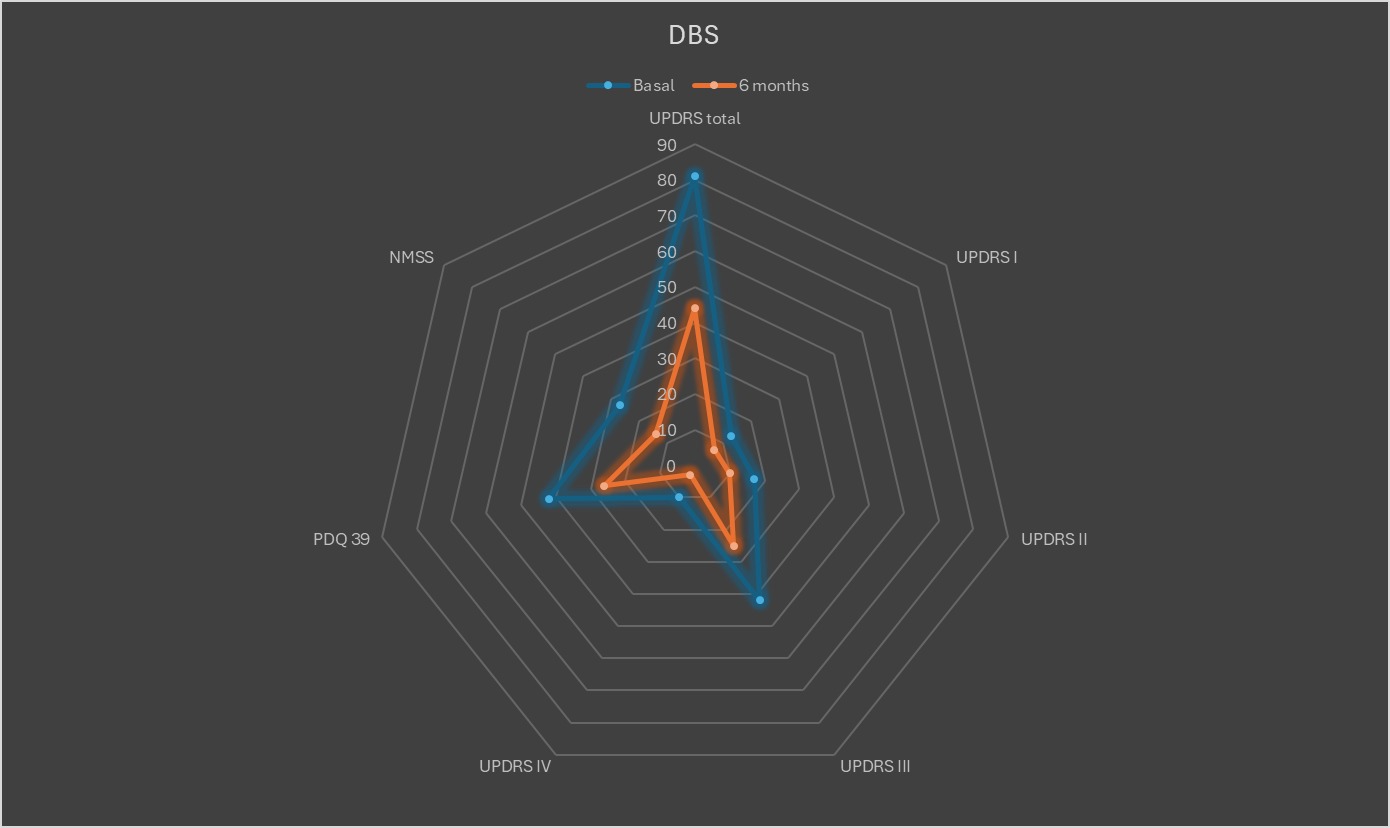
Figure 1
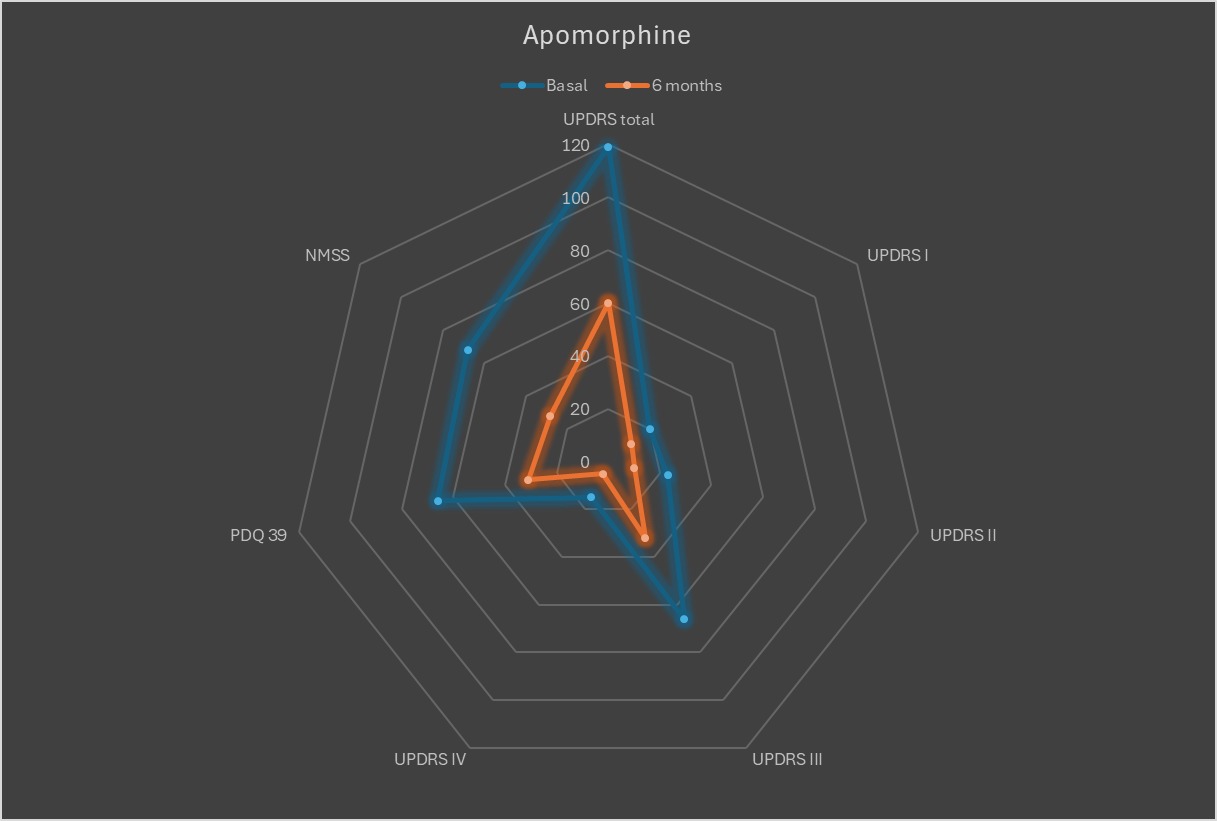
Figure 2
References: 1. Bloem BR, Okun MS, Klein C. Parkinson’s disease. Vol. 397, The Lancet. Elsevier B.V.; 2021. p. 2284–303.
2. Agbo F, Isaacson SH, Gil R, Chiu YY, Brantley SJ, Bhargava P, et al. Pharmacokinetics and Comparative Bioavailability of Apomorphine Sublingual Film and Subcutaneous Apomorphine Formulations in Patients with Parkinson’s Disease and “OFF” Episodes: Results of a Randomized, Three-Way Crossover, Open-Label Study. Neurol Ther. 2021 Dec 1;10(2):693–709.
3. Katzenschlager R, Poewe W, Rascol O, Trenkwalder C, Deuschl G, Chaudhuri KR, et al. Apomorphine subcutaneous infusion in patients with Parkinson’s disease with persistent motor fluctuations (TOLEDO): a multicentre, double-blind, randomised, placebo-controlled trial. Lancet Neurol. 2018 Sep 1;17(9):749–59.
4. Valldeoriola F, Puig-Junoy J, Puig-Peiró R, Workgroup of the SCOPE study. Cost analysis of the treatments for patients with advanced Parkinson’s disease: SCOPE study. J Med Econ. 2013;16(2):191–201.
5. Simonin C, Tir M, Devos D, Kreisler A, Dujardin K, Salleron J, et al. Reduced levodopa-induced complications after 5 years of subthalamic stimulation in Parkinson’s disease: A second honeymoon. J Neurol. 2009 Oct;256(10):1736–41.
To cite this abstract in AMA style:
L. Reyes, C. Martínez, J. Fonseca, F. Castro, A. Calderon, C. Ramirez. Reduction in Dopaminergic Medication in Patients with Parkinson’s Disease Treated with Continuous Apomorphine Infusion versus Subthalamic Nucleus Deep Brain Stimulation: A Cohort Study [abstract]. Mov Disord. 2026; 41 (suppl 1). https://www.mdsabstracts.org/abstract/reduction-in-dopaminergic-medication-in-patients-with-parkinsons-disease-treated-with-continuous-apomorphine-infusion-versus-subthalamic-nucleus-deep-brain-stimulation-a-cohort-study/. Accessed October 1, 2026.« Back to 2026 International Congress
MDS Abstracts - https://www.mdsabstracts.org/abstract/reduction-in-dopaminergic-medication-in-patients-with-parkinsons-disease-treated-with-continuous-apomorphine-infusion-versus-subthalamic-nucleus-deep-brain-stimulation-a-cohort-study/