
Objective: To investigate the longitudinal association between excessive daytime sleepiness (EDS) and motor progression in Parkinson’s disease (PD).
Background: EDS is a common non-motor symptom in PD and has been link to gait and balance impairment. Although several studies have explored predictors of EDS, its influence on long-term motor progression remains unclear.
Method: We analyzed 163 patients with PD who had at least three clinical visits (mean follow-up 2.9±0.6 years). EDS was assessed using the Epworth Sleepiness Scale (ESS), and patients were categorized as EDS (ESS≥11) or non-EDS (ESS≤10). Longitudinal changes in motor severity (UPDRS part III) were evaluated using liner mixed-effects models, adjusting for age, sex, disease duration, baseline UPDRS part III, and levodopa equivalent daily dose (LEDD). Missing data were handled using multiple imputation. Baseline UPDRS part III subitems were compared between groups.
Results: At baseline, patients with EDS had significantly higher UPDRS part III scores than those without EDS (21.0 vs 16.4, p=0.019). Subitem analyses showed that bradykinesia-related scores were significantly higher in the EDS group, including left pronation–supination movements (p=0.014), right toe tapping (p=0.040), right leg agility (p=0.008), and left leg agility (p=0.039). Longitudinal mixed-effects modeling revealed a significant interaction between baseline ESS and time for UPDRS part III (β=-0.16, p=0.004), indicating that higher baseline sleepiness was associated with a slower rate of motor worsening. Consistently, the difference in motor severity in between the EDS and non-EDS groups gradually diminished over the follow-up period.
Conclusion: While most previous studies have focused on identifying predictors of EDS, its impact on disease trajectory has received limited attention. Consistent with earlier reports linking EDS to gait and balance impairment, our findings showed more pronounced lower limb bradykinesia at base line in patients with EDS. Interestingly, motor severity in the EDS worsened more slowly than in the non-EDS group, suggesting that EDS may not simply reflect greater motor impairment but could represent a distinct clinical phenotype within PD. Further studies incorporating neuroimaging and biological markers are warranted to clarify the underlying mechanisms and prognostic implications.
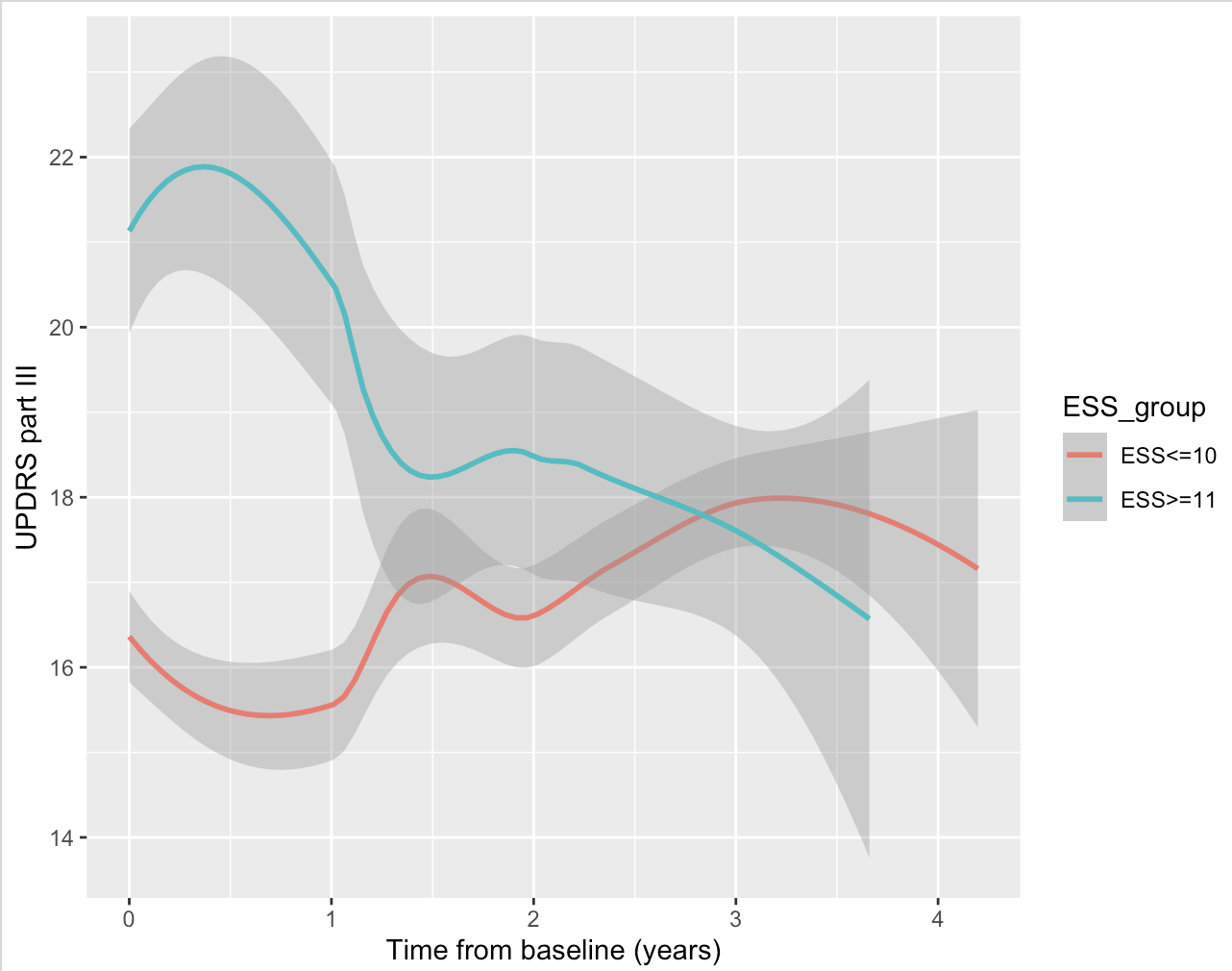
UPDRS Part III Trajectory by ESS status
To cite this abstract in AMA style:
K. Aoshima, S. Ueno, N. Nishikawa, H. Iwaki, E. Igami, H. Takeshige(amano), T. Hatano, N. Hattori. Motor Trajectory in Parkinson’s Disease With Excessive Daytime Sleepiness: A Longitudinal Cohort Study [abstract]. Mov Disord. 2026; 41 (suppl 1). https://www.mdsabstracts.org/abstract/motor-trajectory-in-parkinsons-disease-with-excessive-daytime-sleepiness-a-longitudinal-cohort-study/. Accessed October 1, 2026.« Back to 2026 International Congress
MDS Abstracts - https://www.mdsabstracts.org/abstract/motor-trajectory-in-parkinsons-disease-with-excessive-daytime-sleepiness-a-longitudinal-cohort-study/