
Category: Parkinson's Disease (Other)
Objective: Characterize temporal changes in PD research priorities presented at the MDS Congress from 2016 to 2025. Identify evolving thematic, methodological, and aging-related directions relevant to future Parkinson’s disease (PD) research.
Background: MDS Congress abstracts provide a useful overview of changing research priorities in PD research, yet thematic changes in PD-focused MDS Congress abstracts have not been systematically quantified, to our knowledge.
Method: We compiled, cleaned, and restricted MDS Congress abstracts (2016–2025) to a PD-focused corpus. Topic modeling was performed yearly using non-negative matrix factorization (NMF) and latent Dirichlet allocation (LDA) across multiple topic numbers. NMF with 12 topics was selected based on interpretability. The abstracts were assigned to their dominant topic. Yearly topic shares were calculated, and selected major topics were examined using keyword-based subtheme analyses.
Results: Of the 13,118 abstracts, the largest topic was cognition and dementia (mean share: 19.8%), followed by rehabilitation and care (12.0%), non-motor burden and quality of life (11.3%), motor fluctuations and dyskinesia (11.2%), and deep brain stimulation (10.2%). Rehabilitation and care showed the strongest increase, rising from 9.7% in 2016 to 15.7% in 2025, while genetics and risk increased from 5.5% to 8.5%. In contrast, cognition and dementia declined most strongly, from 21.2% to 17.0% (Figure1). Within the major topics, the emphasis shifted towards prodromal and biomarker-oriented cognition, digital and home-based rehabilitation and care, risk- and GWAS-oriented genetics, and programming and adaptive DBS. Aging-related content mainly clustered in cognition, non-motor, and rehabilitation/care topics, and was predominantly framed through clinical decline, burden, and dependency rather than biological aging concepts.
Conclusion: PD research presented at the MDS Congress has shifted over time in topics and methods. Increased attention to rehabilitation/care, genetics, adaptive DBS, and prodromal or biomarker-oriented cognition suggests growing interest in earlier disease stages, risk-based characterization, technology-based care, and functional management. Aging in PD research is still framed mainly through clinical decline and dependency, while biological aging frameworks remain scarce.
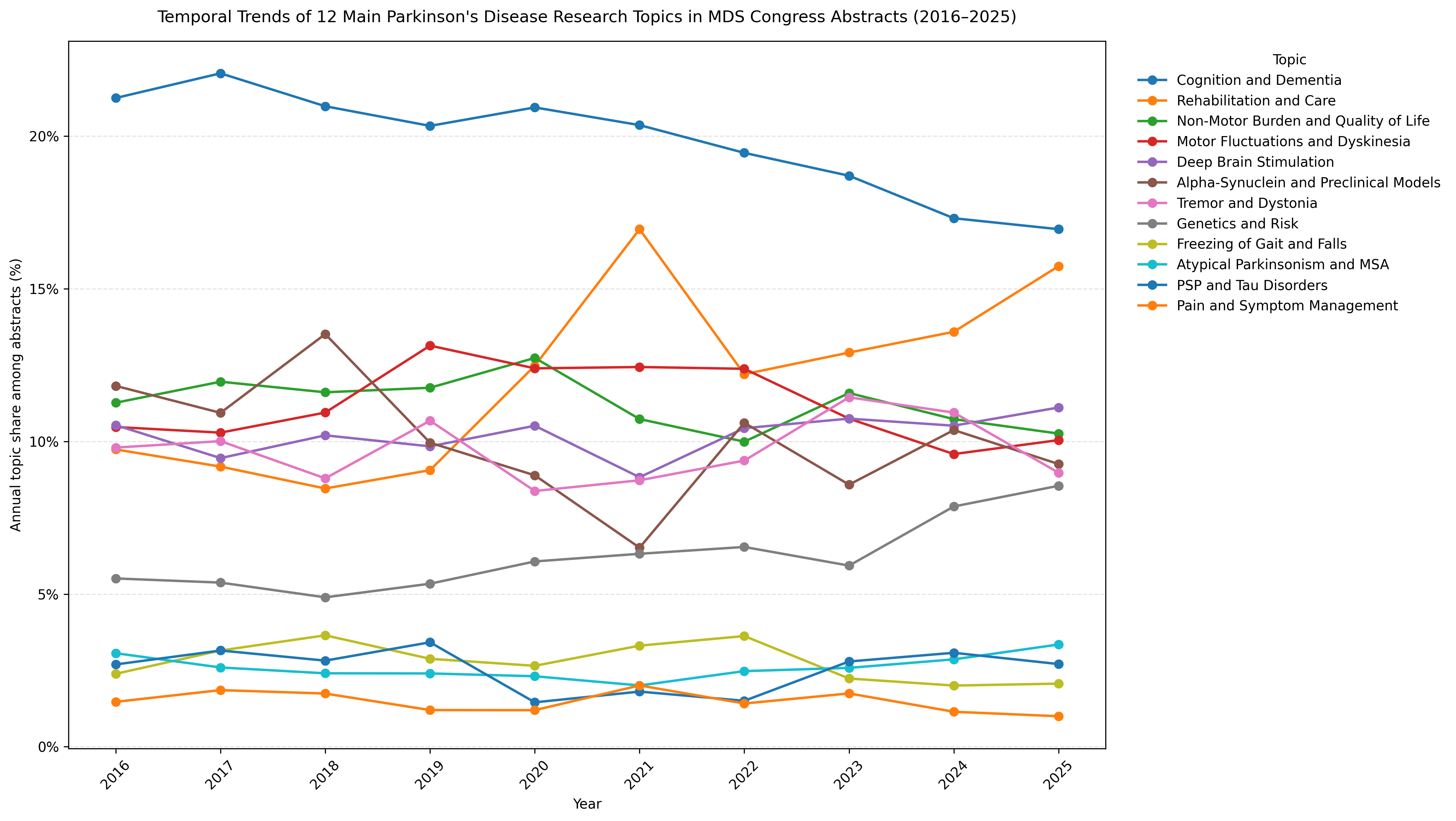
Yearly Trends in NMF-derived PD Topics
To cite this abstract in AMA style:
L. Ramin, D. Wolff. How Parkinson’s Disease Research Has Shifted from 2016 – 2025 at the MDS Congress: A Topic-Based Analysis [abstract]. Mov Disord. 2026; 41 (suppl 1). https://www.mdsabstracts.org/abstract/how-parkinsons-disease-research-has-shifted-from-2016-2025-at-the-mds-congress-a-topic-based-analysis/. Accessed October 1, 2026.« Back to 2026 International Congress
MDS Abstracts - https://www.mdsabstracts.org/abstract/how-parkinsons-disease-research-has-shifted-from-2016-2025-at-the-mds-congress-a-topic-based-analysis/