
Objective: We aim to identify the clinical and biomarker features which best predict re-diagnosis to a Parkinson plus syndrome (PPS) in those initially diagnosed with Parkinson’s Disease (PD).
Background: Some patients with a PPS, including progressive supranuclear palsy (PSP), corticobasal syndrome (CBS) and multiple system atrophy (MSA) are initially misdiagnosed with PD within the early stages. This leads to a diagnostic delay and a delay in appropriate clinical and supportive care, as well as limiting eligibility for clinical trials into much needed disease-modifying therapies.
Method: We used data from two longitudinal UK cohorts, the Tracking Parkinson’s (PRoBaND) and Oxford Parkinson’s Disease Centre (OPDC) Discovery cohort to assess the rate of re-diagnosis from PD to a PPS. Participants were recruited within 3.5 years of a probable PD diagnosis. We used multivariable logistic regression to identify the best combination of variables for predicting a PPS re-diagnosis. Base models with age and sex were compared with combinations of 5 additional variable groups: 1) clinical features reported at the time of diagnosis, 2) clinical features measured at baseline assessment, 3) the clinician-rated probability of PD assigned at baseline assessment, 4) quantitative scale scores at baseline assessment and 5) serum neurofilament light (NfL) concentration.
Results: Re-diagnosis to a PPS occurred in 2.4% of participants recruited with an initial diagnosis of PD (n=2,724) [figure1]. The most common PPS re-diagnosis was MSA (n=28). The model which best improved prediction of a re-diagnosis to a PPS from sex and age alone included features at baseline participation and baseline scale scores. The addition of baseline features and scale scores significantly improved prediction compared to sex and age alone (AUC 0.788, 95% CI 0.707-0.871; p<0.001, n=1626 vs AUC 0.47, 95% CI 0.373-0.568) [table1]. In this model, the significant predictors of a PPS re-diagnosis were sexual dysfunction, poor response to levodopa, a lack of resting tremor, a higher total MDS-Unified Parkinson’s Disease Rating Scale (MDS-UPDRS) part II score and a higher total Sniffin’ sticks score.
Conclusion: Re-diagnosis to a PPS from PD can be best predicted by combining clinical data and research scales. Replication in larger cohorts is needed to validate these findings.
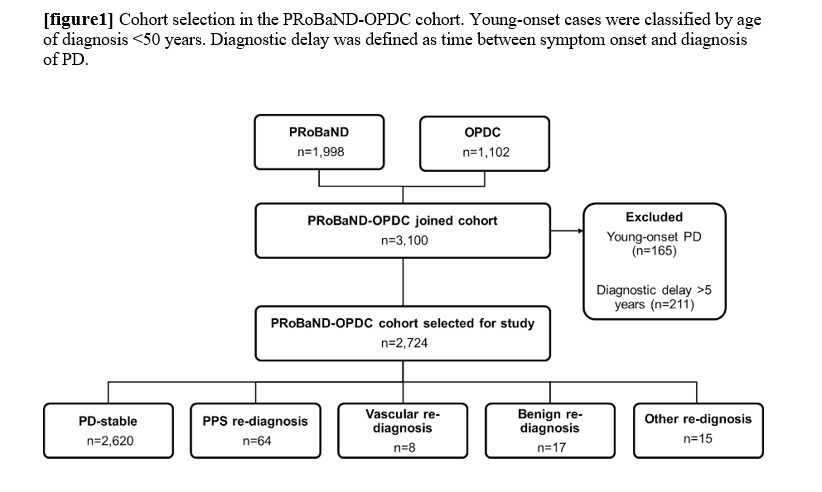
Figure 1
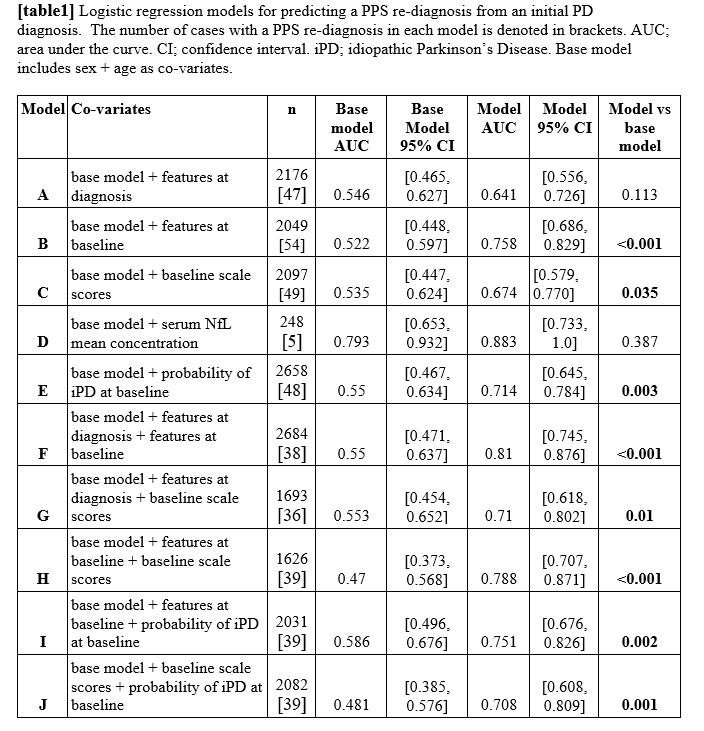
Table 1
To cite this abstract in AMA style:
R. Fumi, D. Vaughan, T. Rittman, J. Rowe, E. Jabbari, A. Nodehi, M. Lawton, T. Zerenner, Y. Ben-Shlomo, D. Grosset, M. Hu, H. Morris. Determinants of Re-diagnosis of Parkinson’s Disease to Atypical Parkinsonism: Results from the Tracking Parkinson’s Cohort (PRoBAND) and Oxford Parkinson’s Discovery Cohort (OPDC) Cohorts [abstract]. Mov Disord. 2026; 41 (suppl 1). https://www.mdsabstracts.org/abstract/determinants-of-re-diagnosis-of-parkinsons-disease-to-atypical-parkinsonism-results-from-the-tracking-parkinsons-cohort-proband-and-oxford-parkinsons-discovery-cohort-op/. Accessed October 1, 2026.« Back to 2026 International Congress
MDS Abstracts - https://www.mdsabstracts.org/abstract/determinants-of-re-diagnosis-of-parkinsons-disease-to-atypical-parkinsonism-results-from-the-tracking-parkinsons-cohort-proband-and-oxford-parkinsons-discovery-cohort-op/