
Objective: To quantitatively evaluate oculomotor dysfunction using video-nystagmography (VNG) in patients with Parkinson’s disease (PD) and determine its association with motor severity, disease duration, and cognitive status.
Background: Parkinson’s disease is characterized by progressive basal ganglia dysfunction affecting voluntary and reflexive eye movements. Quantitative oculomotor assessment using VNG may provide objective biomarkers of disease burden; however, comprehensive clinicophysiological correlations from tertiary-care cohorts remain limited.
Method: In this cross-sectional case–control study, 57 patients with clinically diagnosed PD and 57 age- and sex-matched healthy controls underwent standardized VNG testing. Parameters assessed included saccadic latency, peak velocity, smooth pursuit eye movement (SPEM) gain, and optokinetic nystagmus (OKN) gain (right and left eyes). Clinical assessment included Unified Parkinson’s Disease Rating Scale Part III (UPDRS-III), Hoehn & Yahr (H&Y) stage, disease duration, and Montreal Cognitive Assessment (MoCA). Between-group comparisons were performed using independent-samples t-tests. Correlations were analyzed using Pearson’s coefficient. Key findings are summarized in [table1] and [table2].
Results: PD patients demonstrated significantly prolonged saccadic latency and reduced peak velocity compared with controls (p < 0.001). SPEM and OKN gains were significantly reduced bilaterally (p < 0.01). Saccadic latency positively correlated with UPDRS-III scores and disease duration, while SPEM and OKN gains showed inverse correlations with motor severity. Associations with cognitive status were weaker and primarily observed in OKN parameters.
Conclusion: Parkinson’s disease is associated with measurable impairment in voluntary and reflexive oculomotor function. VNG-derived metrics correlate strongly with motor severity, supporting their potential role as objective, non-invasive biomarkers of disease burden.
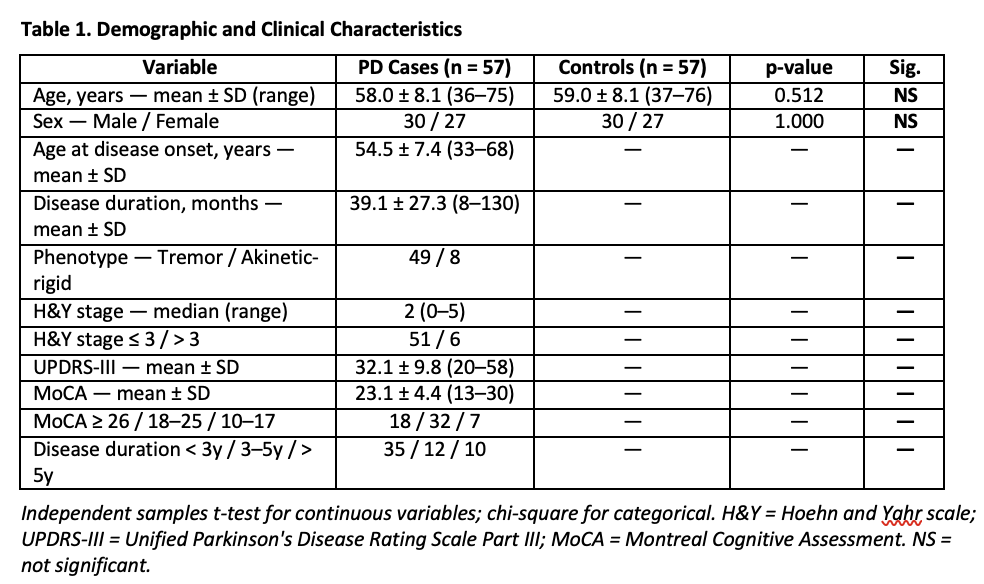
Table 1. Demographic and Clinical Characteristics
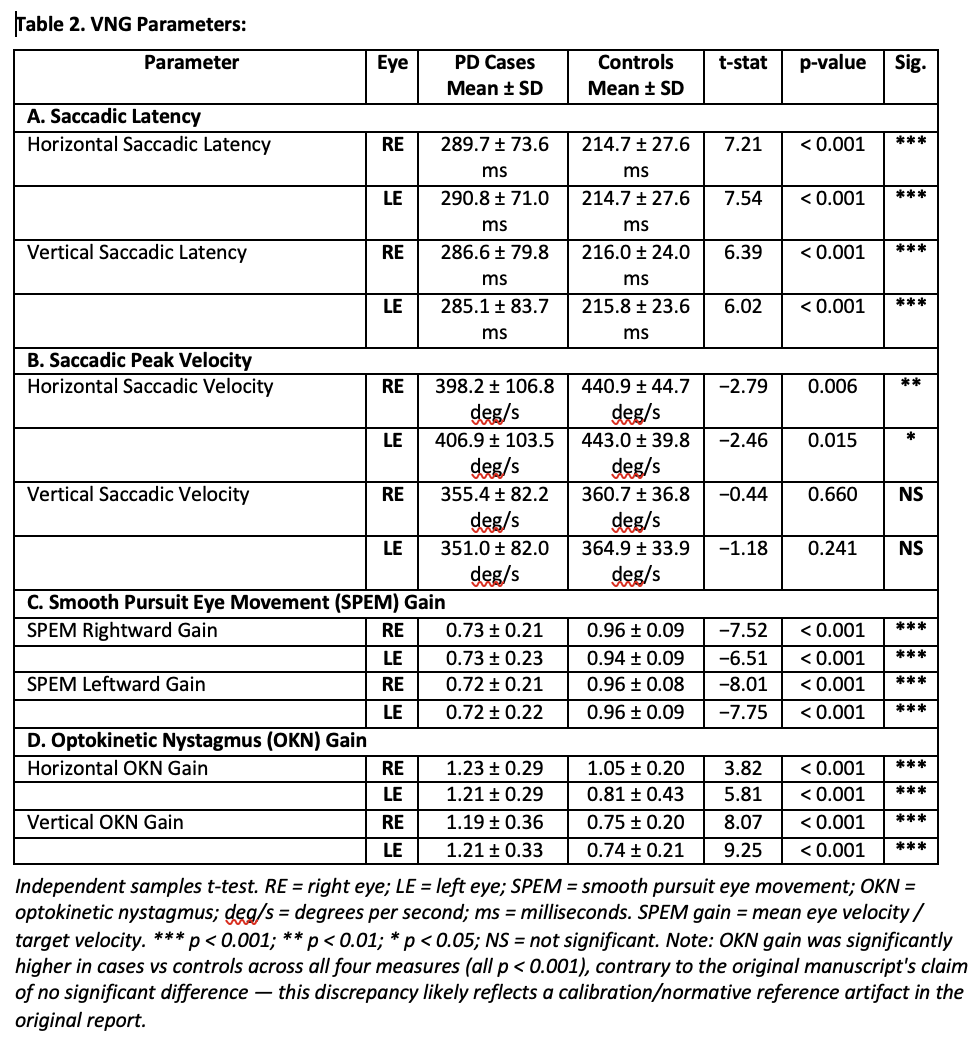
Table 2. VNG Parameters
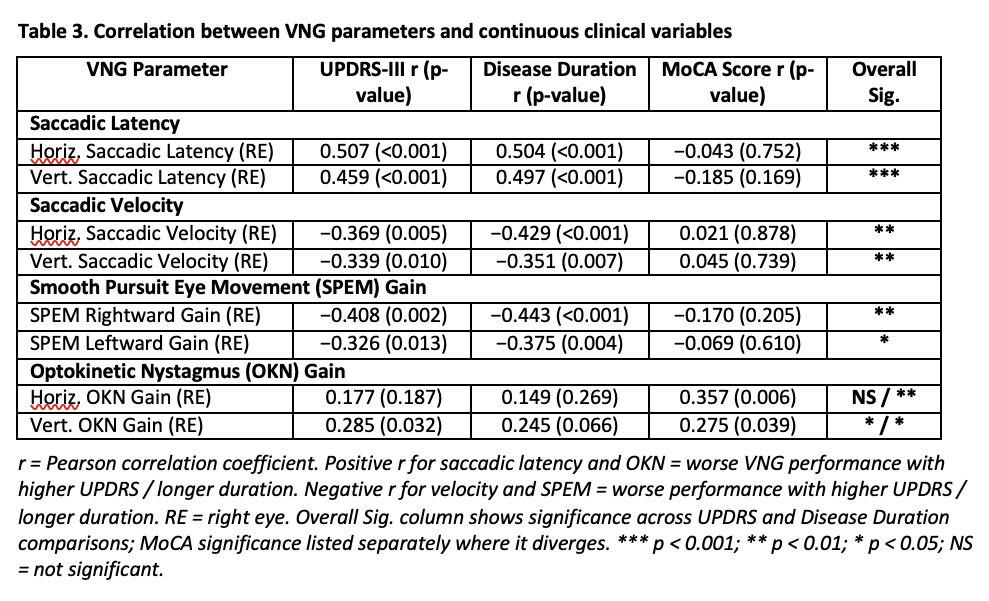
Table 3. VNG parameters and clinical variables
References: 1. Terao Y, Fukuda H, Ugawa Y, Hikosaka O: New perspectives on the pathophysiology of Parkinson’s disease as assessed by saccade performance: A clinical review. Clinical Neurophysiology. 2013, 124:1491–506. 10.1016/J.CLINPH.2013.01.021
2. Antoniades CA, Kennard C: Ocular motor abnormalities in neurodegenerative disorders. Eye 2015 29:2. 2014, 29:200–7. 10.1038/eye.2014.276
3. Shaikh AG, Ghasia FF: Saccades in Parkinson’s disease: Hypometric, slow, and maladaptive. Prog Brain Res. 2019, 249:81–94. 10.1016/BS.PBR.2019.05.001
4. Pinkhardt EH, Kassubek J: Ocular motor abnormalities in Parkinsonian syndromes. Parkinsonism Relat Disord. 2011, 17:223–30. 10.1016/J.PARKRELDIS.2010.08.004
5. White OB, Saint-cyr JA, Tomlinson RD, Sharpe JA: Ocular motor deficits in Parkinson’s disease. II. Control of the saccadic and smooth pursuit systems. Brain. 1983, 106 (Pt 3):571–87. 10.1093/BRAIN/106.3.571
6. Simuni T, Sethi K: Nonmotor manifestations of Parkinson’s disease. Ann Neurol. 2008, 64:S65–80. 10.1002/ANA.21472
7. Guo L, Normando EM, Shah PA, De Groef L, Cordeiro MF: Oculo-visual abnormalities in Parkinson’s disease: Possible value as biomarkers. Movement Disorders. 2018, 33:1390–406. 10.1002/MDS.27454
8.Jung I, Kim JS: Abnormal Eye Movements in Parkinsonism and Movement Disorders. J Mov Disord. 2019, 12:1–13. 10.14802/JMD.18034
9.Biousse V, Skibell BC, Watts RL, Loupe DN, Drews-Botsch C, Newman NJ: Ophthalmologic features of Parkinson’s disease. Neurology. 2004, 62:177–80. 10.1212/01.WNL.0000103444.45882.D8
10. Armstrong RA: Oculo-visual dysfunction in Parkinson’s disease. J Parkinsons Dis. 2015, 5:715–26. 10.3233/JPD-150686/ASSET/CF4A8C7E-4342-4166-89B3-7E9405272972/ASSETS/GRAPHIC/10.3233_JPD-150686-FIG1.JPG
To cite this abstract in AMA style:
K. Tayade, A. Karle, A. Venkitachalam, H. Bharote, D. Asole. Video-Nystagmographic Biomarkers of Oculomotor Dysfunction in Parkinson’s Disease: Correlation With Motor Severity and Cognition [abstract]. Mov Disord. 2026; 41 (suppl 1). https://www.mdsabstracts.org/abstract/video-nystagmographic-biomarkers-of-oculomotor-dysfunction-in-parkinsons-disease-correlation-with-motor-severity-and-cognition/. Accessed October 22, 2026.« Back to 2026 International Congress
MDS Abstracts - https://www.mdsabstracts.org/abstract/video-nystagmographic-biomarkers-of-oculomotor-dysfunction-in-parkinsons-disease-correlation-with-motor-severity-and-cognition/