
Objective: To quantify the diagnostic accuracy and predictive performance of α-synuclein biomarkers in isolated REM sleep behaviour disorder (iRBD), pure autonomic failure (PAF), and idiopathic hyposmia.
Background: Parkinson’s disease and related synucleinopathies have a prolonged prodromal phase creating a critical window for early detection of α-synuclein aggregation when clinical diagnosis cannot be established yet.
Method: Systematic search on PubMed, Web of Science, and Scopus to September 2025 without language restrictions for studies evaluating α-synuclein biomarkers in prodromal cohorts with data for diagnostic accuracy (2×2 tables), predictive associations with clinical diagnosis of synucleinopathy, or quantitative biomarker differences. We pooled sensitivity and specificity using a bivariate random-effects model and generated hierarchical summary receiver operating characteristic (HSROC) curves. Predictive effect sizes were pooled using random-effects models. Risk of bias and applicability were assessed with QUADAS-2.
Results: We included 42 studies comprising 59 analytic arms (48 for diagnostic accuracy; 10 for predictive and 16 for quantitative analyses), with 2,135 prodromal participants and 2,676 controls. Across all diagnostic arms, pooled sensitivity was 0.79 (95% CI 0.73–0.84) and pooled specificity 0.92 (0.88–0.94), with substantial heterogeneity (I² 83.6% and 81.6% respectively); HSROC area under the curve was 0.91. Diagnostic performance differed by phenotype and biospecimen: PAF showed consistently high accuracy (sensitivity 0.92, specificity 0.96), iRBD showed highest accuracy in cerebrospinal fluid assays (0.84 and 0.95), and hyposmia showed low sensitivity but very high specificity (0.48 and 0.97). In predictive analysis (876 participants; 140 incident cases), α-synuclein positivity was associated with increased risk of reaching a diagnostic milestone, most consistently for cerebrospinal fluid seed amplification assays (RR 2.28 [1.09–4.77]); skin pS129 synuclein pathology showed no clear association (0.85 [0.27–2.68]).
Conclusion: α-synuclein biomarkers show excellent overall diagnostic accuracy in prodromal synucleinopathies, with phenotype- and biospecimens-dependent performance variability. Clinical diagnostic prediction was modest and context-dependent, supporting its use for biological confirmation and trial enrichment rather than stand-alone individual risk prediction.
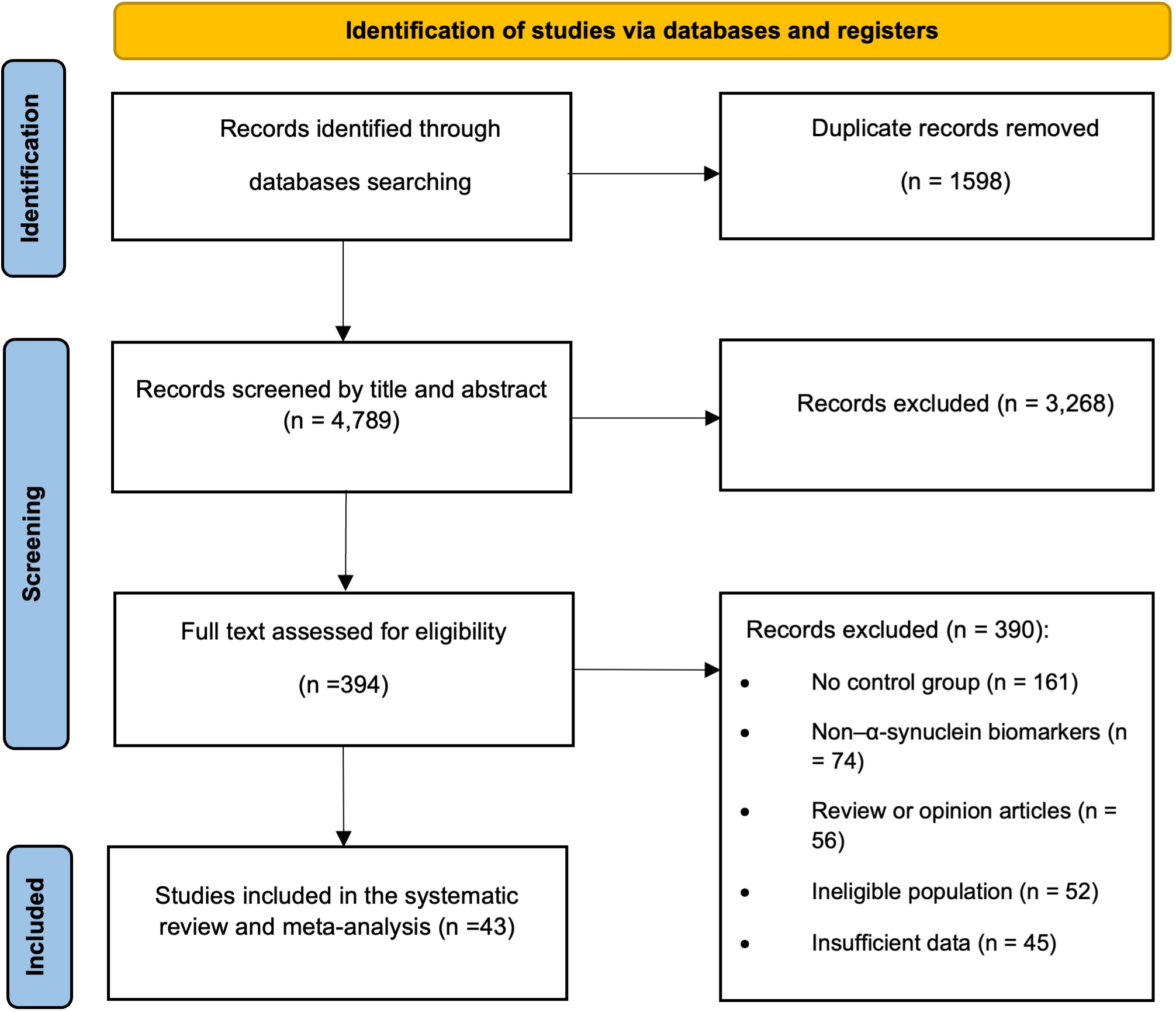
Figure 1. PRISMA flow diagram
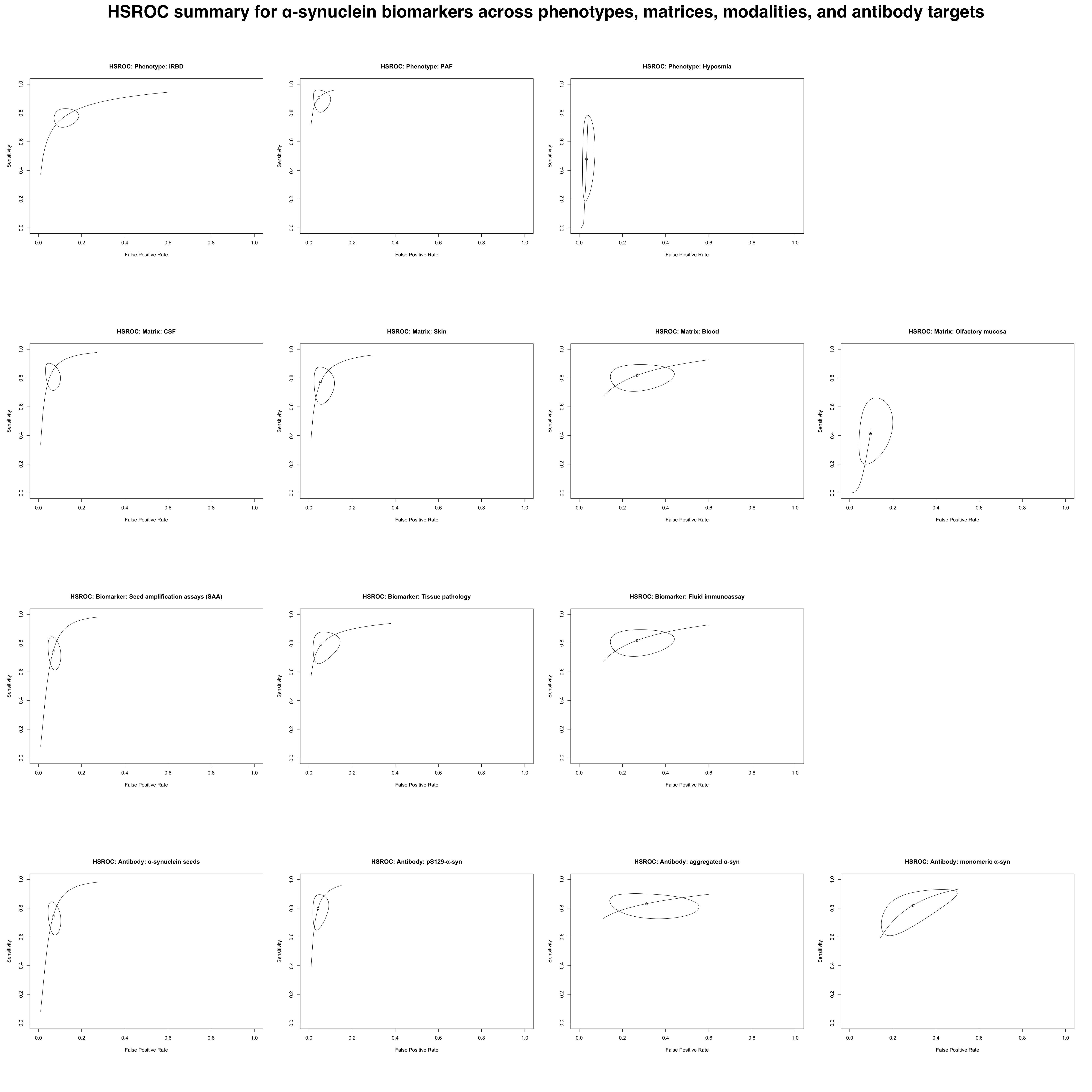
Figure 3. HSROC curves
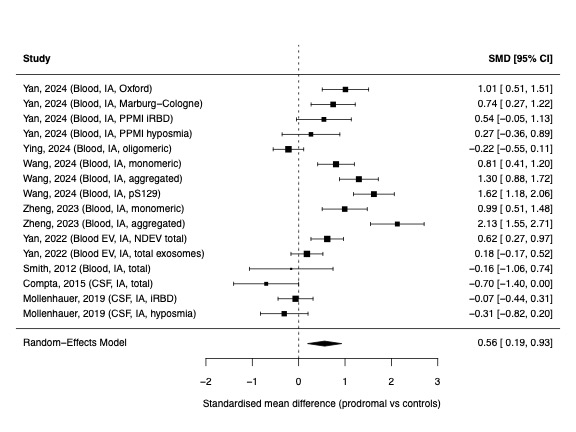
Quantitative differences in α-synuclein biomarkers
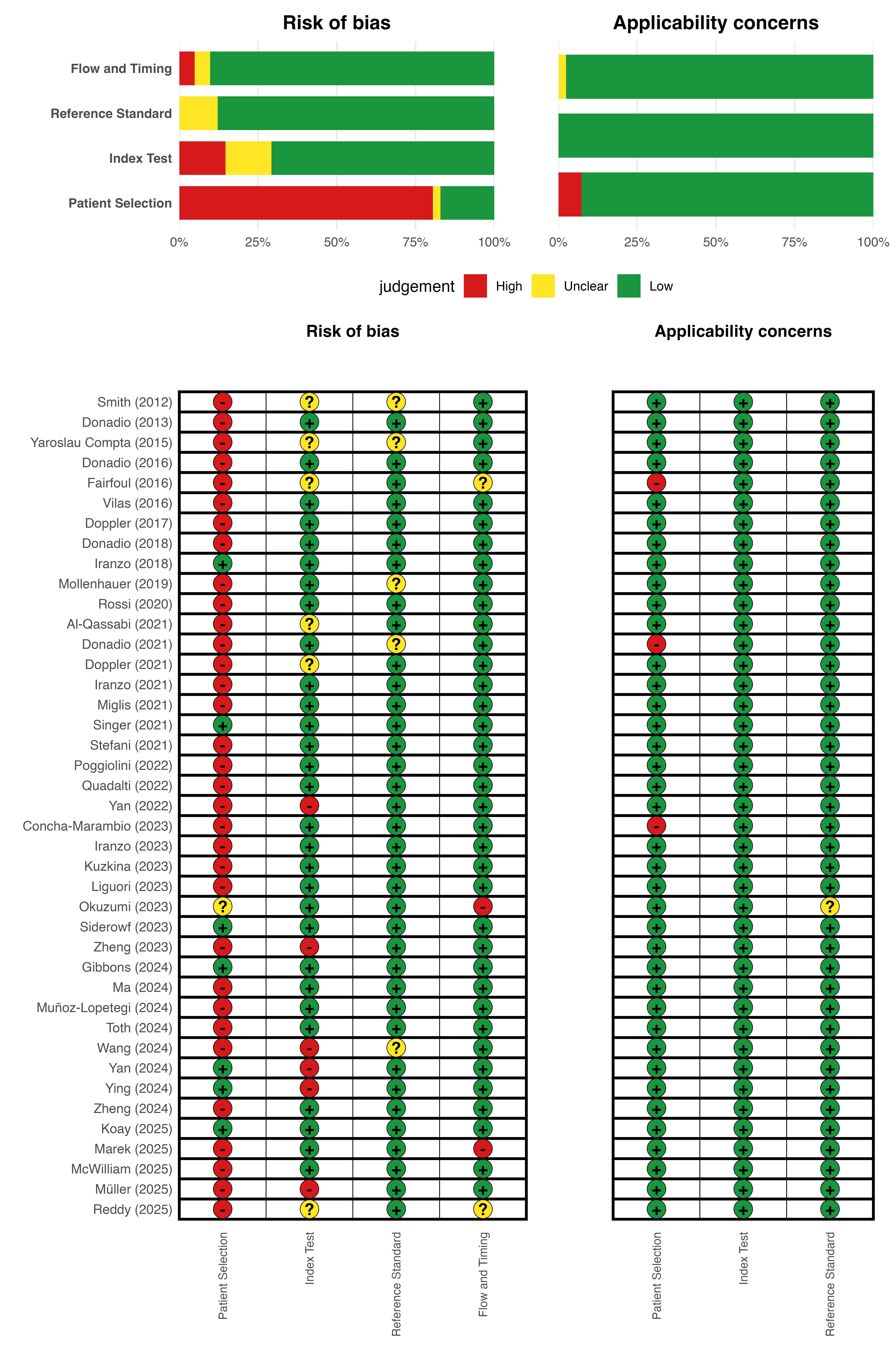
Supplementary Figure 1. Risk of bias
References: 1. Berg D, Postuma RB, Adler CH, Bloem BR, Chan P, Dubois B, et al. MDS research criteria for prodromal Parkinson’s disease. Mov Disord. 2015;30(12):1600–11.
2. Fearnley JM, Lees AJ. Ageing and Parkinson’s disease: substantia nigra regional selectivity. Brain. 1991;114 ( Pt 5):2283–301.
3. Cheng HC, Ulane CM, Burke RE. Clinical progression in Parkinson disease and the neurobiology of axons. Ann Neurol. 2010;67(6):715–25.
4. Goldman JG, Postuma R. Premotor and nonmotor features of Parkinson’s disease. Curr Opin Neurol. 2014;27(4):434–41.
5. Ma L-Y, Liu G-L, Wang D-X, Zhang M-M, Kou W-Y, Feng T. Alpha-Synuclein in Peripheral Tissues in Parkinson’s Disease. ACS Chemical Neuroscience. 2019;10(2):812–23.
6. Mayà G, Iranzo A, Gaig C, Sánchez-Valle R, Serradell M, Molina-Porcel L, et al. Post-mortem neuropathology of idiopathic rapid eye movement sleep behaviour disorder: a case series. The Lancet Neurology. 2024;23(12):1238–51.
7. Beach TG, Adler CH, Sue LI, Vedders L, Lue L, White Iii CL, et al. Multi-organ distribution of phosphorylated alpha-synuclein histopathology in subjects with Lewy body disorders. Acta Neuropathol. 2010;119(6):689–702.
8. Gelpi E, Navarro-Otano J, Tolosa E, Gaig C, Compta Y, Rey MJ, et al. Multiple organ involvement by alpha-synuclein pathology in Lewy body disorders. Mov Disord. 2014;29(8):1010–8.
9. Ma LY, Liu GL, Wang DX, Zhang MM, Kou WY, Feng T. Alpha-Synuclein in Peripheral Tissues in Parkinson’s Disease. ACS Chem Neurosci. 2019;10(2):812–23.
10. Fairfoul G, McGuire LI, Pal S, Ironside JW, Neumann J, Christie S, et al. Alpha-synuclein RT-QuIC in the CSF of patients with alpha-synucleinopathies. Ann Clin Transl Neurol. 2016;3(10):812–8.
11. Shahnawaz M, Tokuda T, Waragai M, Mendez N, Ishii R, Trenkwalder C, et al. Development of a Biochemical Diagnosis of Parkinson Disease by Detection of α-Synuclein Misfolded Aggregates in Cerebrospinal Fluid. JAMA Neurol. 2017;74(2):163–72.
12. Bellomo G, De Luca CMG, Paoletti FP, Gaetani L, Moda F, Parnetti L. α-Synuclein Seed Amplification Assays for Diagnosing Synucleinopathies: The Way Forward. Neurology. 2022;99(5):195–205.
13. Iranzo A, Fairfoul G, Ayudhaya ACN, Serradell M, Gelpi E, Vilaseca I, et al. Detection of α-synuclein in CSF by RT-QuIC in patients with isolated rapid-eye-movement sleep behaviour disorder: a longitudinal observational study. Lancet Neurol. 2021;20(3):203–12.
14. Yoo D, Bang JI, Ahn C, Nyaga VN, Kim YE, Kang MJ, et al. Diagnostic value of α-synuclein seeding amplification assays in α-synucleinopathies: A systematic review and meta-analysis. Parkinsonism Relat Disord. 2022;104:99–109.
15. Zheng Y, Li S, Yang C, Yu Z, Jiang Y, Feng T. Comparison of biospecimens for α-synuclein seed amplification assays in Parkinson’s disease: A systematic review and network meta-analysis. Eur J Neurol. 2023;30(12):3949–67.
To cite this abstract in AMA style:
S. Virameteekul, S. Lim, R. Postuma, E. de Pablo-Fernández, A. Noyce. α-Synuclein biomarkers in prodromal synucleinopathies: a systematic review and meta-analysis. [abstract]. Mov Disord. 2026; 41 (suppl 1). https://www.mdsabstracts.org/abstract/%ce%b1-synuclein-biomarkers-in-prodromal-synucleinopathies-a-systematic-review-and-meta-analysis/. Accessed October 1, 2026.« Back to 2026 International Congress
MDS Abstracts - https://www.mdsabstracts.org/abstract/%ce%b1-synuclein-biomarkers-in-prodromal-synucleinopathies-a-systematic-review-and-meta-analysis/