Category: Parkinson's Disease: Cognitive functions
Objective: To present data on 10 year longitudinal clinical and biological characteristics of sporadic Parkinson Disease (sPD) participants in the Parkinson’s Progression Markers Initiative (PPMI) cohort. To explore biological predictors of variance of progression.
Background: Defining biological predictors and longitudinal correlates of clinical progression is essential for identification of distinct biologically driven PD subtypes to ultimately guide targeted drug development.
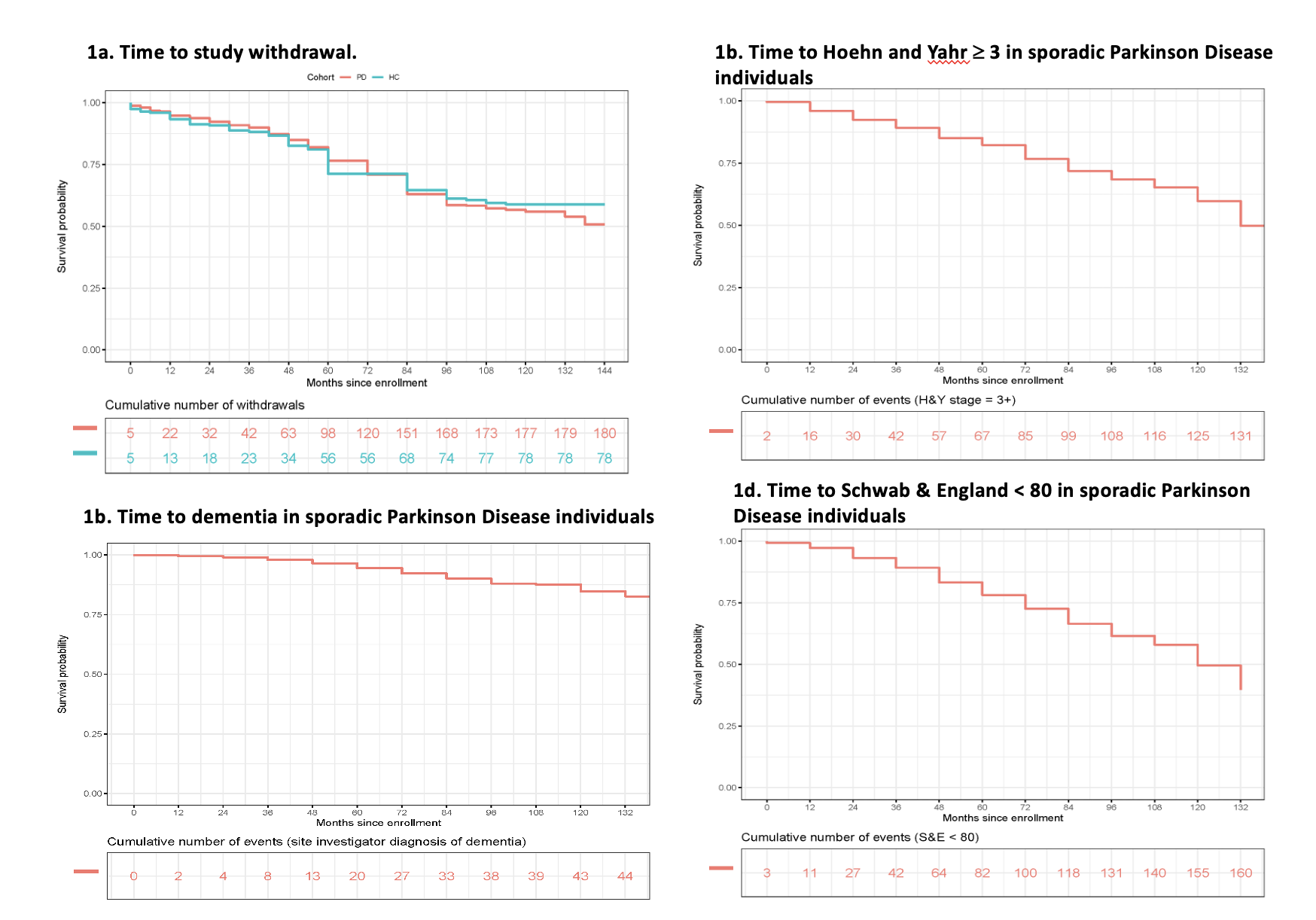
Method: We analyzed longitudinal data from the PPMI sPD cohort (N=397). Participants were assessed longitudinally with comprehensive motor and non-motor scales, DAT imaging and biofluid biomarkers. Kaplan Meier plots were generated to assess for time to study withdrawal, and functional markers of disease progression, including diagnosis of dementia (PDD), Schwab and England (S&E) score <80 and Hoehn and Yahr (H&Y) stage greater or equal to 3.
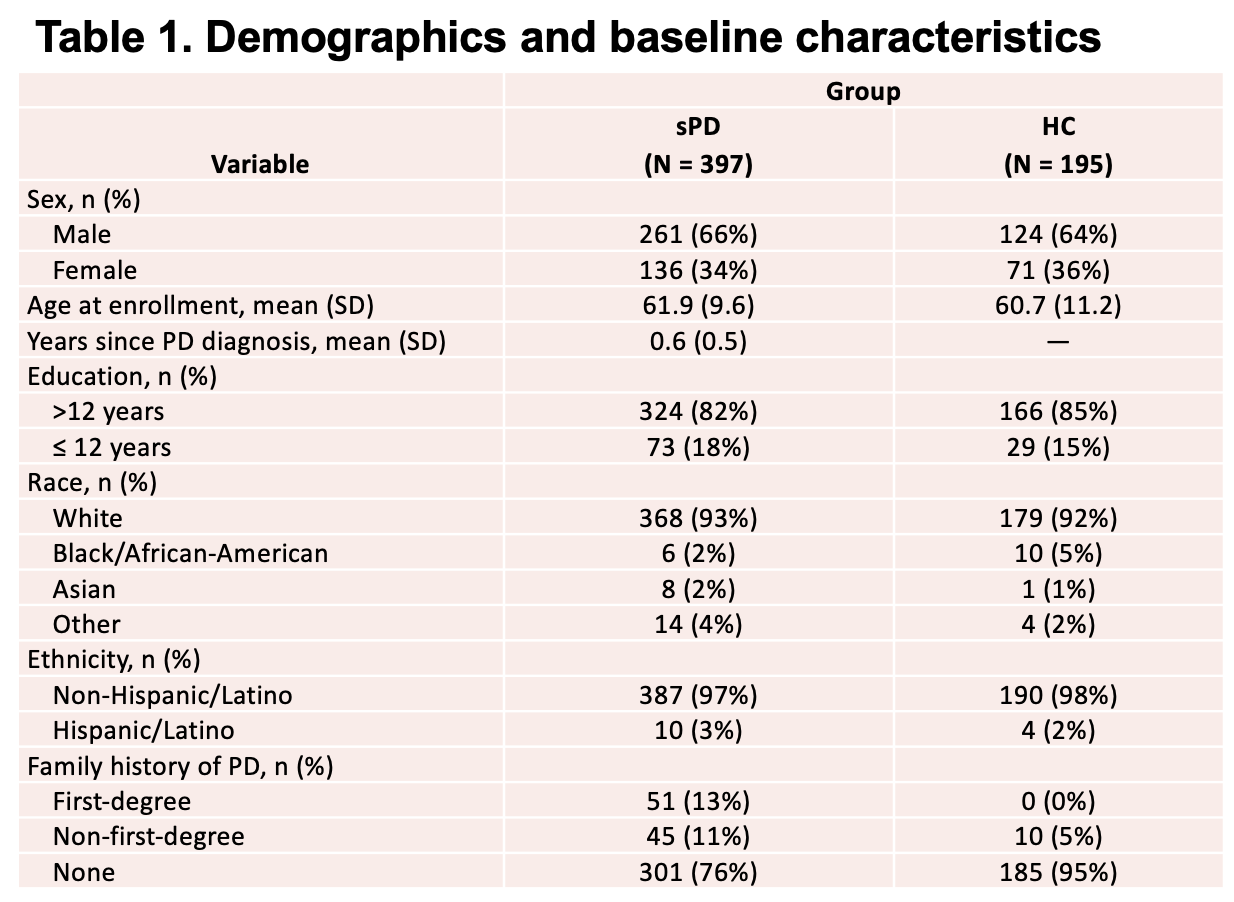
Results: At enrollment, sPD participants had a mean (SD) age 61.9 (9.6) years, 66% male, 0.6 (0.5) disease duration (Table 1). Retention rate was 79% at 5 years and 58% at 10 years and data completeness remained near 100% for most clinical measures in all groups. At 10 years follow up, there was a decline in functional independence (H&Y stage ³ 3 or a S&E score <80); nonetheless, only 20% of participants had developed PDD (Figure 1).
Conclusion: We present data on comprehensive 10-year clinical characterization of the sPD PPMI cohort. Of interest, initial data suggests that the prevalence of PDD a decade after disease diagnosis may be lower than previously reported. PPMI represents the largest PD cohort with available comprehensive clinical, imaging and biofluid biomarker longitudinal data. Results to be reported include longitudinal change in DAT binding, longitudinal comparison of biofluid biomarkers and association between baseline biomarkers and clinical progression.
To cite this abstract in AMA style:
P. Gonzalez-Latapi, T. Simuni, A. Siderowf, J. Fedler, M. Brumm, C. Gochanour, C. Coffey, K. Marek. 10 year longitudinal change in clinical and biological characteristics of sporadic Parkinson Disease PPMI cohort [abstract]. Mov Disord. 2023; 38 (suppl 1). https://www.mdsabstracts.org/abstract/10-year-longitudinal-change-in-clinical-and-biological-characteristics-of-sporadic-parkinson-disease-ppmi-cohort/. Accessed November 11, 2026.« Back to 2023 International Congress
MDS Abstracts - https://www.mdsabstracts.org/abstract/10-year-longitudinal-change-in-clinical-and-biological-characteristics-of-sporadic-parkinson-disease-ppmi-cohort/