
Category: Parkinson’s Disease: Clinical Trials
Objective: To investigate the efficacy and potential disease-modifying effects of of long-term transcutaneous auricular vagus nerve stimulation(taVNS) in patients with early-stage Parkinson’s Disease(PD).
Background: PD currently lacks established disease-modifying therapies. VNS has shown anti-inflammatory and neuroprotective potential in preclinical models[1]. Diffusion tensor imaging (DTI) has identified Free Water(FW) in the posterior substantia nigra (pSN) as a robust, non-invasive biomarker for disease progression[2,3], with values typically increasing longitudinally as nigral degeneration occurs[4]. This study explored whether long-term taVNS can stabilize pSN FW.
Method: Ten patients with early-stage PD (Hoehn and Yahr ≤ 2.5, disease duration ≤ 3 years) were enrolled in this single-arm pilot study. All participants received 30 minutes of daily unilatera taVNS (left-sided, 20 Hz frequency, 500μs pulse width, intensity at sensory threshold) for 6 months. Motor symptoms were assessed using the UPDRS-III scale in the “ON” medication state, and DTI scans were performed to calculate pSN FW values at baseline and at month 6. Statistical analysis included paired t-tests and a sensitivity analysis to account for clinical outliers.
Results: taVNS was well-tolerated with no adverse events reported. A significant reduction in mean UPDRS-III scores was observed after 6 months (17.0±16.6vs.8.9±8.1,p=0.035). Sensitivity analysis confirmed that this clinical improvement remained statistically significant even after excluding a highly sensitive outlier (12.7±10.3vs.7.6±6.9, p=0.041,n=9). In the stimulated hemisphere (left), pSN FW remained stable over 6 months (0.543±0.106vs.0.551±0.101,p=0.609). Conversely, the non-stimulated (right) pSN exhibited a significant increase in FW (0.540±0.088vs.0.580±0.086,p=0.039). The mean bilateral pSN FW showed no significant increase (0.542±0.091vs.0.566±0.088,p=0.103)[figure 1].
Conclusion: Long-term taVNS treatment provided significant clinical motor benefits and demonstrated preliminary evidence of halting neurodegenerative progression in the stimulated pSN. These results suggested that taVNS may exert disease-modifying effects, and support further investigation in larger randomized, sham-controlled disease-modification trials.
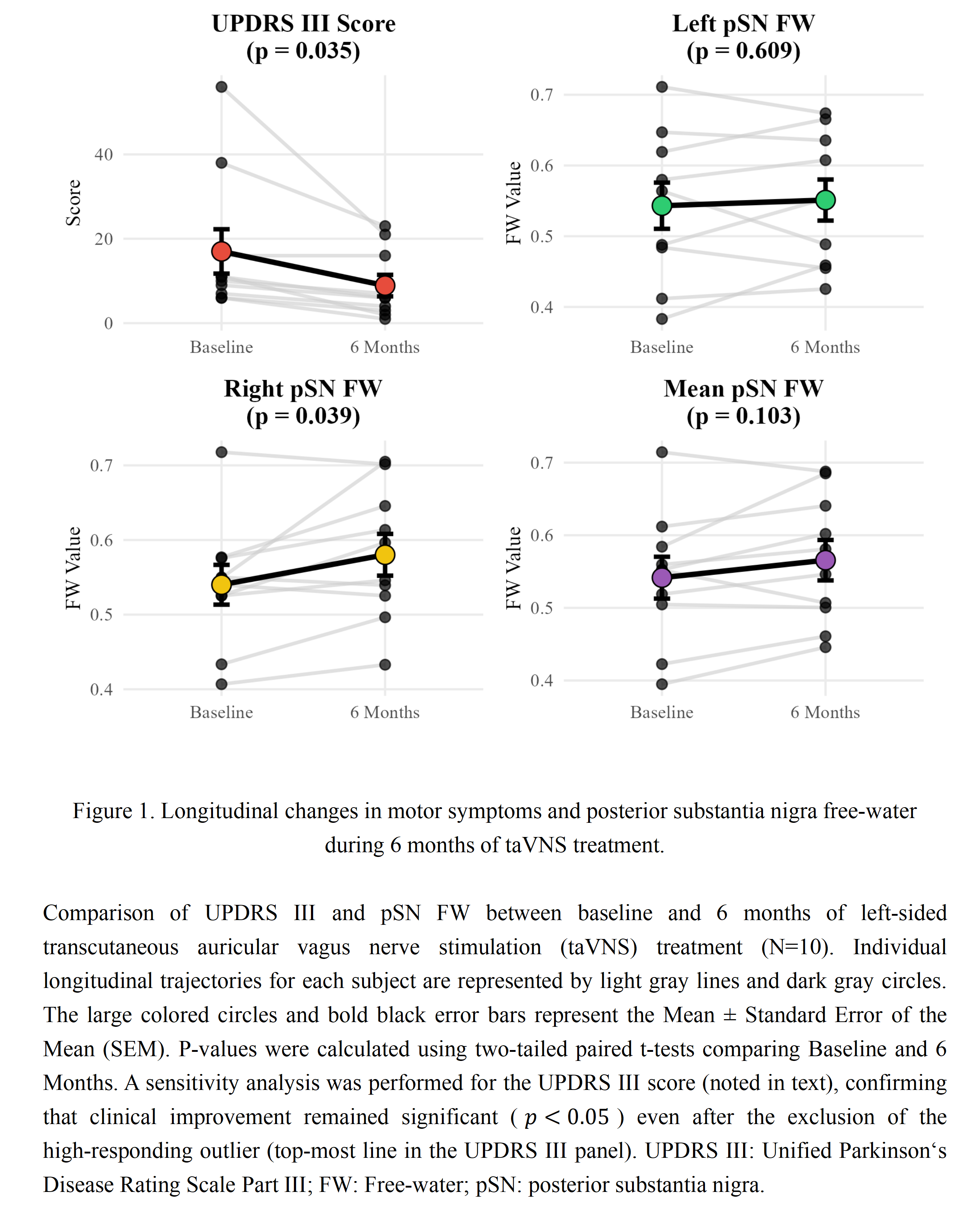
Figure 1
References: 1. Proietti F, Ottaviani MM, Burchi E, Vivacqua G, Anzini G, Ricciuti RA, Capone F, Macefield VG, Di Lazzaro V and Marano M. Vagus Nerve Stimulation in Movement Disorders, from Principles to a Systematic Review of Evidence. Movement Disorders: Official Journal of the Movement Disorder Society. 2025. 2025;40(12):2559-2577
2. Burciu RG, Ofori E, Archer DB, Wu SS, Pasternak O, McFarland NR, Okun MS and Vaillancourt DE. Progression marker of Parkinson’s disease: a 4-year multi-site imaging study. Brain: A Journal of Neurology. 2017;140:2183–2192.
3. Ofori E, Pasternak O, Planetta PJ, Li H, Burciu RG, Snyder AF, Lai S, Okun MS and Vaillancourt DE. Longitudinal changes in free-water within the substantia nigra of Parkinson’s disease. Brain: A Journal of Neurology. 2015;138:2322–2331.
4. López-Aguirre M, Matarazzo M, Blesa J, Monje MHG, Rodríguez-Rojas R, Sánchez-Ferro A, Obeso JA and Pineda-Pardo JA. Dopaminergic denervation and associated MRI microstructural changes in the nigrostriatal projection in early Parkinson’s disease patients. NPJ Parkinson’s disease. 2023;9:144.
To cite this abstract in AMA style:
JX. Shi, KZ. Zhang. A 6-month Pilot Study of Disease-Modifying Potential of Long-term Transcutaneous Auricular Vagus Nerve Stimulation in Parkinson’s Disease [abstract]. Mov Disord. 2026; 41 (suppl 1). https://www.mdsabstracts.org/abstract/a-6-month-pilot-study-of-disease-modifying-potential-of-long-term-transcutaneous-auricular-vagus-nerve-stimulation-in-parkinsons-disease/. Accessed October 1, 2026.« Back to 2026 International Congress
MDS Abstracts - https://www.mdsabstracts.org/abstract/a-6-month-pilot-study-of-disease-modifying-potential-of-long-term-transcutaneous-auricular-vagus-nerve-stimulation-in-parkinsons-disease/