
Category: Dystonia: Pathophysiology, Imaging
Objective: The objective of this study was to assess changes in transcranial sonography (TCS) in patients with focal dystonia (FD) with or without tremor and to evaluate its role as a potential tool in differentiating these conditions.
Background: The association between tremor and dystonia has been recognized for over a century; however, there are still uncertainties regarding the shared underlying pathophysiology of these disorders. Discriminating between these conditions in a clinical setting remains challenging, and there is a need for reliable biomarkers to aid in differential diagnosis. Transcranial sonography (TCS) is a reliable, easily accessible, non-invasive, and cost-effective tool that provides information about brain morphology and has been proven useful in differentiating various movement disorders. Previous studies have reported hyperechogenicity of the lentiform nucleus (LN) in dystonia patients and hypothesized its role as an ultrasound feature of all dystonia.
Method: The study enrolled 92 FD patients who were regularly monitored and treated at the Clinic of Neurology, University Clinical Center of Serbia. They were assessed for the presence of TCS changes.
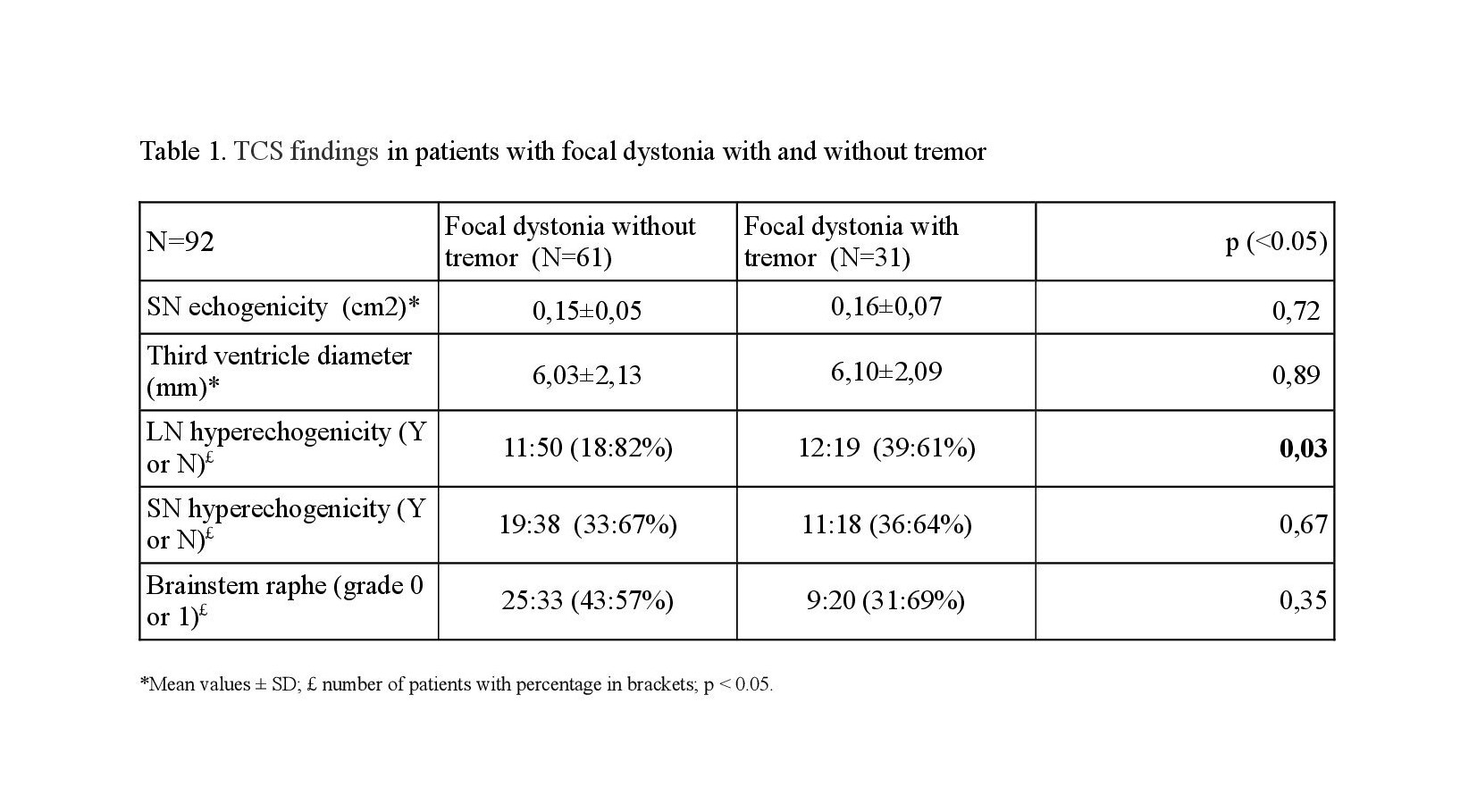
Results: Of the 92 FD patients, 31 (33.7%) had either head tremor or head and arm tremor combined. There were no clinically significant changes observed in the echogenicity of the substantia nigra (SN) or diameter of the third ventricle between the groups. However, TCS revealed a significantly higher prevalence of hyperechogenicity in the nucleus lentiformis (LN) in patients with FD and tremor (p < 0.05) (Table 1).
Conclusion: The higher prevalence of LN hyperechogenicity in patients with FD and tremor suggests a possible role of the LN in the pathogenesis of tremor, as well as highlighting a shared pathophysiological mechanism with dystonia. However, further investigations with a larger sample size are necessary to confirm these findings.
To cite this abstract in AMA style:
č. Jovanović, I. Petrović, N. Dragašević Mišković, A. Pavlović, M. Mijajlović, M. Svetel. A role of transcranial sonography in evaluating patients with dystonia and tremor [abstract]. Mov Disord. 2023; 38 (suppl 1). https://www.mdsabstracts.org/abstract/a-role-of-transcranial-sonography-in-evaluating-patients-with-dystonia-and-tremor/. Accessed October 14, 2026.« Back to 2023 International Congress
MDS Abstracts - https://www.mdsabstracts.org/abstract/a-role-of-transcranial-sonography-in-evaluating-patients-with-dystonia-and-tremor/