
Category: Autoimmune Movement Disorders
Objective: To assess clinico-demographic features and outcomes of anti-amphiphysin Stiff-Person Spectrum Disorders (SPSD), through an Asian case series highlighting an unusual isolated upper-limb presentation, and a systematic review.
Background: Anti-amphiphysin SPSD are paraneoplastic syndromes where neurological symptoms often predate malignancy [1]; however, data, particularly in Asians, are scarce.
Method: We describe two Asian women with breast adenocarcinoma-associated anti-amphiphysin SPSD (upper-limb Stiff-Limb Syndrome [SLS] and classic Stiff-Person Syndrome [SPS]). A systematic search of Medline, Embase and Cochrane yielded 47 records (Fig.1). After excluding three aggregate studies, 44 studies (n=62), and two cases from this present study were analysed (n=64).
Results: Case 1 (Chinese Malaysian) describes upper-limb SLS achieving full resolution after early tumour resection and intravenous immunoglobulin (IVIG). Case 2 (Indian) describes classic SPS with initial relief from IVIG, but with death occurring from cancer progression. The cohort was 76.6% female (n=49/64); mean onset age 61.3±11.4 years. Phenotypes comprised Classic SPS (56.3%, n=36/64), SLS (28.1%), and Progressive Encephalomyelitis with Rigidity and Myoclonus (PERM)/SPS-Plus (15.6%). Patients were mostly from the Americas (53.1%, n=34/64) and Europe (28.1%); only 10.9% were Asians. Analysis found a stiffness hierarchy: lower limbs (82.2%, n=37/45), followed by upper limbs (57.8%), spine (55.6%), neck (28.9%), abdomen (26.7%), thorax (8.9%) and face (2.2%) (Fig.2). Upper-limb stiffness was significantly rarer in SLS (12.5%, n=1/8) than other phenotypes (Classic SPS: 59.3%, n=16/27; PERM/SPS-Plus: 90.0%, n=9/10, p=0.004); Case 1 is the first reported anti-amphiphysin upper-limb SLS. Malignancy occurred in 93.8% (n=60/64), most involving breast (73.4%) or lung (14.1%). Symptoms preceded cancer detection in 80.0% (n=32/40) by median (range: 1-60) of 8 months. Overall, 54.8% (n=23/42) had good outcomes (modified Rankin scale [mRS]≤2), including 68.0% (n=17/25) receiving “triple therapy” (symptomatic, immunomodulatory, oncological) and 76.9% (n=10/13) with confirmed oncological remission (Table 1).
Conclusion: Properly managed, anti-amphiphysin SPSD has good outcomes, particularly following successful cancer treatment. Atypical presentations, including upper-limb SLS, warrant high diagnostic suspicion.
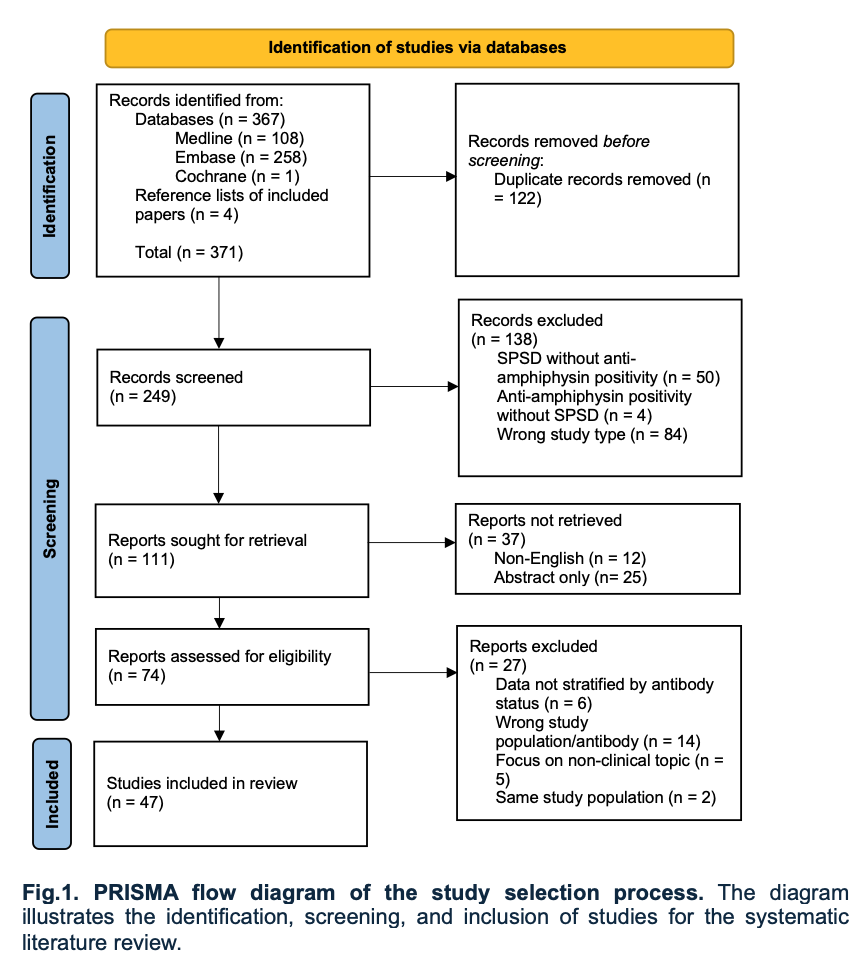
Fig.1.
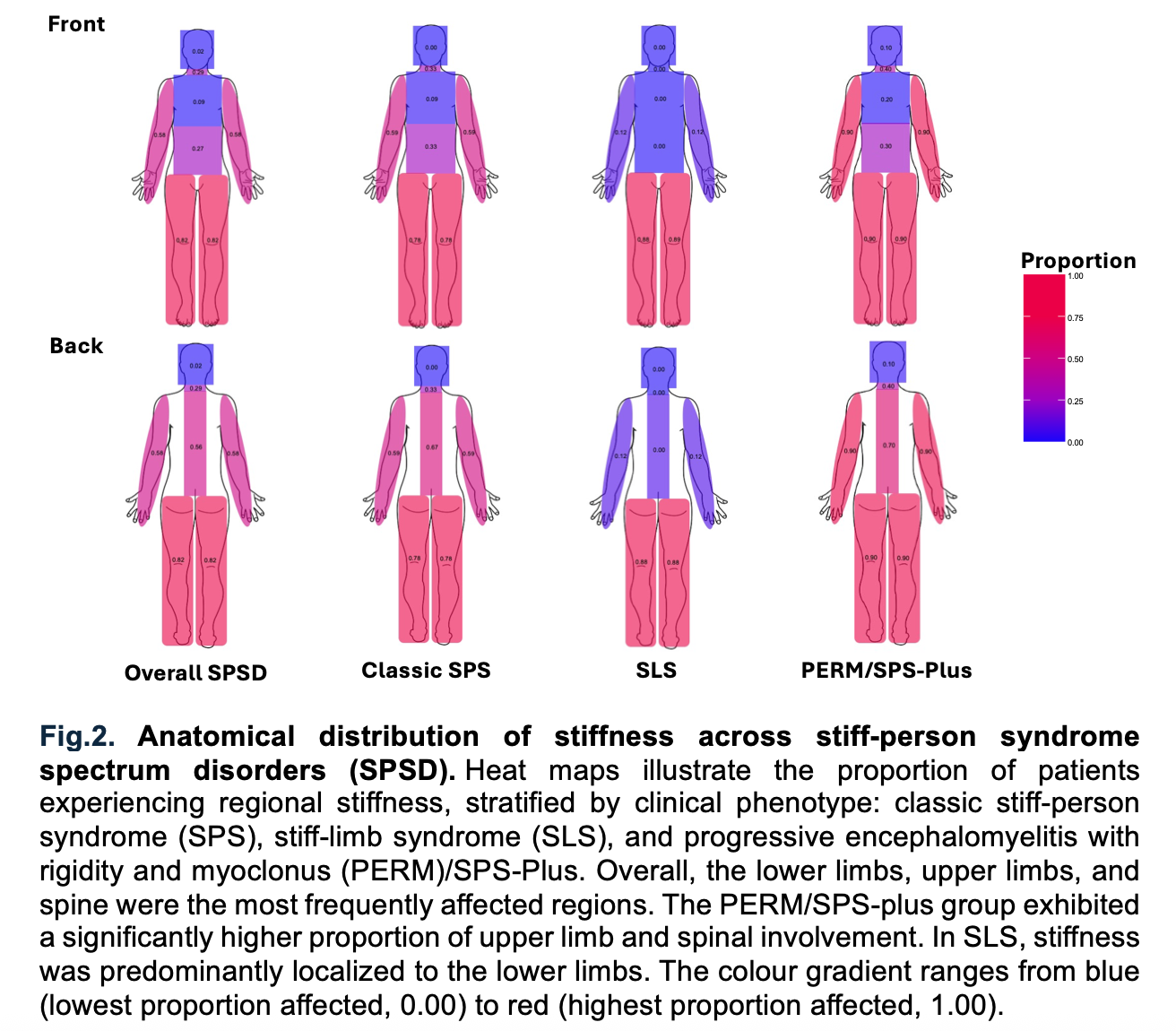
Fig.2.
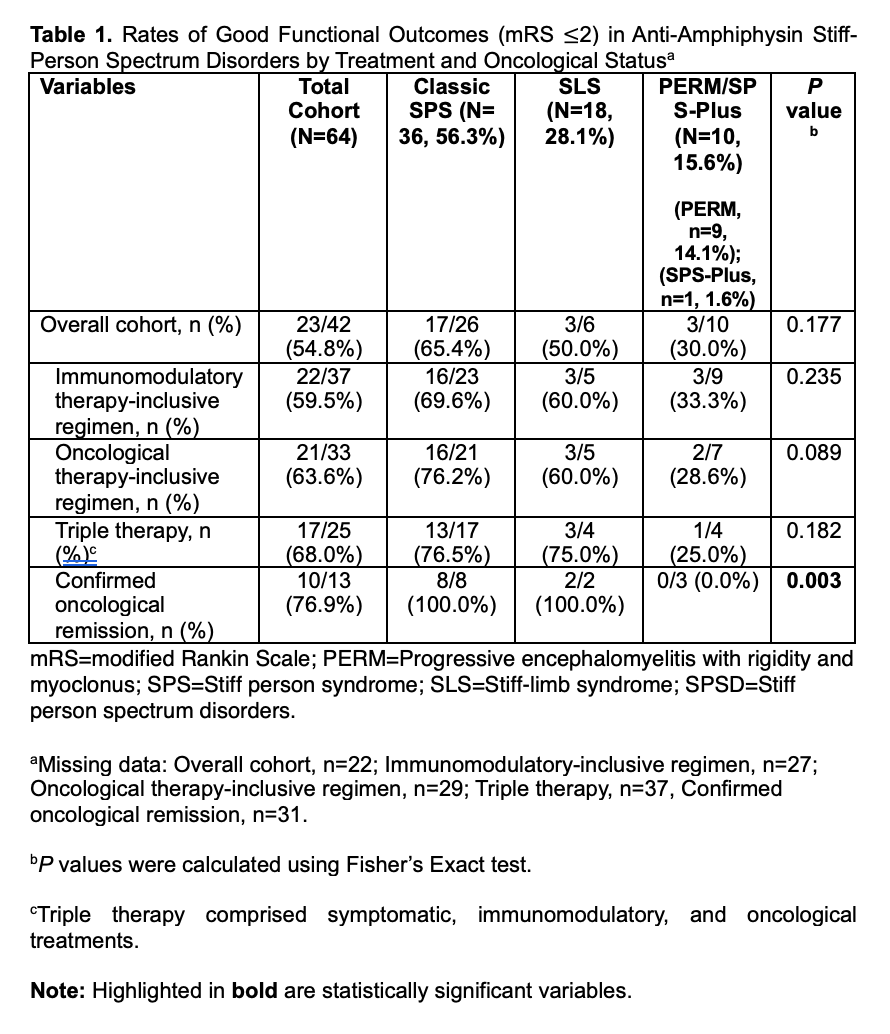
Table 1.
References: [1] Pittock SJ, Lucchinetti CF, Parisi JE, et al. Amphiphysin autoimmunity: paraneoplastic accompaniments. Ann Neurol. 2005;58(1):96–107.
To cite this abstract in AMA style:
AL. Lee, D. Garg, JP. Schee, AMF. Dy Closas, JWY. Tee, ESY. Wong, KJ. Goh, MH. See, MS. Tai, AH. Tan, SY. Lim. Anti-Amphiphysin Stiff-Person Spectrum Disorders: A Case Series Highlighting an Unusual Isolated Upper-limb Presentation and Systematic Review [abstract]. Mov Disord. 2026; 41 (suppl 1). https://www.mdsabstracts.org/abstract/anti-amphiphysin-stiff-person-spectrum-disorders-a-case-series-highlighting-an-unusual-isolated-upper-limb-presentation-and-systematic-review/. Accessed October 1, 2026.« Back to 2026 International Congress
MDS Abstracts - https://www.mdsabstracts.org/abstract/anti-amphiphysin-stiff-person-spectrum-disorders-a-case-series-highlighting-an-unusual-isolated-upper-limb-presentation-and-systematic-review/