
Objective: To investigate the associations between multiple sleep behaviors and the age at onset (AAO) of Parkinson’s disease (PD) using the UK Biobank.
Background: Sleep disturbances are common in patients with PD and may precede the onset of motor symptoms by several years, suggesting a potential link with prodromal neurodegeneration processes. Previous studies have shown that some sleep disorders are associated with an increased risk of PD. However, whether sleep behaviors are related to the AAO of PD remains unclear, despite its importance as a key dimension of disease heterogeneity.
Method: We identified PD cases in the UK Biobank via hospital records and self-reports. AAO was calculated by subtracting the patient’s birth year from the onset year. Baseline sleep behaviors, including sleep duration, ease of getting up, chronotype, napping, insomnia, snoring, and daytime dozing, were assessed via questionnaires. Mann–Whitney U and Kruskal–Wallis H tests were used to compare the median AAO across different sleep groups. Generalized linear regression models were then applied to estimate independent associations between each sleep behavior on AAO. Model 1 adjusted for sex, birth year, and Townsend deprivation index; Model 2 added smoking, alcohol, Body Mass Index (BMI), and physical activity. False discovery rate (FDR) correction was applied for multiple comparisons. A lag-2 sensitivity analysis excluding cases diagnosed within two years of baseline was conducted to reduce potential reverse causality.
Results: In fully adjusted models, several sleep behaviors were significantly associated with earlier PD onset (all PFDR < 0.05). Compared to their respective reference groups, earlier onset was observed among individuals reporting short sleep (≤6 hours) (β = -1.16 years), frequent napping (β = -1.12 years), and frequent insomnia (β = -1.09 years). The strongest associations were observed for frequent daytime dozing (β = -2.12 years) and difficulty getting up (β = -1.95 years) (Table 1). In sensitivity analyses, effect sizes were attenuated but remained directionally consistent. Additionally, long sleep also showed a significant association with earlier onset ((β = -0.77 years) (Table 2).
Conclusion: Our findings suggest that sleep phenotypes may be linked to the timing of PD onset and could represent clinical markers related to prodromal neurodegenerative processes.
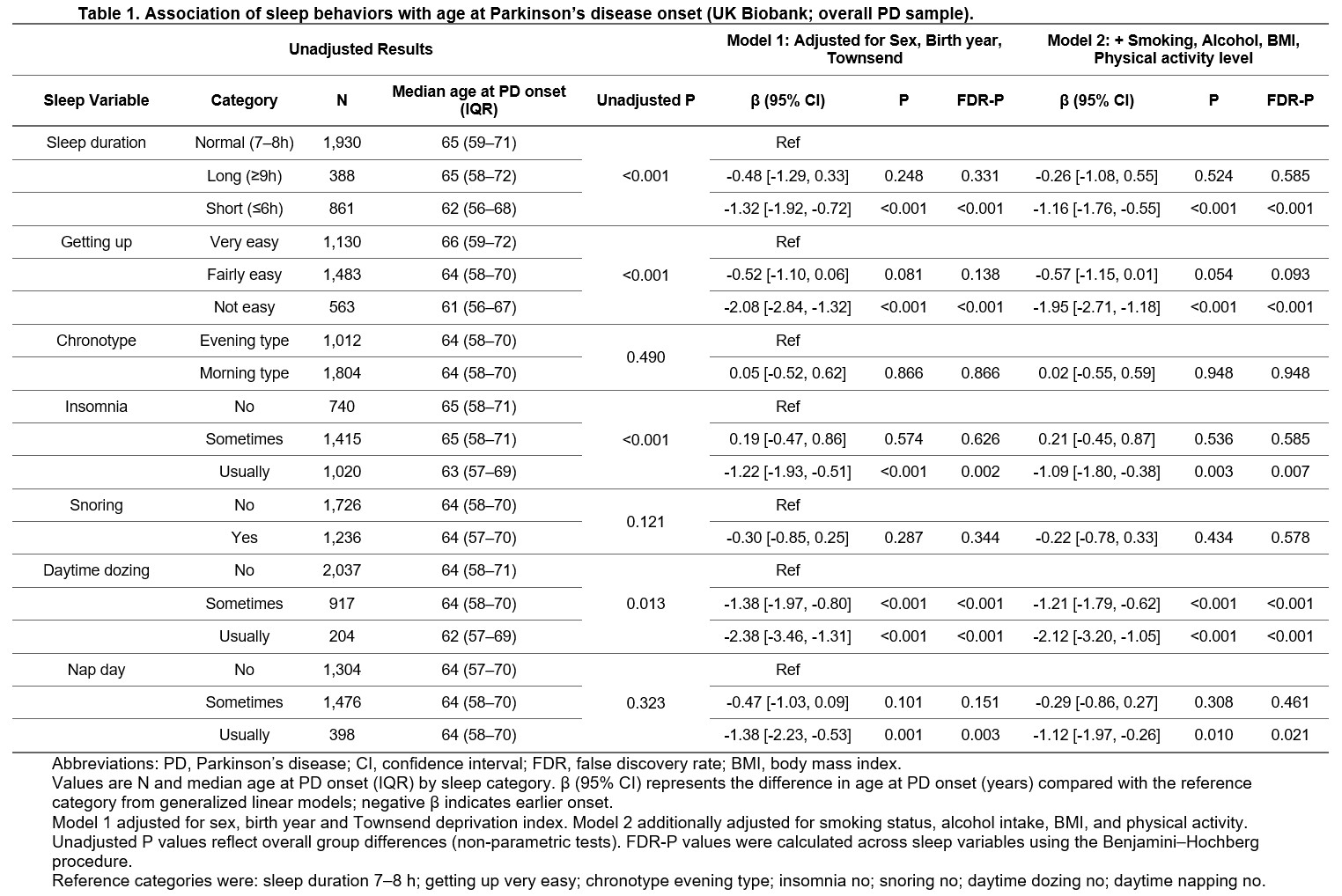
table1
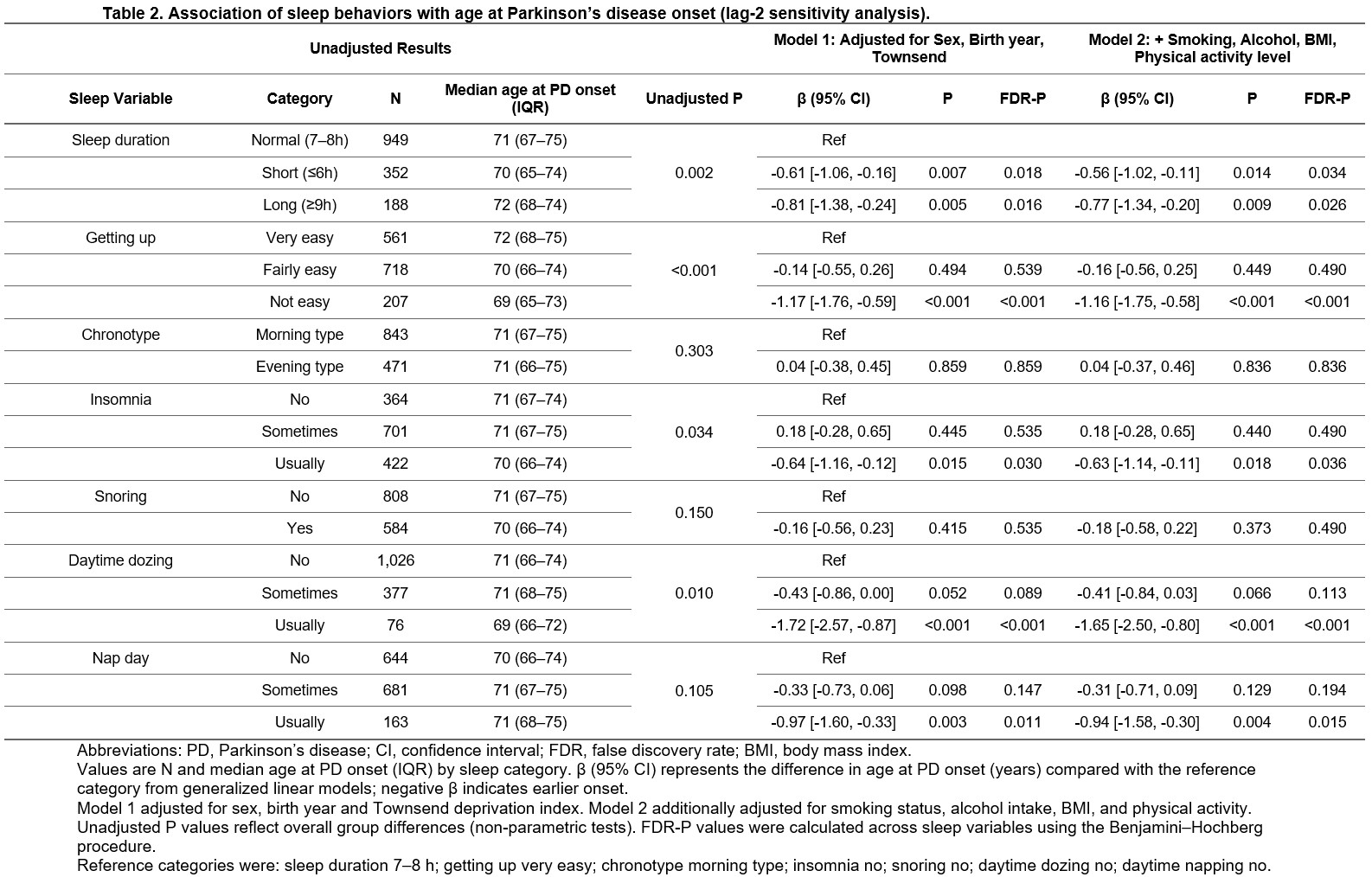
table2
To cite this abstract in AMA style:
N. Zhou, M. Fang, L. He, T. Shao, Z. Liu, B. Liu, R. Li, W. Li. Association between Sleep Behaviors and Age at Onset of Parkinson’s Disease [abstract]. Mov Disord. 2026; 41 (suppl 1). https://www.mdsabstracts.org/abstract/association-between-sleep-behaviors-and-age-at-onset-of-parkinsons-disease/. Accessed October 1, 2026.« Back to 2026 International Congress
MDS Abstracts - https://www.mdsabstracts.org/abstract/association-between-sleep-behaviors-and-age-at-onset-of-parkinsons-disease/