
Objective: To investigate the associations of serum ethanolamine plasmalogens (PlsEtns) with Parkinson’s disease (PD) diagnosis and motor progression.
Background: Altered plasmalogen levels have been reported in PD, but longitudinal evidence for specific serum species remains limited.
Method: We included 388 patients with PD and 186 age-, sex-, and education-matched healthy controls from the Parkinson’s Progression Markers Initiative (PPMI). Baseline serum PlsEtn species were compared between groups using Wilcoxon rank-sum or chi-square tests as appropriate. Spearman correlation and multivariable logistic regression were used to assess associations of serum PlsEtns with clinical features and PD diagnosis. To evaluate prognostic value, patients were stratified into quartiles according to baseline PlsEtn16:0/18:2 and PlsEtn18:0/18:2 levels. Kaplan-Meier analysis and Cox proportional hazards models were used to assess motor progression, defined as an increase of at least one Hoehn and Yahr stage during follow-up.
Results: Compared with healthy controls, patients with PD showed significantly lower levels of two linoleic acid-containing PlsEtn species, PlsEtn16:0/18:2 and PlsEtn18:0/18:2 (both p<0.05), whereas other PlsEtn species did not differ significantly (Figure1). Both species were negatively correlated with age, UPDRS part III, and total UPDRS scores, and positively correlated with MoCA, LDL, HDL, and total cholesterol (all p<0.05). In fully adjusted logistic regression, lower PlsEtn16:0/18:2 (OR 0.785, 95% CI 0.664-0.928, p=0.005) and PlsEtn18:0/18:2 (OR 0.819, 95% CI 0.713-0.940, p=0.005) were independently associated with PD diagnosis. Kaplan-Meier analysis showed that patients in the highest quartile of baseline PlsEtn18:0/18:2 had the lowest cumulative risk of motor progression (log-rank p=0.041) (Figure 2). In fully adjusted Cox regression, the lowest quartile of baseline PlsEtn18:0/18:2 was associated with a higher risk of motor progression than the highest quartile (Q1 vs Q4: HR 2.162, 95% CI 1.084-4.311, p=0.029), whereas baseline PlsEtn16:0/18:2 was not significantly associated with progression.
Conclusion: Lower serum linoleic acid-containing ethanolamine plasmalogens are associated with PD and greater clinical severity. Baseline PlsEtn18:0/18:2 may serve as a candidate blood biomarker for motor progression in PD.
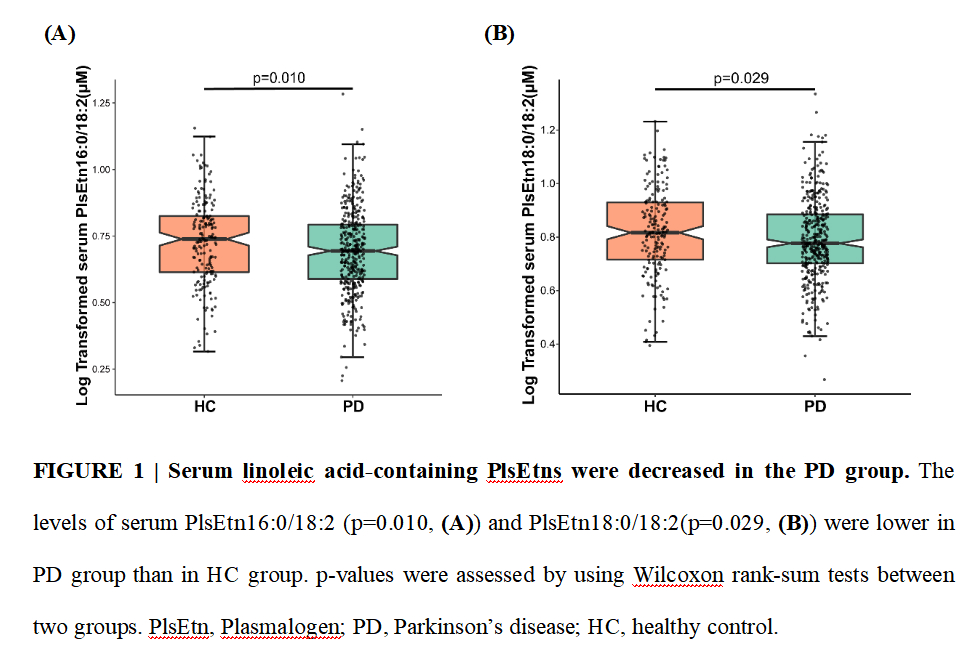
Figure 1
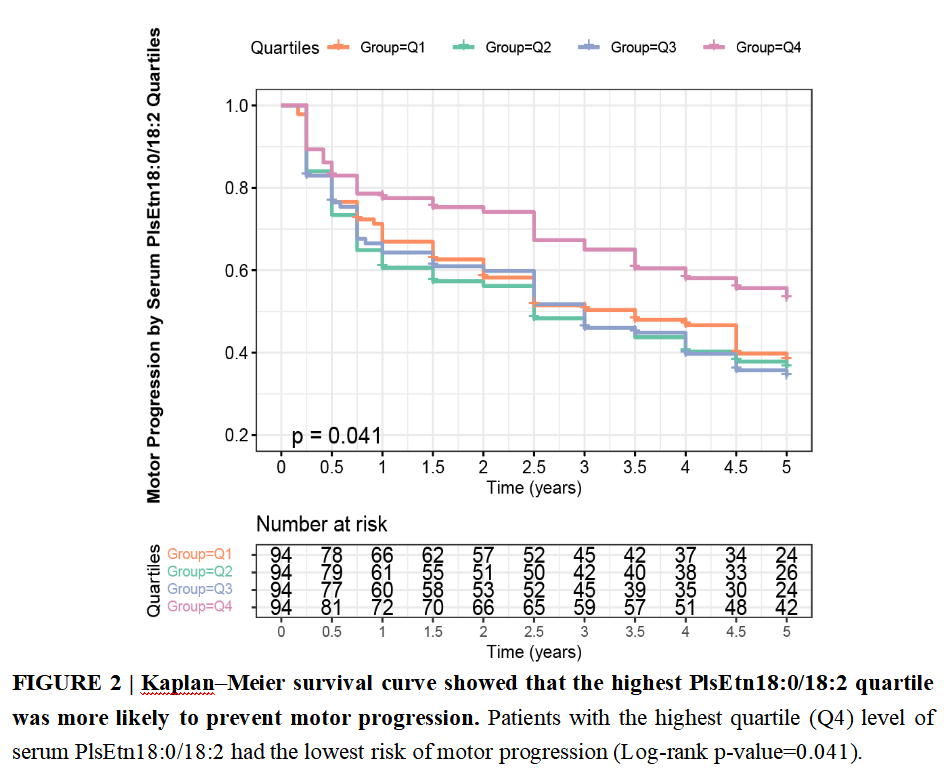
Figure 2
To cite this abstract in AMA style:
D. Wang, Y. Liu. Association of Serum Linoleic Acid-containing Plasmalogens With Parkinson’s Disease: the PPMI Study [abstract]. Mov Disord. 2026; 41 (suppl 1). https://www.mdsabstracts.org/abstract/association-of-serum-linoleic-acid-containing-plasmalogens-with-parkinsons-disease-the-ppmi-study/. Accessed October 1, 2026.« Back to 2026 International Congress
MDS Abstracts - https://www.mdsabstracts.org/abstract/association-of-serum-linoleic-acid-containing-plasmalogens-with-parkinsons-disease-the-ppmi-study/