
Category: Dystonia: Clinical Trials
Objective: We present a case of early-onset Alzheimer’s disease associated with a mutation in the SORL1 gene accompanied by extrapyramidal symptoms, including oromandibular and cervical dystonia.
Background: Alzheimer’s disease (AD) is the most common cause of dementia and a progressive neurodegenerative disorder characterized by cognitive decline and memory impairment. Approximately 5–10% of cases occur as early-onset Alzheimer’s disease (EOAD). Classic monogenic EOAD is most often caused by mutations in the APP, PSEN1 and PSEN2 genes; however, variants in the SORL1 gene have also been implicated. The occurrence of oromandibular and cervical dystonia in the context of Alzheimer’s disease associated with SORL1 mutations is extremely rare and has been described only sporadically in individual case reports or small family series.
Method: In the case report, we present a 58-year-old female patient who sought medical help due to a 5-year history of progressive cognitive deficit, deterioration of speech functions and painful muscle twitching of the muscles around the mouth and neck with abnormal positioning. Neurological examination revealed cognitive deterioration, logopenic aphasia as a variant of primary progressive aphasia, oromandibular dystonia (with mouth pursing, jaw closing, and swallowing restriction) and cervical dystonia (Figure 1 and 2) presented as a lateral shift with platysma spasm and mild extrapyramidal syndrome. We initially performed brain MRI (Figure 3), which showed bilateral temporal brain atrophy. We continued with imaging examinations, including PET/CT with Vizamyl (Figure 4).
Results: The findings supported the diagnosis of early Alzheimer’s disease (PET/CT showed diffusely increased β-amyloid deposition). Genetic testing confirmed a mutation in the SORL1 gene. Treatment was started with levodopa (300 mg), memantine (20 mg) and botulinum toxin injections into the affected dystonic facial and neck muscles with a positive effect.
Conclusion: Mutations in the SORL1 gene represent a recently recognized genetic factor associated with early-onset Alzheimer’s disease. The coexistence of early-onset Alzheimer’s disease with severe oromandibular and cervical dystonia is extremely rare and may represent an atypical manifestation associated with specific genetic variants.
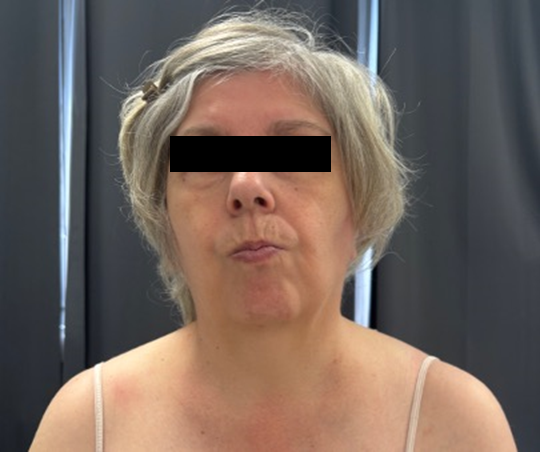
Lateral shift with platysma spasm.

Oromandibular dystonia.
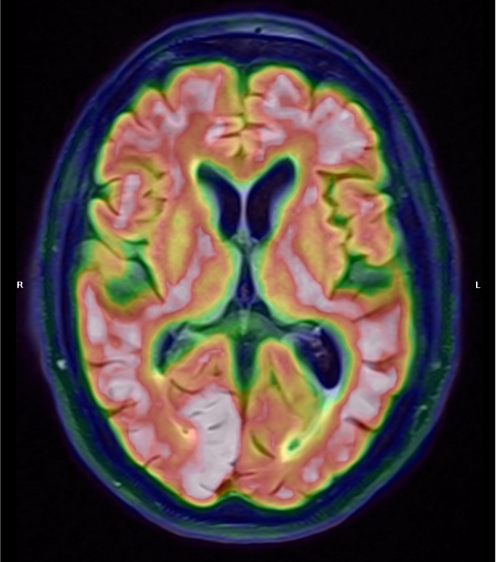
Vizamyl PET/CT.
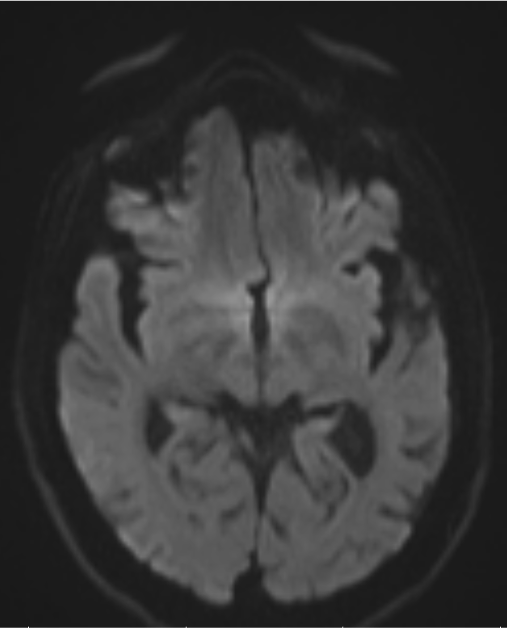
Bilateral temporal brain atrophy.
To cite this abstract in AMA style:
M. Danis, G. Krastev. Atypical Phenotype of SORL1-Associated Early-Onset Alzheimer’s Disease With Oromandibular and Cervical Dystonia [abstract]. Mov Disord. 2026; 41 (suppl 1). https://www.mdsabstracts.org/abstract/atypical-phenotype-of-sorl1-associated-early-onset-alzheimers-disease-with-oromandibular-and-cervical-dystonia/. Accessed October 1, 2026.« Back to 2026 International Congress
MDS Abstracts - https://www.mdsabstracts.org/abstract/atypical-phenotype-of-sorl1-associated-early-onset-alzheimers-disease-with-oromandibular-and-cervical-dystonia/