
Objective: To train a deep learning model to automatically detect dystonic hand posture from images extracted from home-video recordings in GNAO1-related dystonia.
Background: Movement disorders in GNAO1-associated disorder (GNAO1-RMD) are common, with dystonia being the most prevalent. Accurate assessment of dystonia is crucial to titrate treatments and monitor effects. However, measuring dystonia is challenging as symptoms vary during the day and may worsen due to stress or emotions. Current methods rely on expert visual scoring of videos. New advances in computer vision offer potential to develop new analysis techniques for this group.
Method: A total of 94 videos (each 30-60 seconds long) were selected from an available dataset of videos collected by parents of children with GNAO1-RMD using the MODYS@home app. Selection criteria were that the right hand was visible and not used to grasp an object within the video. Videos of three girls and four boys were included. Median age was 11 years (range: 10-14 years). In each video the section with the right hand was automatically detected every 10 seconds using MediaPipe, by identifying the landmarks of wrist, index, thumb and pink, and cut out as an image. The image dataset was then scored by a trained assessor for “Dystonia YES”, “Dystonia NO” and ‘’Skip’’ (i.e. if the assessor was not able to score the video). This lead to a dataset of 323 images scored for the presence of absence of dystonia. The dataset was split in a training and test set (80%/20%), by video-wise random split. A binary image classification model was trained using MobileNetV2 architecture. Model performance was evaluated on the test set consisting of 66 images of 13 videos (unseen by the model during training). Precision, sensitivity, and specificity were calculated from the results.
Results: In the test set a precision of 0.69, a sensitivity of 0.81, and a specificity of 0.74 was found. The confusion matrix of the results is shown in [figure1].
Conclusion: These results provide a first proof-of-concept of the methodology to automatically detect dystonic hand postures within videos. For clinical use, the model needs to be further improved with a larger dataset and an optimal classification threshold. This concept is not only applicable for children with GNAO1-RMD, but for all forms of hand dystonia.
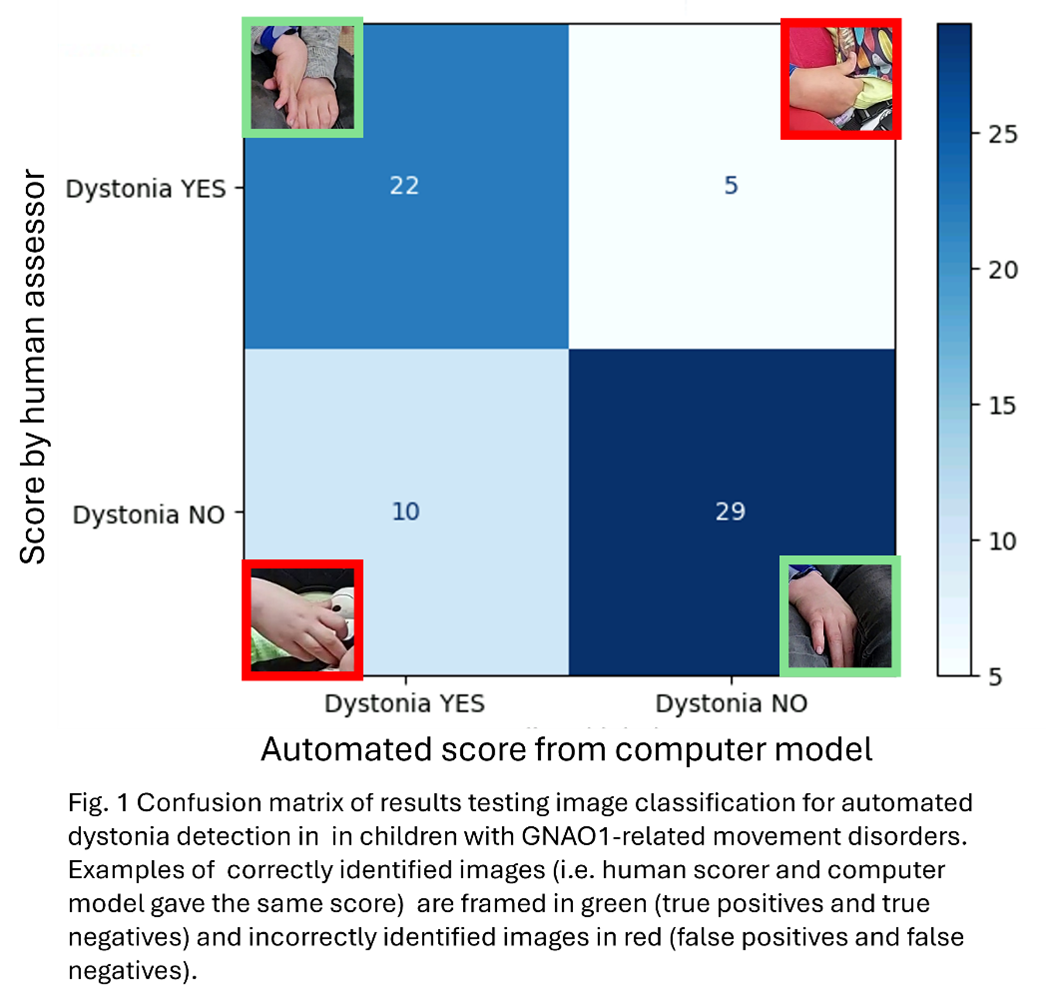
Confusion matrix of results
To cite this abstract in AMA style:
L. Heideman, M. Vander Krogt, S. Vander Ven, N. Wolf, A. Buizer, L. Vande Pol, H. Haberfehlner. Automated dystonic posture detection of the hand in children with GNAO1-related movement disorders from home-based videos using computer vision [abstract]. Mov Disord. 2026; 41 (suppl 1). https://www.mdsabstracts.org/abstract/automated-dystonic-posture-detection-of-the-hand-in-children-with-gnao1-related-movement-disorders-from-home-based-videos-using-computer-vision/. Accessed October 1, 2026.« Back to 2026 International Congress
MDS Abstracts - https://www.mdsabstracts.org/abstract/automated-dystonic-posture-detection-of-the-hand-in-children-with-gnao1-related-movement-disorders-from-home-based-videos-using-computer-vision/