
Category: Parkinson’s Disease: Clinical Trials
Objective: To assess whether changes in peripheral markers of CNS immune cell trafficking relate to clinical response to azathioprine in AZA-PD
Background: We conducted a randomised placebo-controlled trial of azathioprine in PD (AZA-PD), testing the hypothesis that peripheral immunity drives neuroinflammation and disease progression1. We demonstrated a beneficial effect on motor symptoms (exploratory outcome) over 12 months of treatment. Subgroup analysis suggested a greater clinical effect in females, who also had a greater depletion of CSF lymphocytes with azathioprine than males, despite no differential effect on blood lymphocytes. We hypothesize that reduced immune cell migration into the CNS contributed to the clinical effect.
Method: Proteomic analysis was performed with the NULISAseq Inflammation Panel 250 on serum from AZA-PD visits at 0 and 12 months. Participants with >80% compliance with azathioprine/placebo were included. Immune markers associated with CNS leukocyte migration were selected based on literature review2,3. The effect of azathioprine on these markers (delta score) was compared to placebo using ANCOVA, with age, sex, levodopa dose (LEDD), and baseline value as covariates. In the azathioprine cohort, the delta score was compared between the sexes using Mann Whitney U. The relationship between significant markers and change in clinical score in the azathioprine group was assessed using partial correlations, controlling for age and LEDD.
Results: 50 participants met inclusion criteria (azathioprine n=22: 8 female,14 male). Azathioprine treatment was associated with depletion of serum CCL7 [-0.704 (SE 0.327,p=0.037)], CXCL2 [-0.839 (SE 0.375,p=0.031), E-Selectin [-0.885 (SE 0.380,p=0.025)], ICAM1 [-0.991 (SE 0.449,p=0.033)]. Females on azathioprine had greater depletion of the following markers compared to males; CXCL1 (p<0.001), CXCL9 (p=0.006), E-Selectin (p=0.010) and ICAM1 (p=0.013).
There were significant correlations between change in MDS-UPDRSIII and delta CXCL1 (r=0.451,p=0.046) and ACEIII score and delta CXCL1 (r=0.526,p=0.017), CXCL2 (r=-0.516,p=0.020), CCL7 (r-0.499,p=0.025), CXCL9 (r=-0.502,p=0.024), ICAM1(r=0.526,p=0.017, and E-Selectin (r=-0.559,p=0.010), all in a beneficial direction (Figure 1).
Conclusion: There is evidence that azathioprine affects migratory capacity of peripheral immune cells, which may be contributing to the clinical effect in AZA-PD.
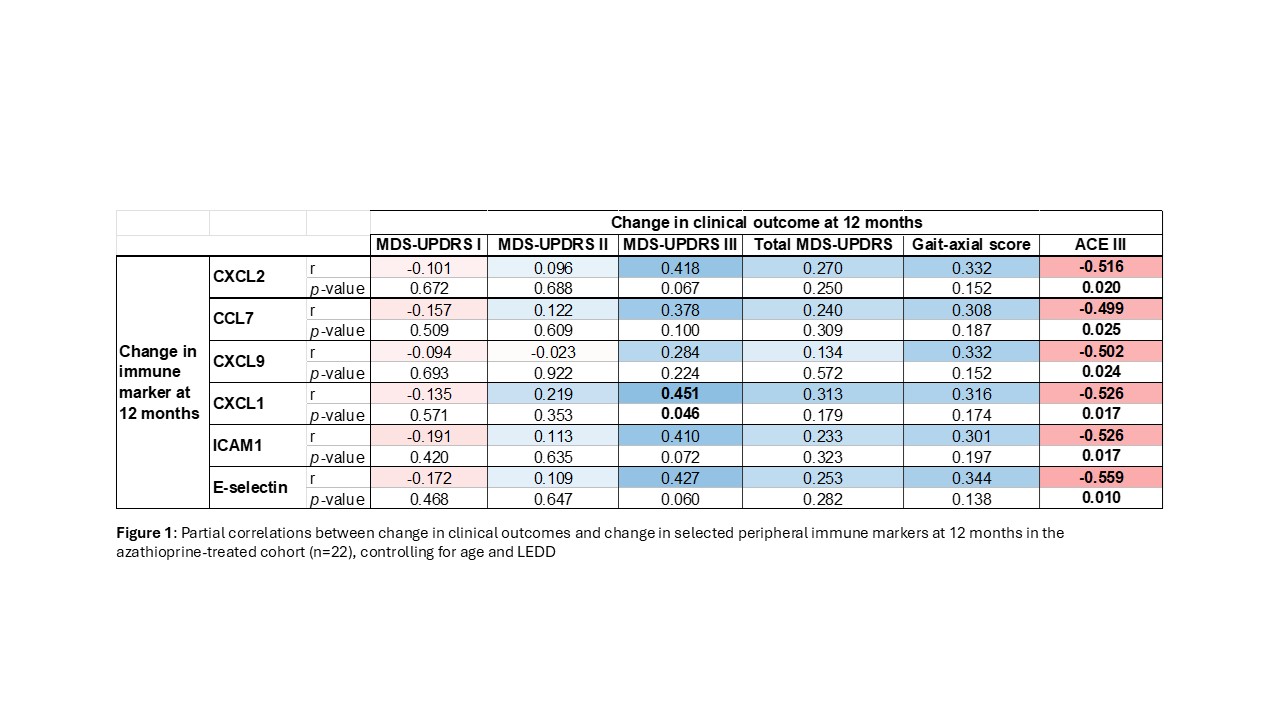
Figure 1
References: 1. Greenland JC, Dresser K, Cutting E, et al. Azathioprine for the treatment of early Parkinson’s disease (AZA-PD): a randomised, double-blind, placebo-controlled, proof-of-concept, phase 2 trial. The Lancet Neurology 2026; 25(1): 39-49.
2. Valletta M, Briel N, Yuksekel I, et al. Fluid biomarkers for neurodegenerative diseases: a comprehensive update. Alzheimer’s Research & Therapy 2025; 18(1): 12.
3. Roodveldt C, Bernardino L, Oztop-Cakmak O, et al. The immune system in Parkinson’s disease: what we know so far. Brain 2024; 147(10): 3306-24.
To cite this abstract in AMA style:
J. Greenland, J. Holbrook, R. Pal, L. Kahanawita, K. Dresser, E. Cutting, C. Williams-Gray. Azathioprine-associated changes in peripheral–central immune signalling in Parkinson’s disease: post-hoc analysis of AZA-PD [abstract]. Mov Disord. 2026; 41 (suppl 1). https://www.mdsabstracts.org/abstract/azathioprine-associated-changes-in-peripheral-central-immune-signalling-in-parkinsons-disease-post-hoc-analysis-of-aza-pd/. Accessed October 1, 2026.« Back to 2026 International Congress
MDS Abstracts - https://www.mdsabstracts.org/abstract/azathioprine-associated-changes-in-peripheral-central-immune-signalling-in-parkinsons-disease-post-hoc-analysis-of-aza-pd/