
Category: Myoclonus/Tics/Stereotypies
Objective: To identify uncommon causes of hemifacial spasm, such as from in-ear hearing aids.
Background: Hemifacial spasm is an abnormal, involuntary contraction of the facial muscles. This is usually unilateral but is bilateral in 2.6% of all hemifacial spasm cases. Hemifacial spasms are usually caused by aberrant compression of the facial nerve at either the cerebellopontine angle or as it exits the skull. Often, the compression is due to abnormal course of a vessel. Treatment is achieved by medications, Botulinum Neurotoxin injections, or surgical.
Method: N/A
Results: We present a 27-year-old male with prior diagnosis of Apert Syndrome who presented for evaluation of bilateral hemifacial spasm. The spasm was conditional on the patient wearing his in-ear hearing aids. It was confirmed that without the hearing aids in, there was no facial spasms present. Shortly after they were placed within the ear canals the myoclonic-like facial movements would occur. These movements involved his orbicularis oris, frontalis, and auricular muscles predominantly. He had previously tried varying types of in-ear hearing aids, and even with the devices off as long as they were within his ear canals the myoclonus would occur. MRI of the internal auditory canal was obtained and demonstrated no signs of damage or compression of the facial nerve as it exits the skull (Figure 1). However, the external auditory canal did appear to be shortened in relation to his abnormal head shape. He was referred to ENT for evaluation of alternative options to treat his hearing loss for which he is being evaluated for a bone anchored implant.
Conclusion: This case represents an unusual cause of bilateral hemifacial spasm restricted to the stipulation of in-ear wearables. We can posit that patients with congenitally shortened external auditory canals are at increased risk for irritation of their facial nerves from external sources. However, in comparison to the constant, involuntary contractions with hemifacial spasms, our patient had the ability to stop the clonic movements by removing his hearing aids.
Consideration given to this patient represents an interesting form of action myoclonus. With our patient, no discernable voluntary action is noted to be the cause and instead begs the question of whether this is being triggered by the sensory input caused by the in-ear devices, or less likely the change in his acoustic stimuli.
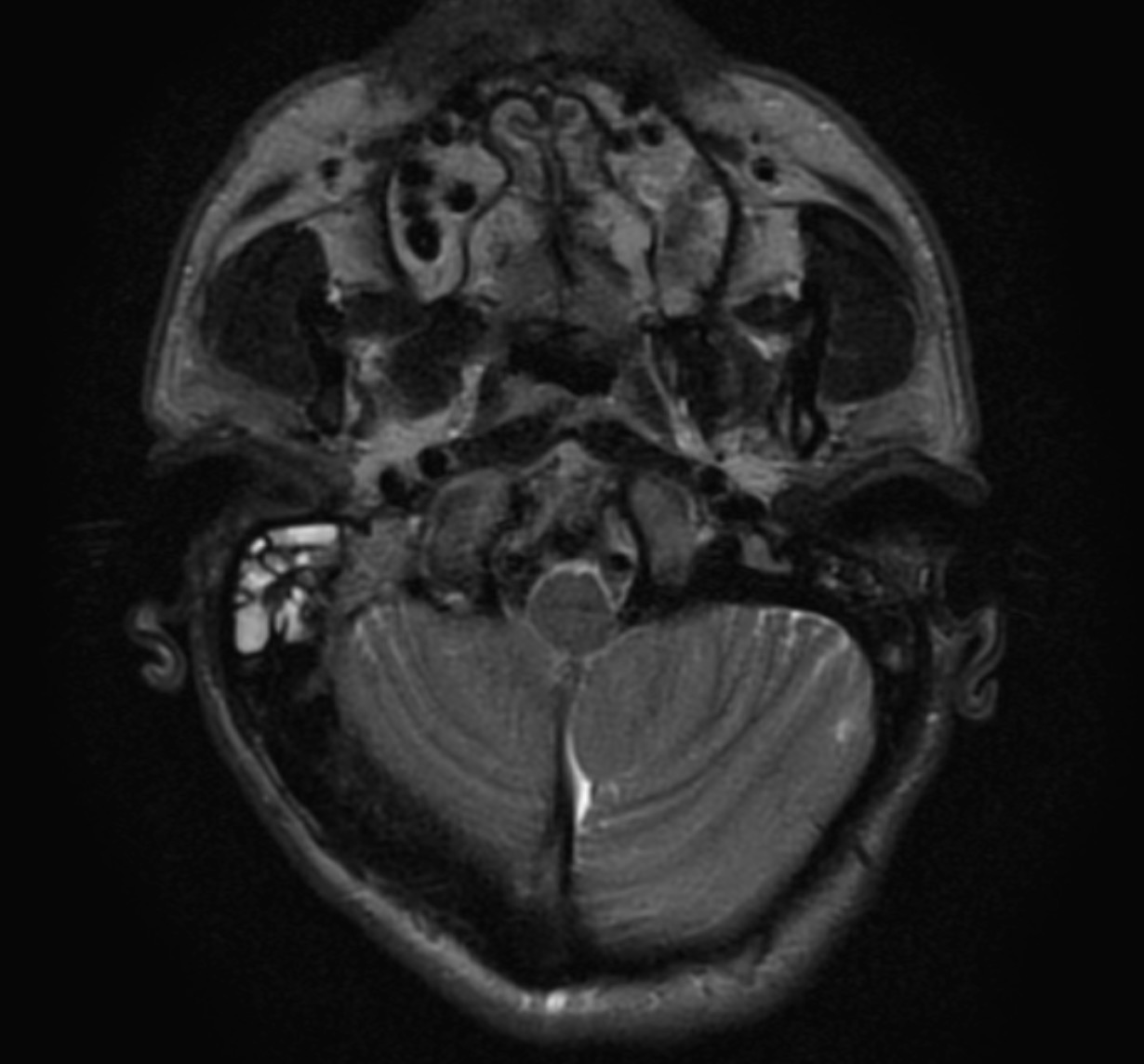
Figure 1
To cite this abstract in AMA style:
J. Thomas, N. Schuck, K. Mangipudi. Bilateral Hemifacial Spasm Caused by In-Ear Hearing Aids [abstract]. Mov Disord. 2026; 41 (suppl 1). https://www.mdsabstracts.org/abstract/bilateral-hemifacial-spasm-caused-by-in-ear-hearing-aids/. Accessed October 1, 2026.« Back to 2026 International Congress
MDS Abstracts - https://www.mdsabstracts.org/abstract/bilateral-hemifacial-spasm-caused-by-in-ear-hearing-aids/