Category: Parkinson's Disease: Pathophysiology
Objective: Development and characterization of a novel non-human primate model of Parkinson’s disease based on the AAV-mediated forced expression of human tyrosinase
Background: Although neuromelanin (NMel) is a dark pigment characteristic of dopaminergic neurons in the human substantia nigra pars compacta (SNpc), its potential role in the pathogenesis of Parkinson’s disease (PD) has been neglected since most commonly used laboratory animals lack NMel
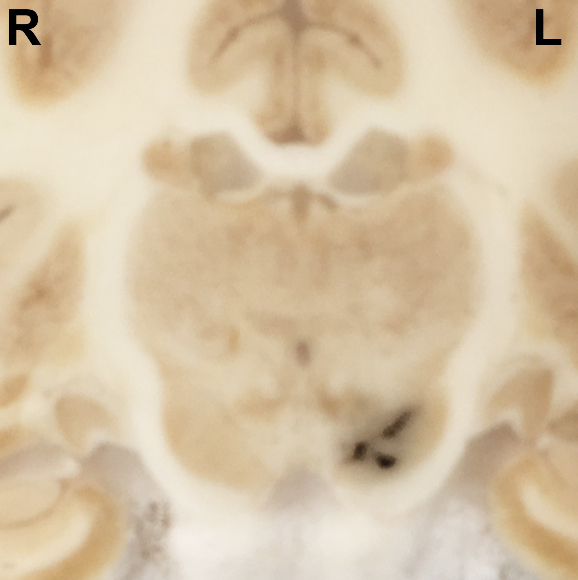
Method: Here we took advantage of AAVs encoding tyrosinase for driving a time-dependent NMel accumulation within the SNpc in macaques up to similar levels as observed in elderly humans.
Results: NMel accumulation induced (i) an endogenous synucleinopathy mimicking intracellular inclusions typically observed in PD, (ii) a progressive degeneration of NMel-expressing dopaminergic neurons, and (iii) a pro-inflammatory phenotype mediated by activated microglial cells and perivascular macrophages. Moreover, Lewy body-like intracellular inclusions were observed in brain areas receiving dopaminergic innervation, supporting a prionoid spread of endogenous synucleinopathy by permissive trans-synaptic templating
Conclusion: The conducted strategy resulted in the characterization and validation of a new macaque model of PD matching the known neuropathology of this disorder with unprecedented accuracy. Finally, evidence was provided showing that intracellular aggregation of endogenous alpha-synuclein is triggered by NMel accumulation, therefore any therapeutic approach intended to decrease NMel levels may provide appealing choices for the successful implementation of novel PD therapeutics
To cite this abstract in AMA style:
J. Lanciego, J. Chocarro, A. Fajardo-Serrano, A. Vazquez, AI. Rodriguez-Perez, J. Labandeira-Garcia, M. Vila, A. Rico. Blaming neuromelanin for Parkinson’s disease: time-dependent tyrosinase overexpression drives endogenous synucleinopathy in non-human primates [abstract]. Mov Disord. 2022; 37 (suppl 2). https://www.mdsabstracts.org/abstract/blaming-neuromelanin-for-parkinsons-disease-time-dependent-tyrosinase-overexpression-drives-endogenous-synucleinopathy-in-non-human-primates/. Accessed November 7, 2026.« Back to 2022 International Congress
MDS Abstracts - https://www.mdsabstracts.org/abstract/blaming-neuromelanin-for-parkinsons-disease-time-dependent-tyrosinase-overexpression-drives-endogenous-synucleinopathy-in-non-human-primates/