
Category: Pediatric Movement Disorders
Objective: To determine the age at onset of bulbar symptoms in patients with Friedreich ataxia (FA) based on real-world data from US medical claims.
Background: FA is a rare, genetic, multisystem, neurodegenerative disorder presenting mainly with ataxia, but also features of systemic problems (e.g., cardiomyopathy) with variable times of symptom onset. Bulbar symptoms are important in FA, given speech and swallowing are two key functions. Limited data are available on the age at onset of bulbar symptoms in FA based on real-world data from US medical claims.
Method: We conducted a retrospective study based on de-identified medical claims linked to mortality data covering October 2015 to March 2024. We stratified the cohort by age at FA diagnosis: 0-7, 8-14, 15-24, and 25-39 years. Key endpoints were age at FA diagnosis, as well as age at onset for bulbar symptoms relative to the timing of onset of composite endpoints related to loss of ambulation (LoA/Death) and cardiomyopathy (CM/heart failure [HF]/Death).
Results: The cohort included 927 patients with FA. For patients aged 0-7, 8-14, 15-24, and 25-39 years, the median age at FA diagnosis was 4.3 (n=129), 12.0 (n=225), 19.3 (n=261), and 32.1 years (n=312), respectively. Bulbar symptoms were observed in 54.3% (n=70; median age at onset, 2.7 years), 34.7% (n=78; 17.8 years), 31.8% (n=83; 27.1 years), and 42.0% (n=131; 39.5 years) for patients aged 0-7, 8-14, 15-24, and 25-39, respectively (Figure). In early-onset FA (diagnosed age 0-7 years), median age of onset for bulbar symptoms preceded FA diagnosis by 1.6 years, while in other aged patients (diagnosed age 8-39 years), bulbar symptoms were observed in temporal proximity to CM/HF/Death, closest to the timing of LoA/Death, and 5.8-7.8 years after FA diagnosis (Table).
Conclusion: These real-world data reveal bulbar symptoms are common and can occur early in the disease, particularly in early-onset patients where symptom onset precedes FA diagnosis. By contrast, bulbar symptoms occurred in typical- and late-onset patients as part of a cascade of worsening clinical outcomes including cardiac symptoms and LoA. These new insights emphasize the need to recognize bulbar symptoms early, particularly in early-onset patients with FA
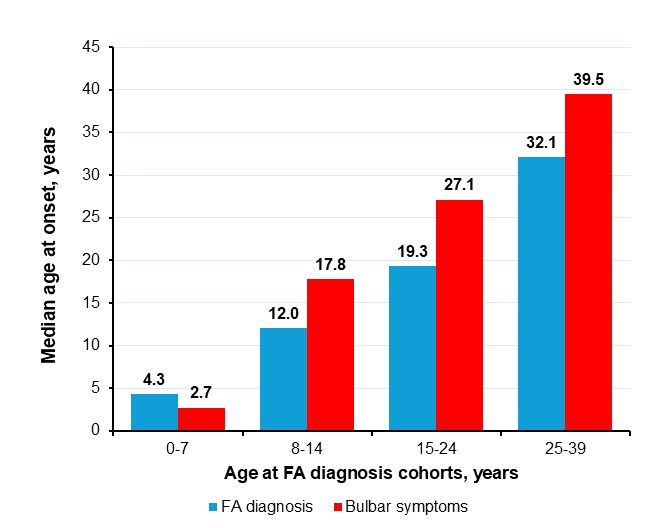
MDS2025 Bulbar Symptoms Figure 12Mar2025
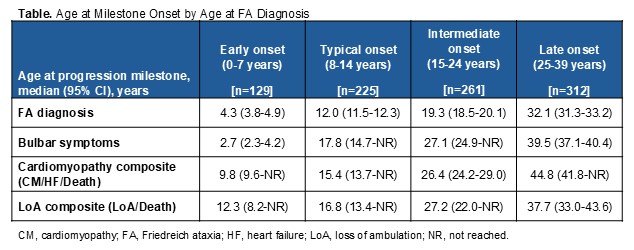
MDS2025 Bulbar Symptoms Table 12Mar2025
To cite this abstract in AMA style:
S. Kuo, S. Nayar, B. Bian, D. Gomes, S. England, J. Mckay, T. Wang, R. Avila, S. Perlman. Bulbar Symptoms Precede Diagnosis in Early-Onset, but not in Typical- to Late-Onset Friedreich Ataxia: Real-World Data From Medical Claims [abstract]. Mov Disord. 2025; 40 (suppl 1). https://www.mdsabstracts.org/abstract/bulbar-symptoms-precede-diagnosis-in-early-onset-but-not-in-typical-to-late-onset-friedreich-ataxia-real-world-data-from-medical-claims/. Accessed October 16, 2026.« Back to 2025 International Congress
MDS Abstracts - https://www.mdsabstracts.org/abstract/bulbar-symptoms-precede-diagnosis-in-early-onset-but-not-in-typical-to-late-onset-friedreich-ataxia-real-world-data-from-medical-claims/