
Category: Choreas (Non-Huntington's Disease)
Objective: Using data from the STAT-PD trial, ClinicalTrials NCT # 4064294, we examined whether lifetime caffeine and nicotine exposure are associated with the presence and severity of dyskinesia in individuals with PD.
Background: Levodopa (LD) remains the most effective treatment for PD, while long term use of levodopa frequently leads to levodopa-induced dyskinesia (LID) which can significantly impair a human’s quality of life. Environmental exposures may influence the development or severity of LID overtime. Observational studies suggest higher caffeine intake may be associated with reduced LID risk [1]. Experimental studies in animal models show that nicotine can reduce LID by modulating and desensitizing nicotinic acetylcholine receptors (nAChRs)[2,3]. However, human data examining the relationship between these exposures and LID severity remains limited.
Method: 74 participants completed a subsection the Parkinson’s Genetic Research Study exposure questionnaire relating to tobacco use and caffeine use (coffee, tea, soda) (Table 1).
Results: Caffeine exposure was not related to the presence of LID (See table 2a). The caffeine types (coffee, tea, soda), current/ever use, total exposure, or total mg/day consumed was not related to the presence of LID. When examining the severity of LID, those that were current users of caffeine had more LID than those that were not current users. Tobacco use (ever smoker), starting age, the amount of smoking, and lifetime exposure was also not related to the presence nor the severity of LID (See Table 2b).
Conclusion: This examination found that only the current use of caffeine was related to more severe LID. We did not control or track caffeine consumption during the LD challenge. This potentially could influence the results, with those that were consuming coffee, soda, or tea during the assessment of LID potentially presenting with more LID than those that abstained on that day. No other measures were related to LID or the severity of LID. Unlike Wills et al, we did not find that the more caffeine that one uses decreases LID. In addition, the measures of exposure were self-reported and could have been influenced by recall issues and the minimizing of exposures and exposure years.
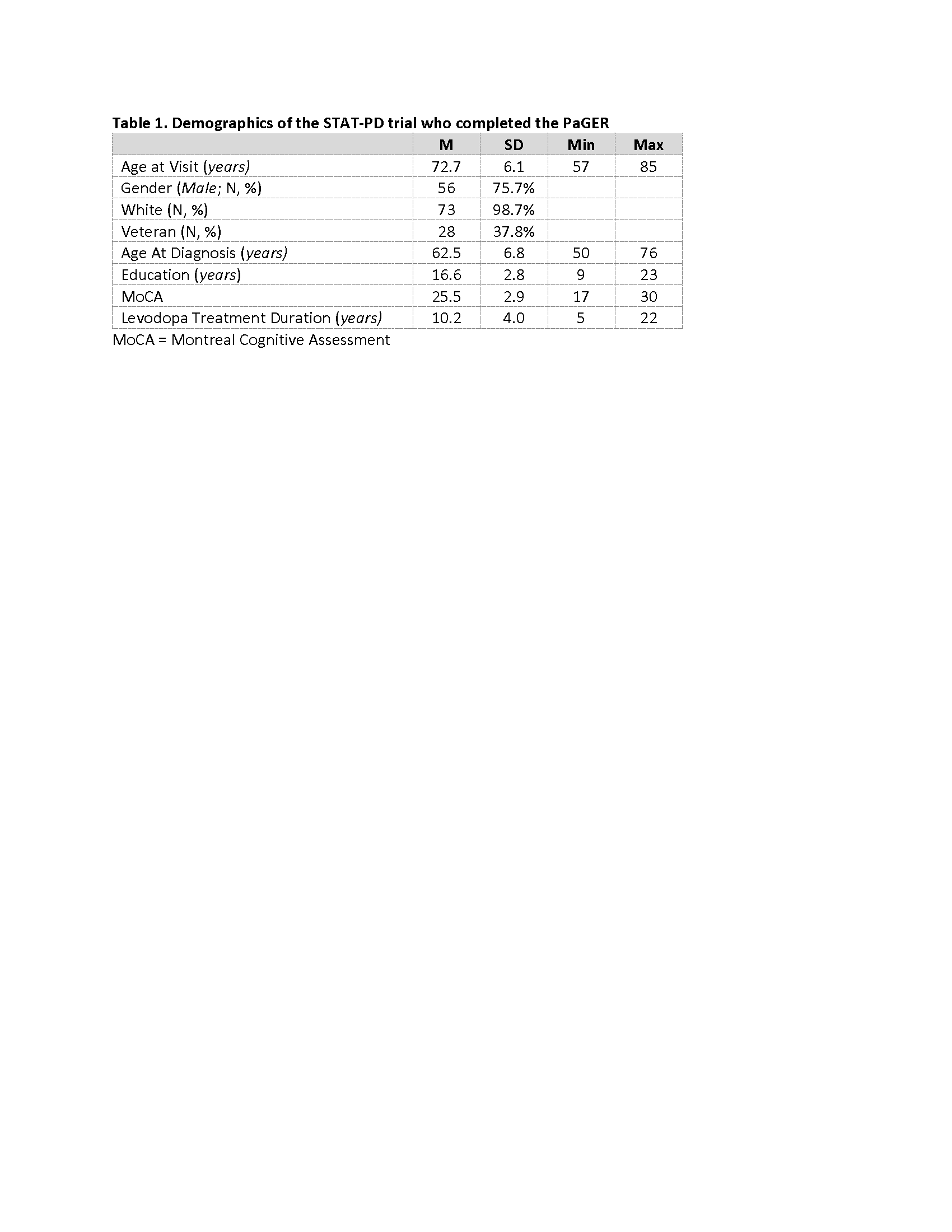
STAT-PD trial Demographics Completing the PaGeR
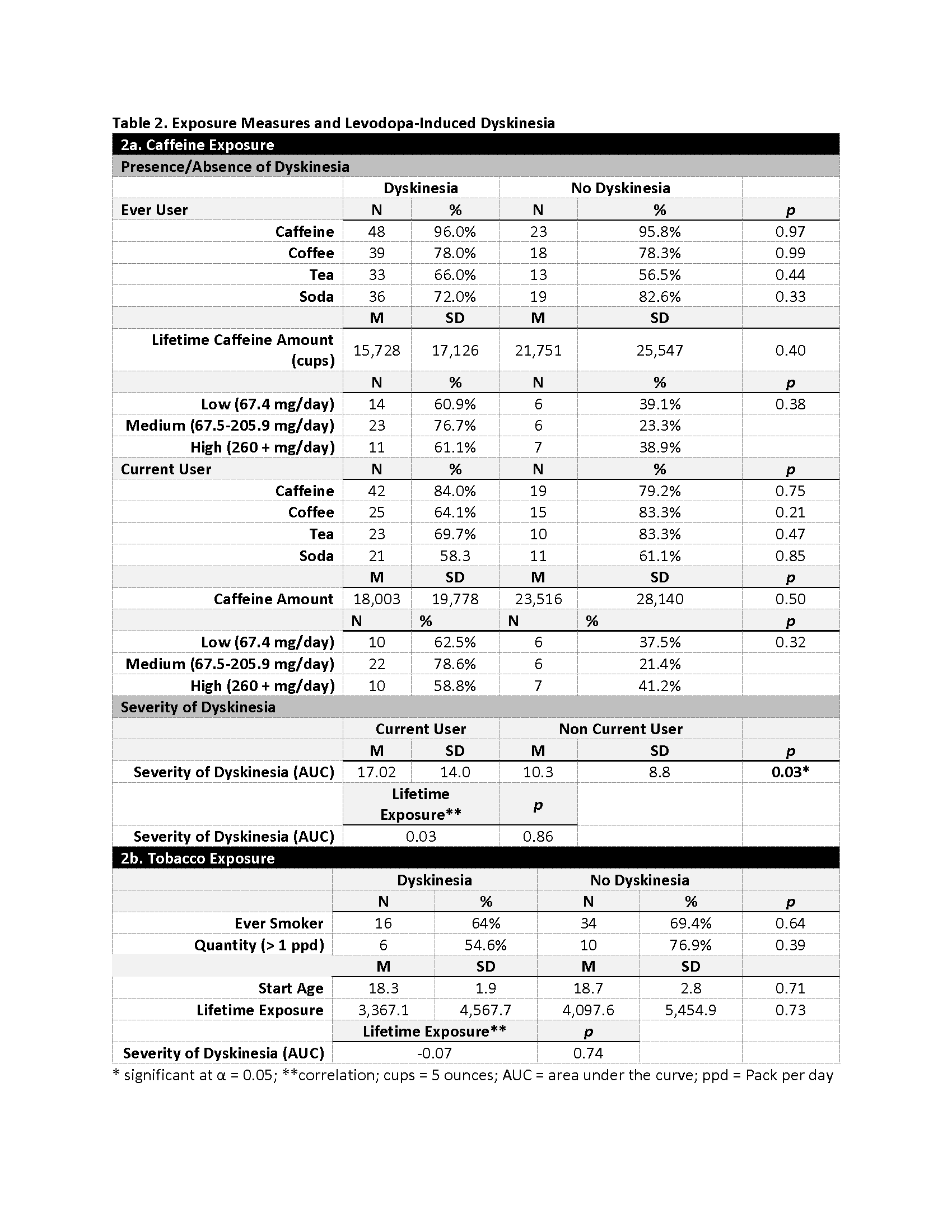
Exposure Measures and Levodopa-Induced Dyskinesia
References: [1] Wills AM, Eberly S, Tennis M, Lang AE, Messing S, Togasaki D, Tanner CM, Kamp C, Chen JF, Oakes D, McDermott MP, Schwarzschild MA; Parkinson Study Group. Caffeine consumption and risk of dyskinesia in CALM-PD. Mov Disord. 2013 Mar;28(3):380-3. doi: 10.1002/mds.25319. Epub 2013 Jan 21. PMID: 23339054; PMCID: PMC3608707.
[2] Bordia T, Campos C, McIntosh JM, Quik M. Nicotinic receptor-mediated reduction in L-DOPA-induced dyskinesias may occur via desensitization. J Pharmacol Exp Ther. 2010 Jun;333(3):929-38. doi: 10.1124/jpet.109.162396. Epub 2010 Mar 3. PMID: 20200117; PMCID: PMC2879940.
[3] Quik M, O’Leary K, Tanner CM. Nicotine and Parkinson’s disease: implications for therapy. Mov Disord. 2008 Sep 15;23(12):1641-52. doi: 10.1002/mds.21900. PMID: 18683238; PMCID: PMC4430096.
To cite this abstract in AMA style:
A. Clarke, B. Lobb, K. Chung. Caffeine and Tobacco Exposure and the Presence of Levodopa-Induced Dyskinesia (LID) in the STAT-PD Trial [abstract]. Mov Disord. 2026; 41 (suppl 1). https://www.mdsabstracts.org/abstract/caffeine-and-tobacco-exposure-and-the-presence-of-levodopa-induced-dyskinesia-lid-in-the-stat-pd-trial/. Accessed October 1, 2026.« Back to 2026 International Congress
MDS Abstracts - https://www.mdsabstracts.org/abstract/caffeine-and-tobacco-exposure-and-the-presence-of-levodopa-induced-dyskinesia-lid-in-the-stat-pd-trial/