
Objective: To categorize cognitive phenotypes in patients with Parkinson’s Disease (PD) using an unsupervised algorithm and validate their clinical, psychiatric, and motor differences.
Background: Four Mild Cognitive Impairment clinical subtypes in PD are described: frontal dominant, posterior cortical dominant, global impairment, and cognitively intact [1]. Initial PD cognitive deficits in executive functions, attention, memory, and visuospatial skills stem from dopaminergic depletion in frontostriatal circuits (frontal and posterior) [2,3,5]. Given this heterogeneity, machine learning algorithms show high accuracy in identifying specific phenotypes, optimizing objective patient classification [4].
Method: A cross-sectional study ran from June 2022 to February 2026. Clinical assessment included the Montreal Cognitive Assessment (MoCA), MDS-Unified Parkinson’s Disease Rating Scale (MDS-UPDRS), and State-Trait Anxiety/Depression Inventories (STAI/ST-DEP). MoCA was the input for the unsupervised Random Forest algorithm; remaining variables served for clinical characterization of the resulting phenotypes.
Results: In 134 PD patients, 3 clusters emerged [table 1]: C1 (n=25) grouped younger patients (60.3 years) with high education (15.1 years) and shorter duration (7.6 years), maintaining preserved cognition (MoCA=27.4) [figure 1]. C3 (n=96; 63.1 years; education 13.1 years) showed deficits in visuospatial skills, executive functions, and memory recall, preserving orientation and language (MoCA=22.1) [figure 1]; with a ~10-year mean duration and lowest depression scores (ST-DEP T=32.6; ST-DEP S=31.8), evidencing significant functional independence loss (MDS-UPDRS PII:14.5). C2 grouped older patients (n=13, 73.7 years) with significantly lower education (7.8 years), presenting global cognitive impairment, marked deficits in visuospatial skills and memory recall (MoCA=10.1) [figure 1], and the greatest motor/non-motor impairment (MDS-UPDRS PI:18.8, PII:21.8, PIII:54.1).
Conclusion: Three Clusters were identified: C1 Cognitively intact, C2 Global impairment, and C3 Frontal dominant impairment. The obtained clusters coincide with clinical subtypes previously described in the literature [1] and provide neuropsychological evidence of frontostriatal circuit dysfunction. The description of key clinical characteristics allows profiling and identifying patients belonging to each cluster from early stages.
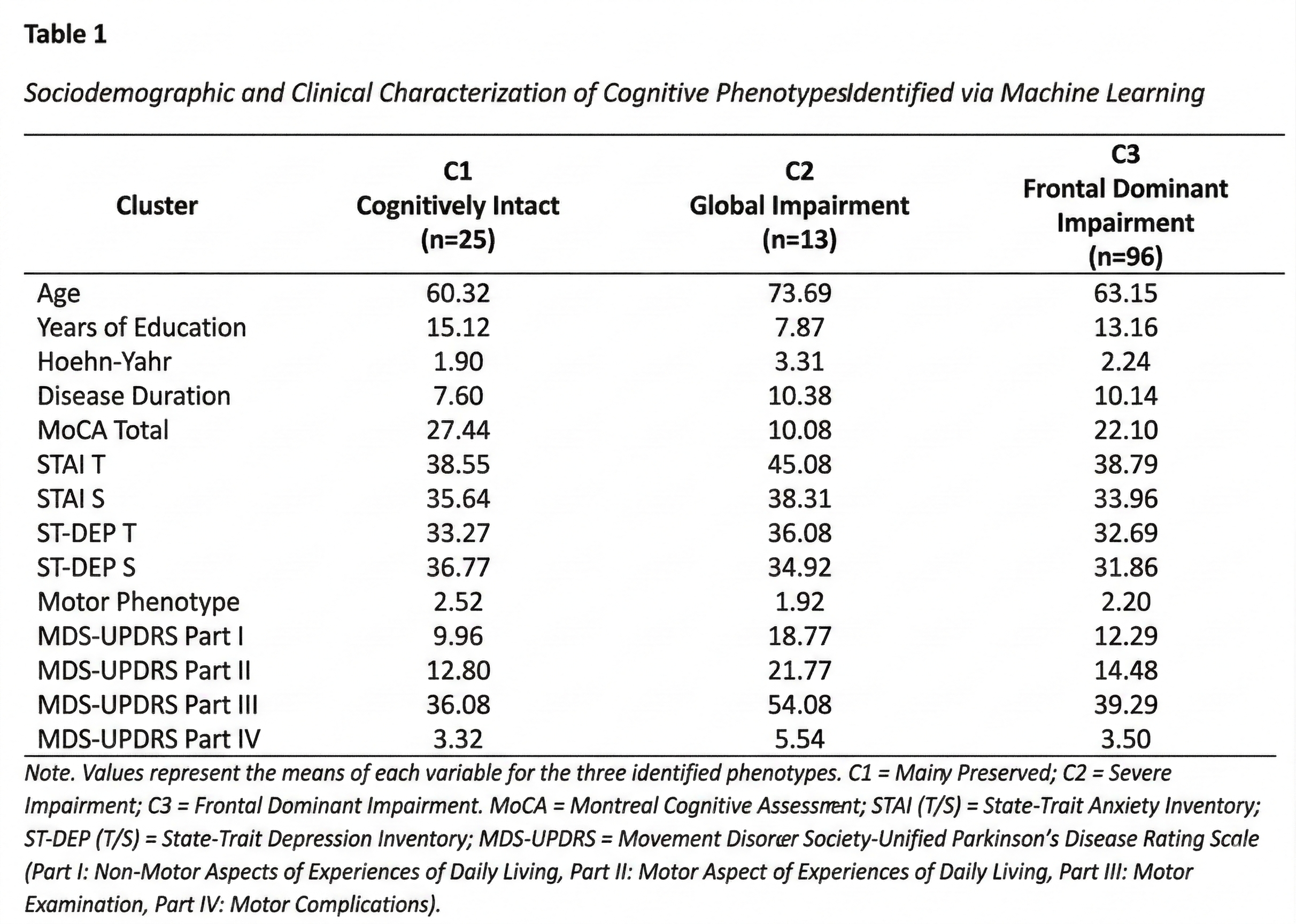
Table 1
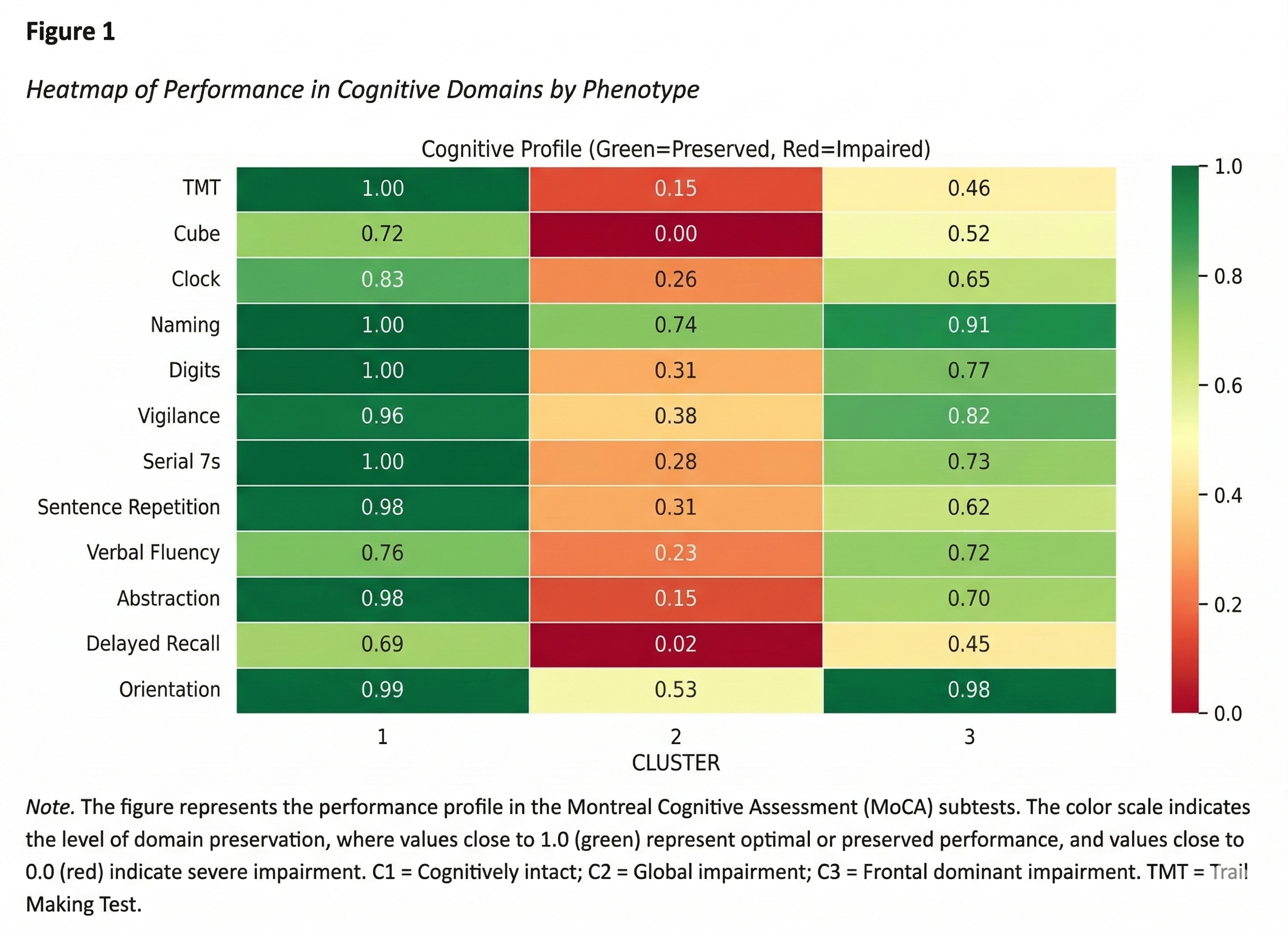
Figure 1
References: 1. Pourzinal D, Yang JHJ, Byrne GJ, O’Sullivan JD, Mitchell L, McMahon KL, et al. Identifying subtypes of mild cognitive impairment in Parkinson’s disease using cluster analysis. J Neurol [Internet]. 2020;267(11):3213–22. Disponible en: http://dx.doi.org/10.1007/s00415-020-09977-z
2. Rodríguez-Antigüedad J, Martínez-Horta S, Puig-Davi A, Horta-Barba A, Pagonabarraga J, de Deus Fonticoba T, et al. Heterogeneity of cognitive progression and clinical predictors in Parkinson’s disease-subjective cognitive decline. J Neurol [Internet]. 2025;272(3):246. Disponible en: http://dx.doi.org/10.1007/s00415-024-12808-0
3. Carceles-Cordon M, Weintraub D, Chen-Plotkin AS. Cognitive heterogeneity in Parkinson’s disease: A mechanistic view. Neuron [Internet]. 2023;111(10):1531–46. Disponible en: http://dx.doi.org/10.1016/j.neuron.2023.03.021
4. Shokrpour S, MoghadamFarid A, Bazzaz Abkenar S, Haghi Kashani M, Akbari M, Sarvizadeh M. Machine learning for Parkinson’s disease: a comprehensive review of datasets, algorithms, and challenges. NPJ Parkinsons Dis [Internet]. 2025;11(1):187. Disponible en: http://dx.doi.org/10.1038/s41531-025-01025-9
5. MacDonald PA, MacDonald AA, Seergobin KN, Tamjeedi R, Ganjavi H, Provost J-S, et al. The effect of dopamine therapy on ventral and dorsal striatum-mediated cognition in Parkinson’s disease: support from functional MRI. Brain [Internet]. 2011;134(Pt 5):1447–63. Disponible en: http://dx.doi.org/10.1093/brain/awr075
To cite this abstract in AMA style:
H. Trujillo-Guerra, R. Trejo-Ayala, P. Téllez-Hernández, J. Esquivel-Del Río, B. Chávez-Luévanos, I. Estrada-Bellmann, X. Ortiz-Jiménez. Categorization and Characterization of Cognitive Phenotypes in Parkinson’s Disease Using Machine Learning. [abstract]. Mov Disord. 2026; 41 (suppl 1). https://www.mdsabstracts.org/abstract/categorization-and-characterization-of-cognitive-phenotypes-in-parkinsons-disease-using-machine-learning/. Accessed October 1, 2026.« Back to 2026 International Congress
MDS Abstracts - https://www.mdsabstracts.org/abstract/categorization-and-characterization-of-cognitive-phenotypes-in-parkinsons-disease-using-machine-learning/