
Objective: To identify factors associated with activities of daily living (ADL) according to disease stage in patients with Parkinson’s disease (PD).
Background: PD is a progressive neurodegenerative disorder in which ADL gradually decline as the disease advances. However, how factors associated with ADL change across disease stages remains unclear.
Method: This retrospective cross-sectional study included patients admitted to our hospital who were diagnosed with PD and received a rehabilitation prescription. Participants were classified into an early-stage group (Hoehn and Yahr stage [HY] 1–2, n=159) and an advanced-stage group (HY ≥3, n=55).
Multiple regression analyses were performed separately for each group with the Barthel Index (BI) as the dependent variable. Independent variables included age, MDS-UPDRS Part III, Mini-BESTest, Trunk Impairment Scale (TIS), Mini-Mental State Examination (MMSE), and the dual-task cost of the Timed Up and Go test (TUG). A forced-entry method was used. Statistical significance was set at p<0.05.
Results: The regression models were significant in both groups (early-stage: F=10.4, p<0.01, adjusted R²=0.24; advanced-stage: F=22.9, p<0.01, adjusted R²=0.68). In the early-stage group, Mini-BESTest (β=0.40, p<0.01) and MMSE (β=0.20, p<0.01) were independently associated with BI. In the advanced-stage group, age (β=0.25, p<0.01), MDS-UPDRS Part III (β=-0.26, p<0.01), Mini-BESTest (β=0.41, p<0.01), TIS (β=0.35, p<0.01), and TUG dual-task cost (β=-0.21, p<0.01) were independently associated with BI. All variables showed VIF values below 2, indicating no multicollinearity.
Conclusion: Factors associated with ADL differed according to PD disease stage. Although postural instability is generally considered absent up to HY stage 2, multidimensional balance ability assessed by the Mini-BESTest was already associated with ADL in the early stage. In patients with HY stage ≥3, age, trunk function and parkinsonian motor symptoms, in addition to balance ability, were associated with ADL. Cognitive function showed stage-specific associations: general cognition was related to ADL in the early stage, whereas dual-task interference appeared more relevant in the advanced stage. These findings suggest that functional targets for maintaining ADL may differ across PD stages and may inform stage-specific rehabilitation strategies.
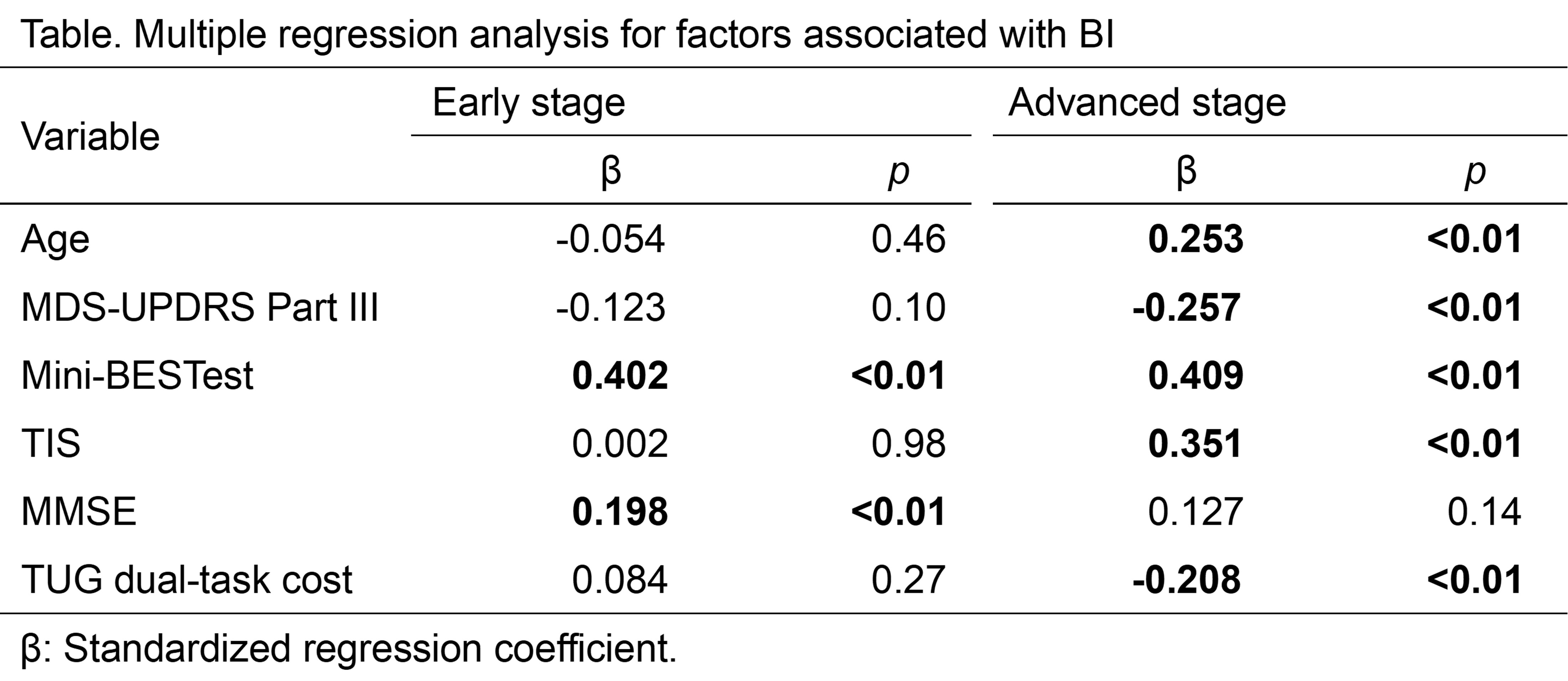
Results of multiple regression analysis
To cite this abstract in AMA style:
K. Watanabe, T. Nakamura, G. Horiguchi, H. Miyamoto, Y. Yamazaki, Y. Kameyama, E. Kitahara, K. Haruyama, N. Nishikawa, T. Hatano, N. Hattori, T. Fujiwara. Changes in ADL-Related Factors According to Disease Stage in Patients with Parkinson’s Disease: Multiple Regression Analysis [abstract]. Mov Disord. 2026; 41 (suppl 1). https://www.mdsabstracts.org/abstract/changes-in-adl-related-factors-according-to-disease-stage-in-patients-with-parkinsons-disease-multiple-regression-analysis/. Accessed October 1, 2026.« Back to 2026 International Congress
MDS Abstracts - https://www.mdsabstracts.org/abstract/changes-in-adl-related-factors-according-to-disease-stage-in-patients-with-parkinsons-disease-multiple-regression-analysis/