
Category: Choreas (Non-Huntington's Disease)
Objective: The primary aim was to describe the clinical and genetic profiles of patients with suspected hereditary chorea. Secondary aims included investigating the genetic causes in non-Huntington’s disease (non-HD) chorea cases and assessing phenotype-genotype correlations in both HD and non-HD disorders.
Background: Hereditary choreas are a varied group of genetic disorders, with HD being the most prevalent. However, many patients with choreiform movements test negative for HD, necessitating evaluation for HD phenocopies. Data on hereditary choreas in Indian populations are scarce, creating a gap in understanding their demographics and phenotypic features.
Method: This observational study, carried out at AIIMS in New Delhi from October 2020 to September 2025, enrolled patients with chronic progressive chorea of suspected genetic origin after ruling out acquired causes. The study involved a detailed collection of clinical history, neurological assessments, and supportive laboratory and neuroimaging data. Genetic testing began with HTT gene analysis for HD, then expanded to screening for common HD-like disorders, and included whole exome sequencing when necessary.
Results: Fifty patients (33 HD, 17 non-HD) with genetic diagnoses were analysed. HD patients had an older onset age (mean 41.6 years), a high family history (64%), and genetic anticipation (58%). The mean CAG repeat length (47) was inversely correlated with age at onset. Chorea was present in all HD cases; other observed movement disorders included ataxia (36%), Parkinsonism (30%), and dystonia (21%). Cognitive impairment affected 66.7% (executive dysfunction being most common), psychiatric manifestations were seen in 64%, and saccadic abnormalities were noted in 100%. Non-HD cases included eight different diagnoses [Figure 1], with chorea-acanthocytosis (35.3%) being the most common. Non-HD patients showed more dystonia and exhibited other distinctive clinical features and laboratory/imaging abnormalities that helped narrow the differential diagnoses [Figure 2].
Conclusion: This first detailed Indian analysis highlights distinct clinical-genetic features of hereditary choreas, with chorea-acanthocytosis as the leading non-HD cause. Findings emphasise the importance of systematic assessment, early identification, and a region-specific diagnostic algorithm for hereditary chorea in India.
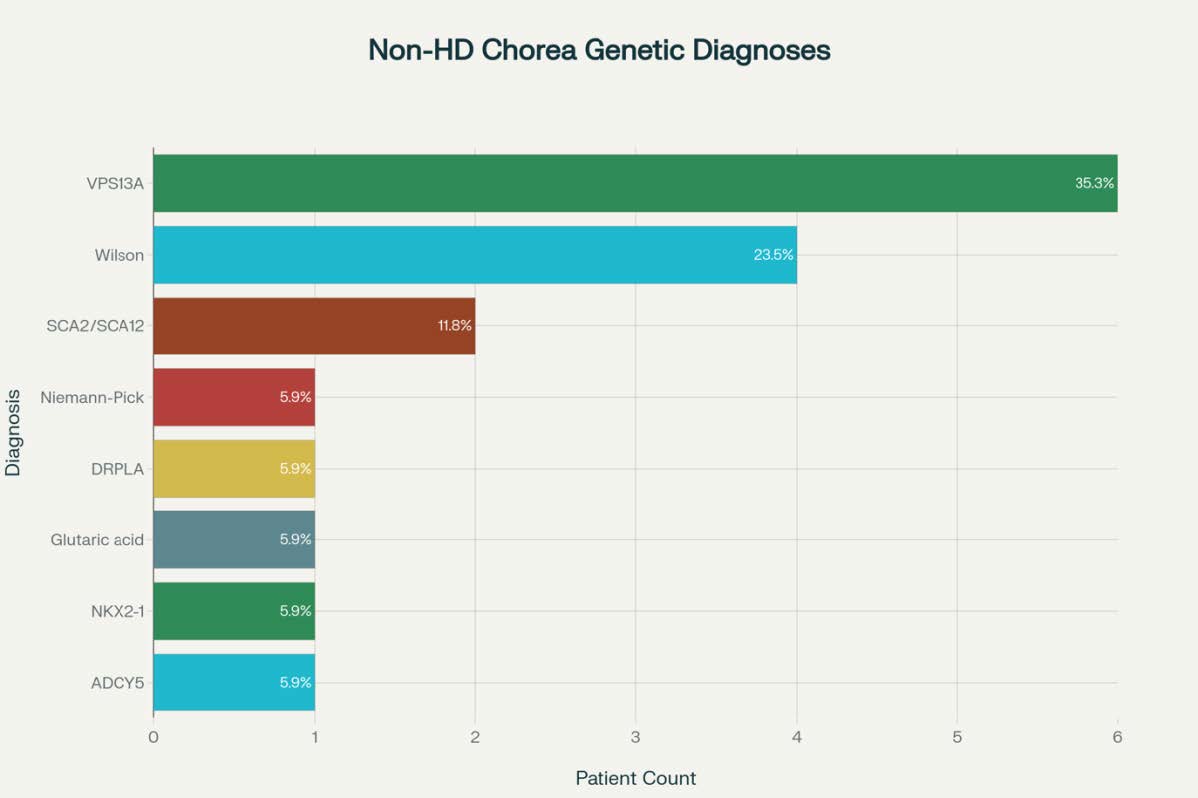
Non-HD Chorea Diagnoses
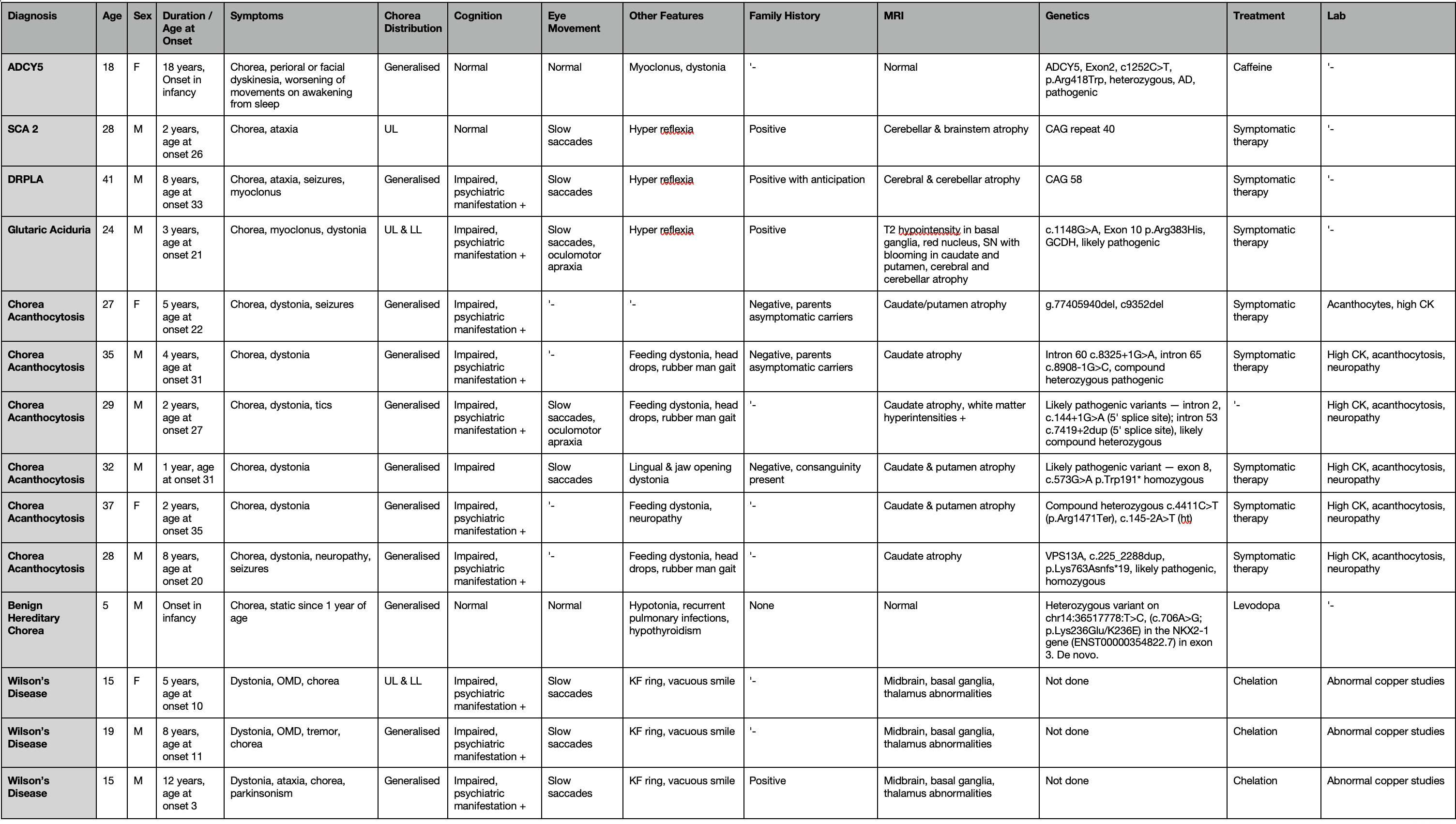
Non-HD Chorea Clinical and Genetic Profile
References: Cardoso F, Maia D, Maciel R, et al. Non-Huntington’s disease chorea: an expanding universe with acquired causes. Brain. 2026 Jan 30:awag038.
1. Moore KP. Huntington disease and chorea. CONTINUUM: Lifelong Learning in Neurology. 2025 Aug;31(4):1066-92.
2. Radhakrishnan, et al. Characteristics of Huntington disease in a north Indian cohort [abstract]. Mov Disord. 2023; 38 (suppl 1).
3. D. Radhakrishnan, et al. Spectrum of Non-HD Hereditary Chorea- Case Series from an Indian Movement Disorder Centre [abstract]. Mov Disord. 2024; 39 (suppl 1).
4. Prashanth LK, Kumar H, Wadia PM, Muthane U. The spectrum of movement disorders in tertiary care centers in India: A tale of three cities. Annals of Indian Academy of Neurology. 2021 Sep 1;24(5):721-5.
To cite this abstract in AMA style:
D. Radhakrishnan, A. Sonakar, P. Mandadi, J. George, F. Mustafa, R. Rajan, D. Garg, A. Das, J. Parihar, E. Elavarasi, M. Faruq, A. Srivastava. Clinical and genetic profiles of patients with Huntington’s disease and other hereditary choreas: Experience from an Indian Movement Disorder Clinic. [abstract]. Mov Disord. 2026; 41 (suppl 1). https://www.mdsabstracts.org/abstract/clinical-and-genetic-profiles-of-patients-with-huntingtons-disease-and-other-hereditary-choreas-experience-from-an-indian-movement-disorder-clinic/. Accessed October 1, 2026.« Back to 2026 International Congress
MDS Abstracts - https://www.mdsabstracts.org/abstract/clinical-and-genetic-profiles-of-patients-with-huntingtons-disease-and-other-hereditary-choreas-experience-from-an-indian-movement-disorder-clinic/