
Category: Tremor
Objective: To evaluate the clinical and kinematic efficacy of a biomechanical glove-based tremor dampener in essential tremor (ET) patients.
Background: ET is a common movement disorder frequently refractory to standard pharmacotherapy (e.g., propranolol, primidone). A wearable device utilizing a non-Newtonian fluid and a tuned mass damper was designed to resist upper-limb tremors mechanically. This study assessed the device’s efficacy against a weight-matched sham across static and dynamic tasks.
Method: Twenty adults with ET completed Fahn-Tolosa-Marin (FTM) tasks and expert scoring under three conditions: baseline (no glove), sham (weight-matched 550 g glove), and treatment (glove with active dampener). An objective kinematics score was calculated from three-axis accelerometry root-mean-square (RMS) power. To isolate therapeutic efficacy, analyses were restricted to task iterations in which subjects exhibited severe baseline clinical impairment, defined as FTM > 2 at baseline. Friedman tests and ANOVA evaluated trends in FTM and kinematic scores, respectively.
Results: The most commonly impaired static tasks included “empty cup, cup to mouth” (n=7), “full cup, arms out-stretched” (n=7), and “full cup, cup to mouth” (n=7). FTM scores significantly improved across conditions for all three tasks (Friedman p=0.009, p=0.004, and p=0.02, respectively). For the full cup out-stretched task, post-hoc analysis confirmed a significant FTM reduction between baseline (median=3) and treatment (median=2, p=0.05). Across these static tasks, RMS acceleration scores generally improved more with the treatment glove than the sham, especially in the three most severely impaired subjects.
The most impaired dynamic task was “Spiral B” (smaller spiral drawing; n=8). While FTM changes trended toward significance (p=0.07; median at baseline=3, treatment=2.5), accelerometry RMS showed significant improvement across conditions (ANOVA p=0.03). The treatment significantly reduced RMS compared to the sham (p=0.02), especially in the three most severe subjects.
Conclusion: The active dampener yields measurable clinical and kinematic tremor reductions in ET during specific static and dynamic tasks for patients with high baseline severity. While weight alone sometimes provides a benefit, the active dampener often demonstrates superior targeted tremor attenuation.
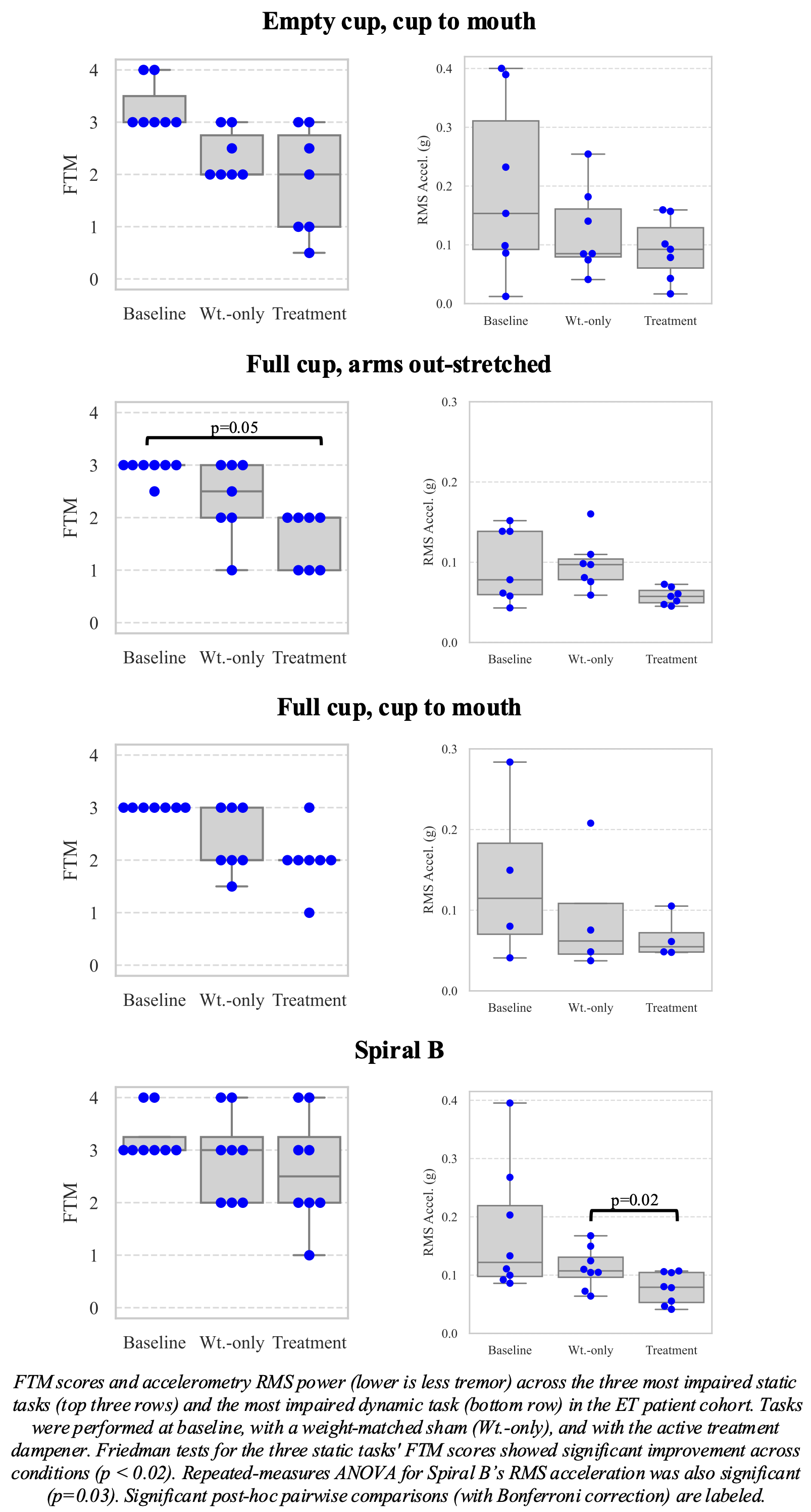
Kinematic and clinical tremor reduction in ET
To cite this abstract in AMA style:
RB. Shi, P. Rizek. Clinical and Kinematic Evaluation of a Tremor-Damping Glove in Essential Tremor [abstract]. Mov Disord. 2026; 41 (suppl 1). https://www.mdsabstracts.org/abstract/clinical-and-kinematic-evaluation-of-a-tremor-damping-glove-in-essential-tremor/. Accessed October 1, 2026.« Back to 2026 International Congress
MDS Abstracts - https://www.mdsabstracts.org/abstract/clinical-and-kinematic-evaluation-of-a-tremor-damping-glove-in-essential-tremor/