
Objective: We aimed to summarize the definitions, underlying neurobiological mechanisms, validated assessment tools (for both screening and rating), management strategies, and future directions for each of these ICBDs.
Background: Impulse control–related behavioural disorders refer to a group of compulsive behaviours seen in patients with Parkinson’s disease, comprising impulse control disorders (ICD), dopamine dysregulation syndrome (DDS), and punding. Evidence now suggests that each disorder involves a distinct neurobiological mechanism. While our understanding has improved, early recognition and appropriate treatment remain a significant challenge for clinicians, patients, and caregivers alike.
Method: This scoping review was conducted using the 5-step framework recommended by Arksey and O’Malley. Study selection process was conducted as per PRISMA extension for scoping reviews (PRISMA-ScR). We performed a systematic search of PubMed, EMBASE, and PsycINFO using the keywords “impulse control disorder”, “dopamine dysregulation syndrome”, “hedonistic homeostatic dysregulation”, “punding”, and “Parkinson’s disease”.
Results: Database search identified a total of 524 articles potentially relevant to the review, including PubMed (n = 336), EMBASE (n = 138), and PsycINFO (n = 50). Of these, 108 met the inclusion criteria and selected for full text review. The selected articles were analysed and categorized into eight themes as follow: prevalence, risk factors, genetics, behavioural studies, neuroimaging and treatment options. Based on the identified articles, distinguish features among ICD, DDS and punding were discussed. Knowledge gap include understanding of pathophysiology of punding, and validated rating scale for clinical use in punding and DDS. Future research directions include investigating the role of selective serotonin 5-HT2A receptor inverse agonists, selective D1/D5 partial dopamine agonists, and transcranial magnetic stimulation in treating ICD in Parkinson’s disease.
Conclusion: Early recognition and distinguishing among the different ICBDs are essential to enable early intervention, specific tailored management, and monitoring of these disorders and their respective treatment effects.
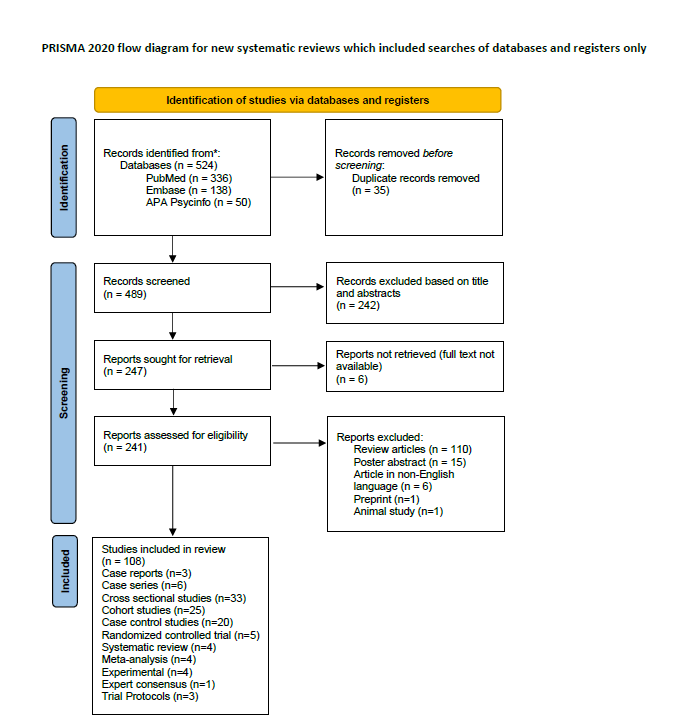
PRISMA flow diagram
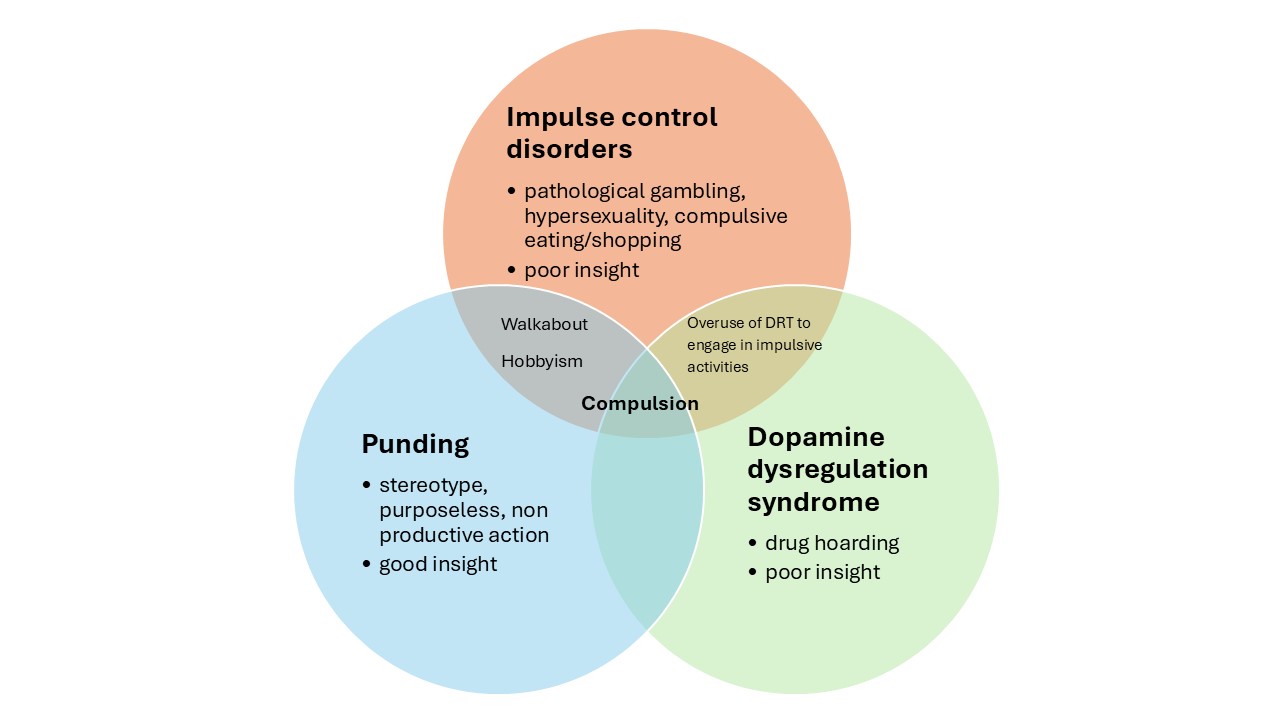
ICBD venn chart
To cite this abstract in AMA style:
G. Jin Yi, C. Lai Gwen, F. Cardoso, L. Tan. Clinical Approach to Impulse Control–Related Behavioural Disorders in Parkinson’s Disease: A Scoping Review [abstract]. Mov Disord. 2026; 41 (suppl 1). https://www.mdsabstracts.org/abstract/clinical-approach-to-impulse-control-related-behavioural-disorders-in-parkinsons-disease-a-scoping-review/. Accessed October 1, 2026.« Back to 2026 International Congress
MDS Abstracts - https://www.mdsabstracts.org/abstract/clinical-approach-to-impulse-control-related-behavioural-disorders-in-parkinsons-disease-a-scoping-review/